Brookline Lens, a BHS student-run photo and video production house, serves clients outside of Brookline High School, in addition to acceptingin-house project requests. The ultimate goal is for Brookline Lens students to graduate with a strong portfolio and resume highlighting advanced skills in photo and video design, project management and business communication. Launched in the 2019-20 school year, Brookline Lens is one of four new programs currently funded by a grant from the BHS Innovation Fund. The BHS Innovation Fund empowers the BHS faculty and community by fostering a culture of innovation and supporting the development of new ideas and initiatives that will enable our students to thrive in a rapidly changing world.
We caught up with the course leads Lori Lynn, a Visual Arts teacher, and Thato Mwosa, a TV Film and Documentary teacher, who share their insights into Brookline Lens this year, both before and after school closed in March due to the coronavirus pandemic.
How did you come up with Brookline Lens as an idea for an Innovation Fund course?
This course created itself. There was a demand for video and photography projects from entities inside and outside the BHS community. We were often approached with project requests and saw an opportunity for BHS students to do real work for real clients. We decided to turn the demand into a class because we needed time and space for students to focus on client work.
How does Brookline Lens differ from other Visual Arts courses?
Brookline Lens is different from other Visual Arts courses mainly because the projects are client-centered. Rather than creating artwork based on a student’s own personal expression, Brookline Lens students must use their creativity and organizational skills to fulfill the needs of others. This model allows students to learn meaningful communication and business skills that are not necessarily part of other Visual Arts courses.
How are community projects distributed to students and how do they manage their workload?
As requests come in from the community, we match projects to Brookline Lens students—taking into consideration skills and workload. In addition, students sometimes see a need within the community for a project and approach potential clients. Students must think about time management and can build a team for larger tasks. We schedule weekly meetings to discuss new job opportunities and the status of any current projects.
What are the opportunities and challenges of this course?
Brookline Lens students must communicate with clients and colleagues in a professional and timely manner, create work that reaches a level of quality expected and respect all deadlines. Students are challenged to always meet the level of professionalism required to complete designs for real clients. These skills are new and challenging for students, but they provide a fantastic opportunity to gain real-world experience and build essential professional skills.
How do you guide and support Brookline Lens students?
As facilitators, we guide students to create work that falls under their expertise, but we also encourage students to try projects that are out of their comfort zone. We work together with students to facilitate the business elements of the course, to inspire individuals to take leadership in groups and with clients and to evaluate performance.
Have students pivoted any projects in response to Coronavirus?
We have a year-long Public Service Campaign that focuses on Mental Health Awareness. When COVID-19 hit our community, we decided to shift gears to create content that still tackles mental health, but with the pandemic in mind. We hope to share those PSAs with the community upon completion. We added a Coronavirus link on the Brookline Lens website. This is space to display both PSAs about how to flatten the curve, and to show off the personal work students have produced during their time at home. The creation of art never stops, even when everyone is separated.
How has teaching remotely impacted Brookline Lens?
One of the big projects our Brookline Lens students were working on was a “Math Video Series” to promote a love of math in middle school. The project was in a pre-production phase and filming had not yet begun when we transitioned to remote learning. The project had to be put on hold, and we are hoping to resume when school opens in the fall. We do have some projects that students are still working on for clients, however. In addition to the COVID-19 PSA, our students just received an opportunity to complete a video for the Brookline Commission for Women.
Dear BHS Parents, Caregivers and Community Members,
I hope this message finds you and your loved ones safe and well. I am writing to provide an update on the BHS Innovation Fund and how we as an organization are working to support BHS leadership, faculty and students during this uncertain time. With the coronavirus pandemic, the last month has brought unprecedented change to our world, both globally and locally. All of us have been impacted in some way by this public health crisis, and many are experiencing challenges that we never thought we’d be facing.
As a parent of two high schoolers and a college student, and a daughter of aging parents, I imagine that I’m not alone in my efforts to keep everyone safe, happy and fed. Yet, in my role as the Chair of the Board of Directors for the BHS Innovation Fund, a nonprofit organization within the high school, I am buoyed by the momentum I see in the BHS community as we all navigate towards a “new normal” at the high school.
At the Innovation Fund, our 2019-2020 funded Program Faculty have also been hard at work adapting their curriculum goals and lessons for online learning:
Our Innovation Fellow, Roger Grande, continues to build a culture of climate sustainability at BHS, by promoting many Earth Day activities and lessons for the community via email and on his GraduateGreen webpage. In addition, Roger is offering timely activities focusing on “pathways out of a pandemic” through his Global Leadership class as well as interviews with leading speakers on important topics including:
a scientific understanding of the pandemic (Jonathan Lambert, Science News);
taking action (Juliette Kayyem, Assistant Secretary for Intergovernmental Affairs for Homeland Security in the Obama Administration and Belfer Senior Lecturer in International Security at the Harvard Kennedy School); and
building empathy for marginalized groups (Brooke Bischoff, JD, Attorney, Las Americas Immigrant Advocacy Center and Burt Pusch, Disability Rights Advocate).
In Experiential Physics for Ninth Grade, teachers are introducing new content on sources of energy around the world, combining the specific physics concepts already taught with a broader discussion of the environmental and health implications of different energy sources.
In Brookline Lens, students are researching COVID-19 PSA Campaigns and then they will write a compare and contrast analysis between two PSAs (print or video) they find online. They will also write and create their own COVID-19 campaign, which may be submitted for statewide competition.
In Hub, teachers connected to ninth grade students remotely to share ideas about how they could replicate some elements of their “circle” practices from Hub with their family members up-close or at-a-distance. These focused on mindfulness and breathing exercises and “rounds” of questions, discussions and personal reflections.
In keeping with our mission to foster a culture of academic innovation at BHS, we at the Innovation Fund are discussing how we can support both teachers and students to address the educational impact of COVID-19. We are asking,
“What does academic innovation look like in a new educational environment?”
“How can we best support BHS teachers with new funding opportunities for out-of-the-box ideas?”
“How can our work support BHS students as they adjust to new learning challenges?”
“What else might be on the horizon and how can we respond?”
I look forward to providing an update and sharing more information with you as we solidify our program plans.
Wishing you all good health at home, Ellen Rizika, P ‘22 Chair, BHS Innovation Fund Board of Directors
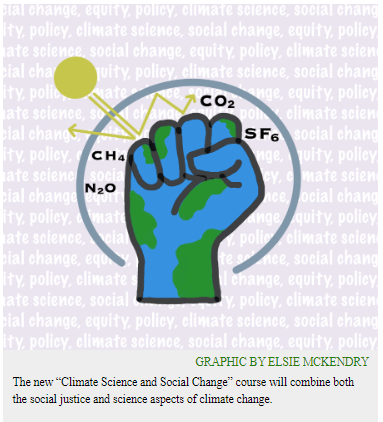
The new “Climate Science and Social Change” course will combine both the social justice and science aspects of climate change.
One of the most currently relevant issues is climate change. While classes have previously addressed this issue scientifically, they have neglected the other half of the story.
The new course “Climate Science and Social Change” is a unique approach to the ever-more relevant topic of climate change. If approved by the Innovation Fund, it will merge science with social, political and economic perspectives. Roger Grande, who proposed the course alongside Briana Brown, believes that students will be more empowered to respond to these climate threats with the experience they will receive in this course.
According to Grande, Climate Science and Social Change will spend the first semester of the year discussing the fundamentals of climate science. Students will study how the earth is changing and why these shifts are taking place. Grande also said the second half of the course will look at climate change from a social perspective. For example, students will look at case studies and think about innovative ways to address the impacts of our changing climate.
Grande explained that Climate Science and Social Change will spend time focusing on how the climate crisis is being addressed in the media.
“The course would look at how people discuss climate change, truth, objectivity, news and newsmakers,” Grande said. “We’re really focusing on information literacy, arming students with some of the skills needed to decipher the things they’re hearing and to understand what is true and what is not.”
This new course will also have students think about innovative ways to approach climate change. By looking at case studies, students will be able to examine the effect climate change has on various groups of people.
“We will look at a lot of issues around racial equity, class equity and just equity around the world. Who suffers the most? Who will suffer the most? Who will be most impacted, in contrast to who are the largest consumers of fossil fuels?” Grande said.
Brown, who (pending funding) will teach this class side by side with Grande, said it is important to learn the societal impacts of climate change as well as the impacts it will have on the environment.
“I think it’s important to really emphasize that this is not just a science problem. This is an everything problem and every aspect of society is going to be impacted by climate change: food production, where people can live, migration issues, etc. You can’t look at science in isolation,” Brown said.
Without enough institutional support surrounding our ecological crisis, Grande looks at Climate Science and Social Change as a fundamental step in preparing students to apply what they learn in his class to their lives outside of BHS.
“I’m a little bit stunned that there has been zero messaging from school leadership to begin getting students to think about how they’re going to thrive, financially, emotionally and socially in the future,” Grande said. “We give students skills to prepare for work, to prepare for college, but the largest existential phenomena of probably human existence is before us and we have decided to not address that.”
Students, as well as teachers, believe in the importance of learning the social effects of our current climate crisis. Junior Niovi Rahme believes that the Climate Science and Social Change course will be an effective approach to addressing this issue.
“I think learning about the social and societal aspect of climate change makes it completely different from any science classes we have,” Rahme said. “It makes it easier to know what’s truly going on in our world today and to prepare us for the future of fighting a climate battle.”
Junior Kira Wu-Hacohen first heard about the Climate Science and Social Change course when Grande pitched it to her social justice class. She hopes to take advantage of this educational opportunity next year.
“Right now I don’t really know what I can do and what difference it will make. Climate change is something that affects everyone in this school and everyone on this planet. We have to learn the consequences of our actions,” Wu-Hacohen said.
According to Brown, the impacts of climate change will accelerate in the coming decades. By studying climate change from new perspectives, students will come out of the class with a well-rounded understanding of the world they will live in and how they can change it.
“I hope to leave this class with a new, reformed understanding of climate change, how it is affecting different people and cultures around the globe and what we can do to help,” Rahme said. “It’s important to be educated about this because it’s something we will have to deal with our entire lives, so we might as well be knowledgeable about it and understand what’s truly going on.”
The composting initiative has significantly cut down Brookline High School’s carbon emissions
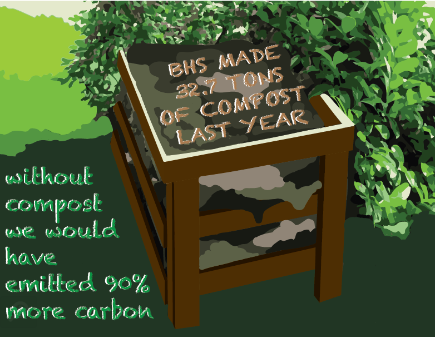
The smallest actions sometimes have the greatest impacts, even here at the high school. Last year, Brookline High School saved eight metric tons of carbon after composting, reducing our output of greenhouse gases that are detrimental to the environment.
Social Studies teacher Roger Grande said that he believes the high school community needs to reevaluate how we think about our effects on the environment.
“For several years, I’ve been thinking that it’s not just me wanting change. The climate crisis is intensifying, and we as a school, along with all schools really, need to train students with the skills to be prepared and to be resilient to adaptation,” Grande said.
Grande applied to the Innovation Fund’s “Innovation Fellowship” two times before his third proposal was accepted. He plans to use the resources to make his sustainability initiative become a reality.
GraduateGreen is the term Grande coined for this sustainability initiative. He hopes that students will graduate from the high school with a green mindset, and that they’ll consider the impact they have on the environment as they move on to college or a career.
Grande is also the advisor for the Food Justice Club, who worked with the Environmental Action Club to develop lessons to be taught during advisories throughout February. The clubs collaborated to create three lessons: Recycling, Compost and Food Waste, and the Food System.
“As a school we have an opportunity to cultivate habits of the mindset. This is something that everybody can be involved in. It can be our culture change.” — Roger Grande, World History teacher
Seniors Grace Sokolow and Gigi Walsh are the co-leaders of the Food Justice Club, which is working with Grande to bring improved sustainable culture to BHS. Sokolow said that Grande wants this to be a student initiative.
“We have a composting system in place, we have a recycling system in place, and now it’s up to the students to use it correctly and effectively,” Walsh said. “There is always more progress to be made in sustainability and that both come from the actions of the students as well as actions and policies that are up to the administration.”
Some teachers are currently implementing lessons of sustainability into their curriculum. Grande believes this should be done on a larger scale, even in departments whose classes are less connected to environmental issues.
“It’s not the science department’s job. It’s no more their responsibility than it is for the rest of us,” Grande said. “Climate change is the consequence of economic and political decisions, and it’s going to take economic and political decisions to resolve the issue.”
Grande said that it will take a cultural shift in how we think about education in order to implement sustainability into all subjects. He thinks this can be achieved if the students can, keeping the larger impacts in mind, change their routines because of learning about sustainability in the curriculum.
“As a school we have an opportunity to cultivate habits of the mindset,” Grande said. “This is something that everybody can be involved in. It can be our culture change.”
According to Grande, the ultimate vision is to make the Brookline school system into designated Green Ribbon schools. The U.S. Department of Education Green Ribbon School’s aim is to encourage districts to start sustainability practices that reduce environmental impact and cost, and improve health and wellness with sustainability culture.
Sokolow is excited to start teaching the sustainability curriculum in junior advisories, and she hopes that students will be open to trying something new for the environment.
“People would be surprised how easy it is to make some of these switches, and how good it feels to know you have power over how much plastic you use in your life,” Sokolow said. “I want people to give this a shot, come at it with open hearts and minds, and try to do something sustainable.”
While global prospects can seem grim, Walsh remains optimistic. She believes students care about these issues, especially after demonstrating at the Boston Climate Strikes, and will feel empowered in understanding their impacts on the environment.
“I think students should care about sustainability because it’s an environmental issue, but beyond that it is a human rights issue and it’s an issue that is going to directly affect our lives in more ways than we can imagine,” Walsh said. “I think our actions and decisions we make now are going to directly shape the future we experience.”
Roger Grande, the BHS Innovation Fund 2019-2020 Innovation Fellow is taking on climate change at BHS:
Roger Grande has been teaching social studies for 20 years at BHS and was named the BHS Innovation Fund Innovation Fellow for 2019-2020. The Innovation Fellow is a BHS faculty member serving as a catalyst for innovation in the BHS community, sparking interdisciplinary collaboration within the school, and supporting innovative projects at BHS. In this role, Roger will focus on building a learning culture of climate sustainability at BHS. Climate change is one of the most pressing issues of our time and will impact every BHS student. As such, BHS seeks to develop a culture of learning and sustainability among all students to give them the leadership skills and tools needed to tackle issues related to climate change at BHS and beyond. Roger answers five key questions about his plans to engage the BHS community in issues of climate sustainability.
How will you build a learning culture of climate sustainability at BHS and why is it important?
My goal is to make climate change a school-wide mission at BHS, one that will produce many tangible benefits that the community will see and feel over time. Making sustainability part of our classroom and school culture makes for great education and addresses some of the things we all aspire to: building a common purpose, social solidarity, empowering students to lead and innovate, ownership over learning to address challenges, examining our impact, systems thinking, addressing equity and more.
We have a long way to go to build a true sustainability culture at BHS but I’m excited about the opportunities ahead. I have been meeting with multiple stakeholders at BHS and in the town of Brookline, including town officials, school employees, members of the Solid Waste Advisory Committee, advocates and even people from other districts to better understand the challenges to improved recycling and composting and reduction of waste, and ultimately methane production. I see a number of exciting areas where we can make an impact. Currently, I’m working with students to design lessons that will be taught in Advisory with the goal of creating a learning sequence for the whole year that will train and teach students about improving waste practices. I will also launch a paper challenge and a water bottle challenge to reduce waste—the money from the bottle challenge will be used to support the Brookline-Nicaragua Sister City project to support their water treatment initiative. My aim is to expose students in as many areas as possible across the school and cultivate a sense of importance, stewardship and common mission.
What are the key challenges/obstacles that you see in addressing climate change?
Until now climate change has been covered in only a handful of science class lessons. We haven’t had the systems, synergies and support in place to develop robust curriculum and integrated learning experiences to better educate our students. My goal is to develop authentic, school-wide educational initiatives that support and engage BHS staff and students and create hands-on learning experiences. I see opportunities to provide support and leadership to teachers to help them begin finding connections between what they are already doing and sustainability education. I also see opportunities to integrate waste collection, cafeteria, restaurant and school store into sustainability learning opportunities.
How will you work with BHS faculty and students to make sustainability part of the classroom and school culture to affect change?
I plan to work with the BHS faculty and students to integrate sustainability in many different ways. I’ve been working closely with BHS teachers and students on sustainability initiatives and curriculum development including developing a Concept Curriculum Map. Soon I will engage staff, students and community members in focus groups to gather input, develop additional ideas, and build a vision for BHS as a sustainable institution. I will also meet with food services, along with Food Justice students, to brainstorm ways we can reduce waste and emissions generated by supplies, menus and other practices. Additionally, Brookline Schools will soon have access to a freight farm, and I will work with the company to develop internship opportunities, curriculum and hopefully a summer program for Steps to Success students. Stay tuned for more details and opportunities for involvement.
What do you hope to achieve? What does success look like?
My aim is to make sustainability part of our common culture and expectations: common norms and practices in the cafeteria regarding waste; more teachers who are explicit about using less paper and reusing supplies; and, more sustainable practices in terms of the food and food service in the cafeteria and restaurant. My goal is to have at least two teachers in every department modify, amend or add to their curriculum so that sustainability is embedded into lessons and classroom practices. I also hope to create more opportunities for student leadership such as “compost captains” in the cafeteria.
What does the opportunity to be an Innovation Fellow mean to you and how has it influenced you as a teacher at BHS?
The short answer is much more than I had imagined. In fewer than two months, I have learned a lot, have connected with many people I would not have otherwise, and have begun to build excitement across the school. I have deepened, energized and accelerated my thinking and excitement, and have begun to think about how to continue to lead this essential work beyond this year.
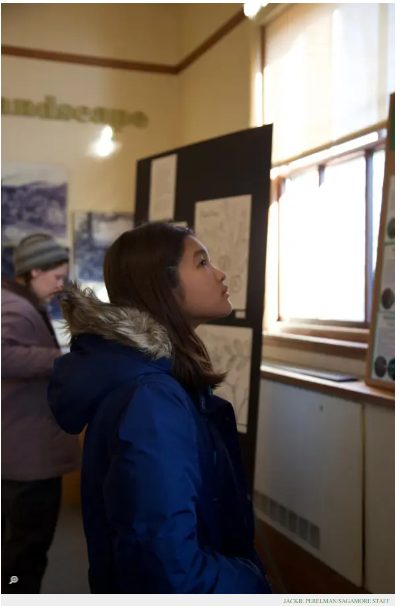
After observing plant species in the Arnold Arboretum, students then choose a specimen to illustrate.
The curvature of a bird’s beak. The hue of a flower’s petal. The texture of a tree’s bark. Although many may consider the spheres of art and science to be entirely distinct, their observations of the natural world fall hand in hand.
Through the creation of scientific illustrations, the Drawing for Understanding in Field Science course employs both artistic and scientific knowledge, making it one of the most unique and all-encompassing classes offered at the high school.
According to visual arts teacher Donna Sartanowicz, the idea for the course was initially conceived when she and Jill Sifantus, a retired science teacher, partook in a workshop at Harvard University. The workshop highlighted the close relationship between illustrations and the study of the natural world. Feeling inspired, the two of them accepted a grant from the Innovation Fund to establish the course, where Sartanowicz would teach the artistic aspects while Sifantus would teach the scientific aspects.
Students took a field trip to the Arnold Arboretum to gain inspiration.
Sartanowicz believes that this course gives students, who may be apprehensive of the arts, an opportunity to see that there is more to it than they might think.
“For me, I felt like a lot of kids were afraid to take art because they think they’re not talented, or they’ll have to draw self-portraits, or paint feelings, or whatever, but art has a very practical side,” Sartanowicz said. “It’s a way of studying the world and communicating what you know.”
Similarly, Visual Arts Curriculum Coordinator Alicia Mitchell believes that the interdisciplinary nature of the course makes it attractive to both students who are interested in science and art.
“It’s a good class for either student,” Mitchell said. “It’s good for the artist who wants to get better because this class hones in on observational drawing, attention to detail, and accurate reproduction. For the student who loves science, to find out that their love of science can blossom into a different career and way of expressing themselves can really open up their thinking around the sciences.”
Ultimately, the course began receiving financing from the high school itself rather than the Innovation Fund. With this, only one teacher was permitted to teach the class, leaving Sartanowicz as the sole instructor.
As an arts teacher, Sartanowicz felt like she needed help to incorporate the scientific elements of the course. To do this, she invites graduate students from Harvard University to give presentations that are relevant to their curriculum.
“I decided if I couldn’t have a science teacher, I would have scientists instead,” Sartanowicz said.
Apart from in-class studies, the course has the opportunity to create and display illustrations at the Arnold Arboretum. During the first semester, students visit the Arboretum to see its extensive library, herbarium, and gardens before choosing a specimen to base their drawing off of. Their work is then put on display, with the last exhibit having gone from Dec. 1 to Jan. 15.
Junior Anjali Mitra, for example, chose the Japanese Zelkova tree because it grows in her neighborhood, so she found a personal connection with it.
After their trip to the Arnold Arboretum, students then chose an specimen to illustrate.
According to Mitra, scientific drawings like the one she did for the Japanese Zelkova are all about a balance between what is written and what is shown.
“You find certain aspects about the organism that you want to convey through your art, and other ones you want to convey through writing,” Mitra said. “You can’t draw the name of the tree, but you can write it. Sometimes, the leaf shape is more easily drawn than described. So you find something you’re interested in, deepen your understanding about that thing, and then try to convey your sense of wonder through
your art and how you put together your piece.”
Sartanowicz also believes that illustrations, as opposed to photographs, allow for a greater understanding of the subject matter.
“Drawing is much more active than taking a photo,” Sartanowicz said. “You spend much more time and much more of your attention understanding the form, how it’s all put together, and how it works.”
From the scientific knowledge gained from research to the emotional connection that is felt with the subject matter, Mitra sees these illustrations as a bridge between the worlds of art and science.
“Art is a lot more emotional,” Mitra said. “In some ways, it’s how you think and how you feel. Science is the things you know, and combining the things you know with the things you feel can create very powerful pieces.”

 Brookline Lens, a BHS student-run photo and video production house, serves clients outside of Brookline High School, in addition to acceptingin-house project requests. The ultimate goal is for Brookline Lens students to graduate with a strong portfolio and resume highlighting advanced skills in photo and video design, project management and business communication. Launched in the 2019-20 school year, Brookline Lens is one of four new programs currently funded by a grant from the BHS Innovation Fund. The BHS Innovation Fund empowers the BHS faculty and community by fostering a culture of innovation and supporting the development of new ideas and initiatives that will enable our students to thrive in a rapidly changing world.