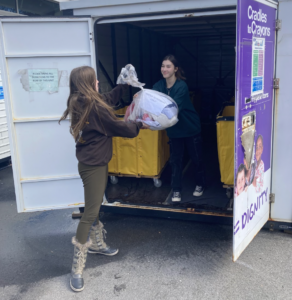
For members of the Turkish and Syrian diaspora, Feb. 6 will mark a day of mass destruction and devastation. The 7.8 magnitude earthquake along the Turkey-Syria border left millions displaced, thousands dead and put reconstruction costs in the billions.
Within a week of the disaster, students in Global Leadership, an elective course designed to educate students about modern-day challenges across the world, shifted their efforts to aiding the crisis. The class organized fundraisers, set up donation centers and spread awareness around the community.
Sophomore Sasha Harwin, a student in Global Leadership, said that despite the project being teacher facilitated, students took initiative and led the fundraising process.
“When we learned about the earthquake, we dropped everything else and immediately started to brainstorm ways we could help Turkey and Syria. Going in, we already knew there were going to be donation aspects, but we also wanted to put a big emphasis on spreading awareness around the school,” Harwin said.
Due to the urgency of the issue, the class had minimal time to prepare and organize logistics. They ultimately broke up into four separate groups to cover all bases: awareness, publicity, in-kind donations and monetary donations. Harwin said that each student was able to choose their own group, and everybody remained passionate about their work.
“The whole thing came together so fast and everybody stayed accountable,” Harwin said. “It’s a real and dire issue, so everyone was willing to help out in their free time.”
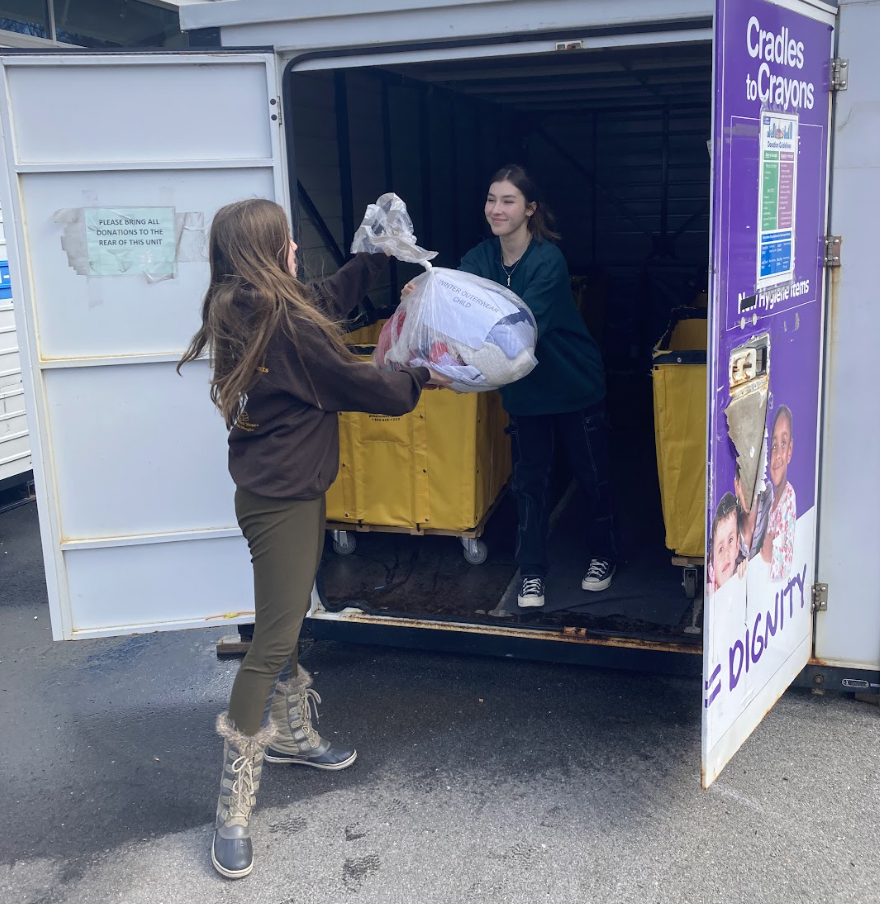
Harwin was a member of the awareness team, and gave presentations to World Language classes to generate more attention on the issue. Harwin and her team also reached out to all Brookline Public Schools to set up more donation centers. Despite only successfully connecting with Baker and Florida Ruffin Ridley school, she said that the team still managed to amass nearly twenty large bags of clothes, tents and blankets.
The class initially planned to send the in-kind donations to the Turkish embassy; however, their recently updated donation requirements forced the group to look elsewhere to donate. Harwin said that although she is disappointed with the unexpected change, she is still happy to know that they are able to donate everything to Cradles-to-Crayons and On-the-Rise, two local and dedicated organizations.
“It still feels so empowering because for most projects we do, we just talk and learn about big disasters in the world, but this felt so real because we’re actually going to make a difference for the first time,” Harwin said.
For junior Yoni Tsapira, a member of the monetary donations team, fundraising was also a new experience that he said will stick with him. His group managed to raise over $9,000 dollars through a GoFundMe page in two weeks and was only a few hundred dollars short of their ten-thousand dollar goal. He said that the GoFundMe is still active, but the class is planning to deposit their donations to UNICEF soon, a United Nations agency dedicated to providing humanitarian and developmental aid to children.
“It’s really cool to know that we as high school students can have a real impact,” Tsapira said. “If you think that you’re just a teenager and can’t do much, well, you can—because we just did something.”
Global Leadership teacher Roger Grande said that overall, he considers the fundraising efforts to be a major success for reasons beyond just the money raised.
“It was great that we achieved our goal, but it was so powerful because the students saw what they could do; it was both a real life effort and a classroom effort,” Grande said. “What I wanted them to take away from this project is what I want them to take away from this class in general: that they are insightful, their thoughts are real, and that they are powerful; that they are changemakers.”
Sophia Su, Staff Writer https://thecypressonline.com/ | April 7, 2023
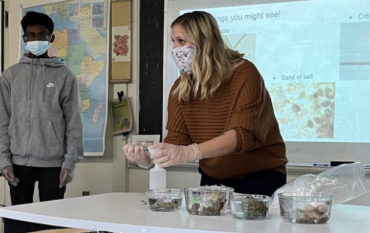
Students learned about the threat of microplastics in the environment and specifically in water supplies with a lab on Nov. 15.
Four thousand miles is not enough to stop the Global Leadership class from connecting with Brookline’s sister city, Quezalguaque, Nicaragua.
Global Leadership aims to help students gain more experience and knowledge in solving world issues. On Jan. 31, they will begin the Tap Challenge, which lasts for 10 days and encourages students to use reusable water bottles instead of plastic, single-use ones.
Global Leadership teacher Roger Grande said before the start of the Tap Challenge, students learned about Quezalguaque and its specific water-related needs.
“We learned about their water insecurity: that many people in one of the hemisphere’s poorest nations do not have regular and easy access to potable, clean water,” Grande said.
Junior and Global Leadership student Agnes Shales said although Brookline and Quezalguaque are many miles away from one another, the Tap Challenge brings the two together. Money donated to the Tap Challenge will be given to a fund in Quezalguaque to help with their water security efforts.
“We’re a city in possibly one of the areas of the world with the best water. We are so incredibly lucky that we aren’t forced to pay for water in the same way that they do there,” Shales said. “As their sister city, we can take responsibility for improving the planet and helping out. We try to do this by reducing our use of plastic water bottles because it’s an example of our privilege, damaging the Earth in ways we don’t need to be.”
Junior and Global Leadership student Zoe Raybould said the Tap Challenge allows students to practice leadership skills as they each have individual roles.
“We’re learning to be leaders on a global scale and to have the outreach that affects people all over the world, not just in our small community. But at the same time, we want to make a real difference in both of our communities,” Raybould said.
Shales said the Tap Challenge permits her to help another community while honing leadership skills for the Global Leadership class.
“We are a class that focuses on development and leadership skills and issues facing the international community. I think that finding a way in which our lives tie into that, through the sister city project, is a super interesting take on that,” Shales said. “Usually projects are about areas that we didn’t have a real impact on before. I think this is a way to make an impact through the global lens that we’ve been trying to cultivate in our class.”
The Global Leadership class conducted a lab with the help of two Boston University graduate students, Caroline Fleming and Jenna Rindy, on Nov. 15. The lab centered around small plastic debris called microplastics and their negative role in the environment.
Rindy introduced the microplastics lab by explaining how chemicals enter the environment through plastics not being disposed of properly.
“Plastics are made of chemicals and as they get exposed to things like rain, they release chemicals into our environment. A lot of those chemicals are really toxic,” Rindy said. “The issue is that they can enter our soils and be really harmful for what grows and lives there. These plastics are also harmful for animal life, land and sea.”
According to Grande, the purpose of the microplastics lab was to demonstrate the danger plastics pose to coral, which connects back to the Tap Challenge.
Junior and Global Leadership student Dan Hernan said that the microplastics lab prepared students for the Tap Challenge because they learned about microplastics’ harm to the environment.
“The microplastics lab we did was almost like a smaller version of what we’re going to do with the Brookline High School community,” Hernan said. “It was bringing awareness to students in the class about the prevailing and dangerous force of microplastics in our own water supply.”
Audrey Garon, DEI Editor|January 21, 2022
 Brookline High School alumna Maya Rozen interviewed current students about their experiences participating in BHS Innovation Fund courses. Hear the impact of the Innovation Fund at BHS in the students’ own voices.
Many of the courses offered at BHS revolve around a curriculum that students are required to take, which is why many students relish the academic opportunities that grant them more freedom to explore other areas of study more on their own terms. For students interested in engineering, Engineering by Design is a great class that allows students to explore different areas of engineering and design and to pursue projects that they are passionate about. Other classes like Social Justice and Racial Awareness provide a safe space for students to learn about important topics with the freedom to share their own thoughts, experiences, and beliefs. Many of these classes allow students to explore new subjects that aren’t always covered in the required curriculum.
In your opinion, what makes your Fund class different compared to your other classes?
“Something that stood out to me about the class was the amount of freedom we had because I kind of expected it to be really structured with a lot of rules, but I found that with all of the projects there was a lot of room for our own ideas and a lot of room for creativity, which I liked.”
~Sarah S., BHS ’21, Engineering by Design
“I think since you have to apply, everyone who is in the class is really interested in social justice and wants to be there. It’s not like people are taking it just to check it off the list or just to say they took it. I can see people who were in my class that are now doing things on their own time, whether they have an internship, or they’re volunteering, or they’re just doing research and finding ways to work on the issues that we learned about. I also think that since everyone wanted to be there, people really opened up because we’re all so passionate about it. Everyone’s open to hearing the perspective of other people who are passionate and I think a lot of that comes from Ms. Leslie because she has so much passion. You can see when she’s teaching that she wants to be there so much and she wants to give us all this knowledge of what is actually happening, and then give us the freedom to talk about what we think, and that is something that I often don’t find in a class.”
~Aine D., BHS ’21, Social Justice
As a ninth grader entering BHS, the thought of graduation seems as if it is a million years away. Freshman and sophomore years pass by in the blink of an eye, and then suddenly you’re in your junior year and it’s time to begin figuring out what your next steps will be after you graduate high school. Some students go through high school with a clear idea of what those next steps are whether it’s pursuing a certain career or studying a specific major in college, but for many students this is not the case. Having the opportunity to try out different classes can expose them to new subjects and inspire new interests. Many students find that classes like Social Justice can lead to new interests that they are excited to continue pursuing after high school. Aside from exposing students to new topics, these classes also teach students very valuable skills that they don’t always learn from their required courses. Tutorial helps many students learn how to better manage their time and their work, teaching them valuable skills such as organization, time management, and how to plan out their week. Other classes like Racial Awareness can help students feel more comfortable going out of their comfort zone through being exposed to new points of view or learning how to have tough conversations. All of these skills are very important to have during their time at BHS and beyond.
How has the class shaped who you are as a student? How have you grown as a result of this class?
“As a student, I noticed as I was taking this class that before I tended to make more assumptions about people, and this class has helped me think about the reasons I’m doing that and how not to act on those assumptions, and I think I definitely have grown from taking this class.”
~Kate C., BHS ‘22, Racial Awareness
“I think I’ve grown a lot in the way that I feel like I can voice my opinions more if someone brings up an issue. I feel like I have the knowledge and the power to actually voice my opinion because I’ve learned about it. I think that a lot of times now I’ll hear conversations going on and I’ll actually know what they’re talking about which I think is really cool because I can participate in the conversation. Now more than ever I feel like I can help. I have so much of an understanding of what’s going on, so I can really help and try to help other people try to understand what’s going on.”
~Zoey F., BHS ‘22, Global Leadership
“I think I’ve grown in my abilities to ask for help and to make sure that I have a plan for the week for my assignments and projects and when I should be doing them. I think my experience would be a lot harder, I would be less organized, and I don’t think I would get as much work done without tutorial.”
~Declan T., BHS ‘22, Tutorial
“I think that I’ve been able to want to have the uncomfortable conversations. A lot of times people don’t want to talk about a certain thing because they know people have conflicting points of view or that it affects someone personally and they don’t feel like it’s their place to talk about it. This class made me realize that you can have a voice, but it’s also really important to listen, and listen to the uncomfortable conversations and be able to ask questions and be able to talk about it even though it might be uncomfortable.”
~Aine D., BHS ‘21, Social Justice
Many classes like Global Leadership and Social Justice offer students the unique opportunity to learn about current, important topics while simultaneously engaging in real world problem solving and solutions. Fundraisers, volunteering, and peaceful protests are some of the many ways where students can feel like they are not just doing the important learning, but also feel like they are making a real difference and contributing to the solution.
Can you describe some of the most memorable parts of the class and talk about a couple of your favorite assignments?
“We were having a lot of meetings and conversations about the Black Lives Matter movement. We got to talk about them as a class and getting to hear from other people about what they’ve been doing and how they’ve been using the things that we learned from this class to contribute to this movement was great.”
~Kate C., BHS ‘22, Racial Awareness
“I think a lot of people will say this but definitely learning about the incarceration system. The prison trip is always something people talk about for a really long time. I was excited about the trip because I think the incarceration system isn’t something that we see on the news every day. When I sit down to watch the news, I don’t see them talk about all the oppression and discrimination that exists in the incarceration system. I think that it’s overlooked a lot so I really wasn’t aware of what was happening in the system, and being able to go to a prison and then talk to inmates was really cool because we could hear their first hand experiences and they were really honest. They talked about the guards there and how they’re not nice to them and what it’s like in solitary confinement. They were just really really honest about what’s happening, and being able to see that after watching movies about the incarceration system and what happens was really powerful, so that was the night that really stood out to me.”
~Aine D., BHS ’21, Social Justice
“One of the assignments we did was called the TAP Challenge which was where we raised money for clean water in Nicaragua, and we did that by starting a school campaign to have everyone bring their own water bottles and not use plastic water bottles for 25 days. We sold reusable water bottles and tumblers and also stickers. I thought it was really cool because it really felt like we were making an impact instead of just learning about the issue. I actually felt like I was doing something about it while still learning about it in class.”
~Zoey F., BHS ’22, Global Leadership
Dear BHS Parents, Caregivers and Community Members,
I hope this message finds you and your loved ones safe and well. I am writing to provide an update on the BHS Innovation Fund and how we as an organization are working to support BHS leadership, faculty and students during this uncertain time. With the coronavirus pandemic, the last month has brought unprecedented change to our world, both globally and locally. All of us have been impacted in some way by this public health crisis, and many are experiencing challenges that we never thought we’d be facing.
As a parent of two high schoolers and a college student, and a daughter of aging parents, I imagine that I’m not alone in my efforts to keep everyone safe, happy and fed. Yet, in my role as the Chair of the Board of Directors for the BHS Innovation Fund, a nonprofit organization within the high school, I am buoyed by the momentum I see in the BHS community as we all navigate towards a “new normal” at the high school.
At the Innovation Fund, our 2019-2020 funded Program Faculty have also been hard at work adapting their curriculum goals and lessons for online learning:
Our Innovation Fellow, Roger Grande, continues to build a culture of climate sustainability at BHS, by promoting many Earth Day activities and lessons for the community via email and on his GraduateGreen webpage. In addition, Roger is offering timely activities focusing on “pathways out of a pandemic” through his Global Leadership class as well as interviews with leading speakers on important topics including:
- a scientific understanding of the pandemic (Jonathan Lambert, Science News);
- historical perspective (Dr. Johanna Daily, MD, MS, Infectious Disease Specialist);
- taking action (Juliette Kayyem, Assistant Secretary for Intergovernmental Affairs for Homeland Security in the Obama Administration and Belfer Senior Lecturer in International Security at the Harvard Kennedy School); and
- building empathy for marginalized groups (Brooke Bischoff, JD, Attorney, Las Americas Immigrant Advocacy Center and Burt Pusch, Disability Rights Advocate).
In Experiential Physics for Ninth Grade, teachers are introducing new content on sources of energy around the world, combining the specific physics concepts already taught with a broader discussion of the environmental and health implications of different energy sources.
In Brookline Lens, students are researching COVID-19 PSA Campaigns and then they will write a compare and contrast analysis between two PSAs (print or video) they find online. They will also write and create their own COVID-19 campaign, which may be submitted for statewide competition.
In Hub, teachers connected to ninth grade students remotely to share ideas about how they could replicate some elements of their “circle” practices from Hub with their family members up-close or at-a-distance. These focused on mindfulness and breathing exercises and “rounds” of questions, discussions and personal reflections.
In keeping with our mission to foster a culture of academic innovation at BHS, we at the Innovation Fund are discussing how we can support both teachers and students to address the educational impact of COVID-19. We are asking,
- “What does academic innovation look like in a new educational environment?”
- “How can we best support BHS teachers with new funding opportunities for out-of-the-box ideas?”
- “How can our work support BHS students as they adjust to new learning challenges?”
- “What else might be on the horizon and how can we respond?”
I look forward to providing an update and sharing more information with you as we solidify our program plans.
Wishing you all good health at home,
Ellen Rizika, P ‘22
Chair, BHS Innovation Fund Board of Directors
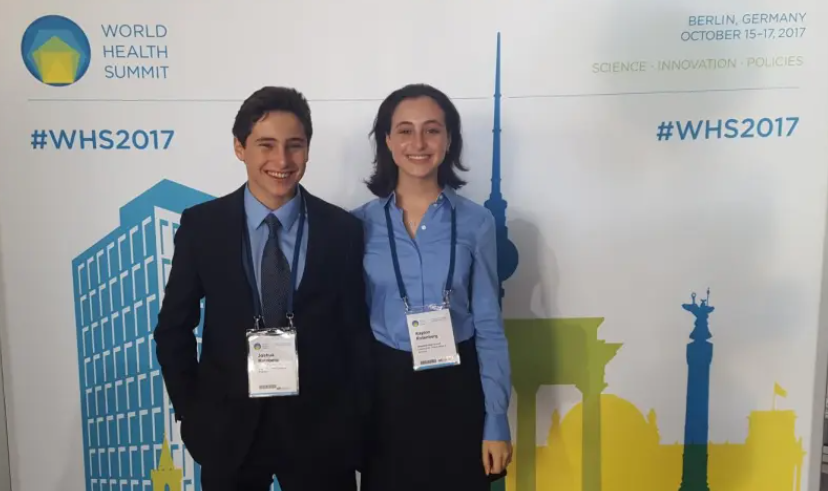
Juniors Josh and Kayton Rotenberg were participants in the high school’s trip to Berlin last October for the World Health Summit. This was just one of many trips the Global Leadership program runs.
Last October, sophomore Zeb Edros found himself surrounded by other people who truly cared about health issues in the world. The catch? He, along with other students from the high school, were the only non-professionals at this conference. Oh, and they were in Berlin.
Every year, students have the opportunity to travel to places such as Amsterdam, Portugal, Nicaragua, Tanzania and Berlin, some in the Global Leadership class, some not, but they all have a shared an interest in world health and learning.
The trips serve as a non-traditional approach for the students to learn and gain experience in a different environment.
According to social studies teacher Ben Kahrl, who teaches the Global Leadership class, the trips function to give the students insight on real situations.
“The trips have two purposes. One is for students to work with and get mentoring from adults who are seeking to solve real-world complex problems. The other is so that they can see these real-world complex problems,” Kahrl said.
According to Edros, who travelled to Berlin for the World Health Summit this past October, the conference was a unique experience for him.
“I think the fact that we were the only students at a professional conference meant that everybody talked to us as if we too were their equals, which let us understand not just more about their fields, but just how to interact with these people in general,” Erdos said. “They answered our questions. They gave us advice on our futures which is really helpful.”
Kahrl believes that the information and skills that the students learn on trips like these will help improve their future and their range of possibilities.
“They {now} have confidence. They can enter the adult world and have conversations with professionals rather than being on the sidelines,” Kahrl said. “Students get exposed to possible careers that they wouldn’t otherwise, simply because they meet people who do things they’ve never heard of.”
According to Kahrl, many of the students who go on Global Leadership trips are in the Global Leadership Class. Sophomore and Global Leadership student Jack Heuberger said that the students do a lot of work pertaining to many different aspects of global problem solving.
“You also learn about situations happening in other countries, such as the Libya slave crisis, and you have to think about ways to possibly solve those problems,” Heuberger said. “It’s about a lot of learning about how the world works and government and how other governments work together, and it’s a lot of critical thinking and collaboration.”
Kahrl said that he hopes to expand the program and give the opportunity of traveling and learning to many more students in the future.
“My goal is that all students, regardless of their socioeconomic background, have a chance to get mentoring from people around the world, and to have an opportunity to travel to places where these challenges are real and immediate” Kahrl said.
Contributed by Kayton Rotenberg
Dan Friedman, Staff Writer
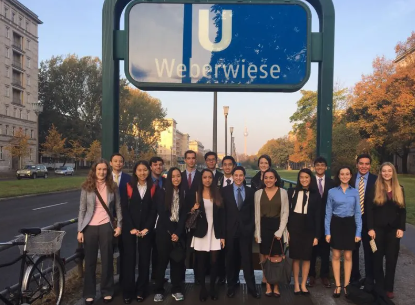
Students posed for a group photo during their time in Berlin. They attended the World Health Summit conference in October.
All teenagers know the anxiety that can come with sitting down next to strangers at lunch. But that feeling of anxiety becomes a lot worse when you are in a foreign country trying to put your plate down next to a full-fledged medical professional.
For 17 students, this was a reality for a week in October. Being given the chance to attend the World Health Summit in Berlin gave these students new experiences and knowledge about global health, global health security, cancer in Africa and other skills.
To be accepted to be a part of the trip, students filled out an application last spring, consisting of multiple essay questions. The 17 students, along with three teacher chaperones, left on Oct. 13.
Junior Katie Rotenberg, one of the students who attended the trip, said that since students are not medical health professionals, the purpose of the trip was to expand their experience in the fields discussed, including medical and scientific fields.
“We went to Berlin for the World Health Summit, which was a gathering of international scientists, doctors, global health leaders, politicians and all kinds of different things, so it was a really great mix of science and global policy,” Rotenberg said.
Social studies teacher Ben Kahrl, who teaches the Global Leadership class, said that one benefit the trip offers for him is the perspective on international health and the views of other countries.
“Boston has huge amounts of medical stuff; it’s world class. But when you go to Germany or Montreal or Portugal, you meet people from all over the world and see how they look at the world differently than us,” Kahrl said.
This trip allowed students to see and meet many professional doctors and politicians who had influence over the medical community. Rotenberg said they met the uppermost people of the field.
According to senior Jerry Chen, being the youngest members of the conference provided the group with unique opportunities.
“We were the only high school students there and we were able to meet so many professionals and famous people you can normally only see on TV or social media,” Chen said.
The conference hall was arranged as a rotunda, with an auditorium in the middle, surrounded by a circular hallway. Keynote speakers held talks in the middle, while conference rooms around the outside of the hallway were for smaller conferences or workshops.
Rotenberg said her favorite speech was made by the princess of Jordan. Since she is a princess and the head of multiple cancer organizations, she uses her authority to administrate others helping find cures, Rotenberg said.
“She was just in the audience two rows behind us, and she gets up and makes this very, very passionate speech about how you can’t begin to have all this high tech stuff in communities until you first have the structure there,” Rotenberg said. “You can’t go and give everyone laptops when they don’t have running water and basic things like that.”
Chen said he thought the most inspiring speaker was the host of a talk concerning cancer in Africa. This speaker talked about his experience and brought his message to the audience.
“He decided to study abroad in England for five years to learn skills to treat cancer, but it was very sad when he came back and realized they wouldn’t have any clinics or technology available in Africa to actually use these skills,” Chen said. “That was very powerful.”
Chen said he didn’t realize how many obstacles there are within public health, including political and technological challenges.
“Before I went on the trip, I wasn’t super interested in public health, but afterward, I felt like it really was our job to make sure that people in the world have access to proper medical care and treatment to their diseases,” Chen said.
Rotenberg said that being part of the conference could be intimidating. Chen agreed that meeting and talking with the professionals at the conference was difficult, especially since they were strangers, but it got easier throughout the week.
“You had to really just go out there and be aggressive. During lunch, put your plate down in front of some scientist and be like, ‘I’m going to sit here now; let’s talk,’” Rotenberg said. “If you didn’t do that, I think you really missed out on a lot of good opportunities.”
The conference helped provide students with the unique experience of learning about possible future career paths. Rotenberg said she probably wants to go into medicine. Chen said he wants to go into medical engineering to research new treatments for Down syndrome.
Kahrl said that being in an environment with professionals who have pursued these dreams for themselves offered a good example for students on how many career opportunities now exist.
“In terms of exploring careers and the breadth of careers, rather than just saying ‘I’m going to be a nurse or a doctor,’ there are all sorts of roles in public health that people can get into,” Kahrl said.
CONTRIBUTED BY JERRY CHEN
Madison Sklaver, Staff Writer