The Data Science and Social Justice class works to apply mathematical ideas to social justice issues students are passionate about.
As an algebra class discusses taking the standard deviation of a data set, just down the hall, the Data Science and Social Justice class is using a data set to find the intersection between math and global issues.
Taught by math teachers Danielle Thiessen, Danielle Rabina and Christopher Monschauer, the Data Science and Social Justice class was created after the teachers sent a grant proposal to the Innovation Fund. Theissen, Rabina and Monschauer hoped that this course would allow for students to apply mathematical theories to topics they are passionate about.
Thiessen said the idea was derived partly because most math courses offered are more theoretical.
“Because data science ties into the world around us so much, we thought this would be the perfect opportunity for the math department to cover a course on social justice. Every other course has a class on social justice and we didn’t, and it was really hard to tie social justice into the algebra curriculum,” Theissen said.
Senior Dylan Krakowski said they were drawn to the class after learning it intertwines two topics they are passionate about.
“I didn’t want to take just a ‘normal’ math class. I really like using math in real world scenarios, and I also pursue social justice in the real world—I try to live my life in a way that benefits humanity. So I was like, ‘kill two birds with one stone,’ and take the class,” Krakowski said.
Rabina said class is spent working on various projects that will eventually teach students how to complete the data science cycle. According to Rabina, the last step of the cycle is for the researcher to share their work- the backbone of the course,
“The data science cycle encompasses what a data scientist would need to do to complete a project. You start with asking the questions, then you gather data and then you might go back and fix your questions based on the data you see. Once you have your data, you have to learn how to take this huge amount of data and analyze it,” Rabina said. “Then, you create some way to communicate what you found to the world around you.”
The class’s first unit will culminate in a project that centers around gun violence during the summer months in Boston. The idea for this project was born after Thiessen, who lives in Boston, noticed an uptick in violence this past summer. At the end of the project, students in the class will analyze the patterns established through the data, and ultimately will make recommendations to the Police Commissioner of Boston based on these patterns.
Rabina said the data science cycle is helpful to analyze local events.
“We were talking about what happened, and thinking about how we could involve it in the curriculum and what factors may have led to this increase in gun violence. This is actually part of the data science cycle: noticing things in your world and asking a question about it, then gathering data, then drilling it down to a clear idea. We thought this could be our first project, and that’s how it was born,” Rabina said.
Prior to this major project, students are completing smaller projects in which they learn different skills pertaining to data science. Krakowski said one of the highlights of these projects has been that it is up to the students to decide which direction they want to take them.
“Students have a really big voice in the class, which is one of the ways in which they’re intertwining social justice into their curriculum. They’re allowing a lot of student power and student decisions to choose to work on something which we are passionate about,” Krakowski said.
Thiessen said one of the key qualities of the course is that there are no prerequisites; the class is open to all students.
“I recommend this class to any student who is coming out of standard, honors or advanced,” Thiessen said. “Any student who wants to learn more about statistics and data science from a more hands-on experience and is eager to learn about social justice. We built this class wanting it to be for everyone.”
Ava Varrell, Sports Managing Editor|October 21, 2022
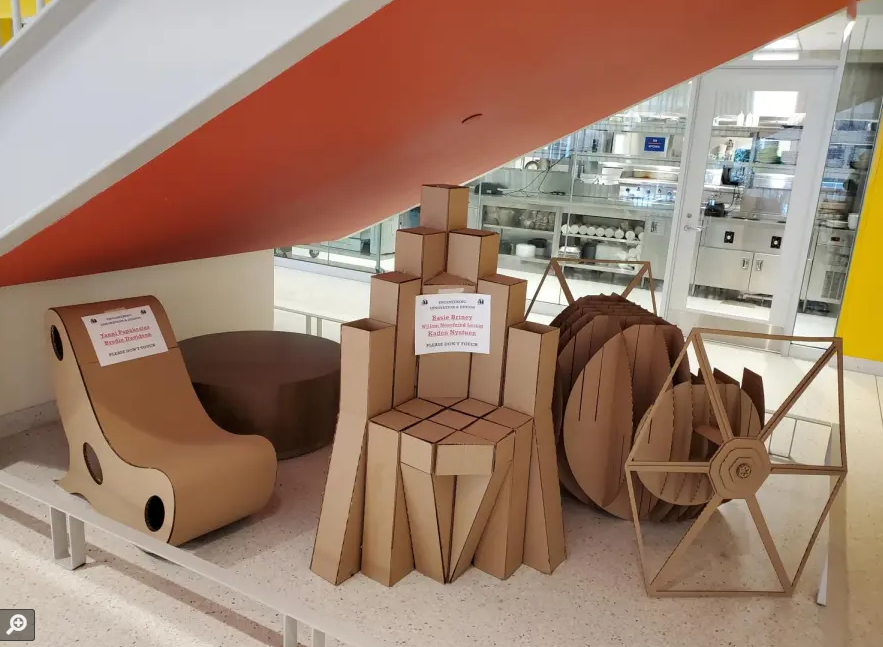
Displays of students’ art made in the Engineering Innovation and Design class are scattered around the school, like this one, which can be found on the first floor of the STEM wing.
Creativity and team building are at the heart of a unique class split between a robotics classroom in the STEM wing and a workshop in the Unified Arts building.
In the Engineering Innovation & Design class, students learn about engineering and problem solving through interactive processes with the help of constructive peer feedback to adapt their ideas.
Engineering teacher Aubrey Love said when he was first creating the class alongside ceramics teacher Andrew Maglathlin, they hoped the class would be able to complement other engineering classes by incorporating the nuances of art and collaboration.
“We wanted to incorporate critique, the idea that you are working with other people and their ideas are relevant and valuable,” Love said. “Then, we wanted to maintain function; we wanted to solve problems in a functional way as engineers should, so the final projects that we created for the class meshed function and form.”
Love said the collaborative environment that the students work in prompts much of the success and creative ideas found in the class.
“A student’s foundational knowledge is important, but it’s not just about what brilliance you have in your head but what pieces of knowledge you can pull together. Being able to talk to other people and come up with ideas as a group is huge,” Love said. “Collaboration is being able to listen to other people’s ideas and find value in them and not saying ‘let’s agree to disagree because I like my idea.’”
A unique quality of the class is the environment. Senior Maxwell Hatchett said he enjoys that the class generally feels less like a technical engineering course and more like a problem-solving class. He said the laid-back but extremely productive environment is one of his favorite parts of the class.
One of the class’ major projects is the cardboard chair project. The challenge is to create a full-size functional chair that could be used by anyone, employing only 10 pieces of cardboard.
“We brainstormed a bunch of different ideas and designs and finalized them before working on bringing the chair to life using the tools and materials available to us,” Hatchett said.
Senior Joshua Heinstein said the cardboard chair project requires an iterative design and construction process considering the difficulty of scaling a 2D material, cardboard, into a 3D design. The class teaches students to accept given constraints and adapt to them.
“We couldn’t just design the chair in the 3D modeling software, push a button, and have it printed. We had to brainstorm and design cardboard that could be cut and then assembled into the final product which is a much more involved process,” Heinstein said.
Working within the boundaries set by the project, Love hopes that students who go through his classes are able to embrace new concepts and better observe the world around them through the lens of an engineer.
“I’m hoping people understand humility in their design ideas. High school teaches you often that what’s in your head determines your worth, and I’m trying to move kids past that,” Love said. “There are great ideas that exist all around us; we just have to go out and find them, and then try to bring them all together to form a solution.”
Engineering Innovation & Design fuses art and STEM
Connor Quigley, Staff Writer|June 15, 2022
Last summer, the BHS Innovation Fund provided a grant to enable coding to become integrated into the 9th grade math and science curriculum. Josh Paris (JP) is the Math Department Chair who, along with Ed Wiser, Chair of the Science Department, and Britt Stevens, Chair of Career and Technology, supervised the initiative. Mr. Paris discusses what excites him about the Coding initiative and its impact on students:
Q: How did the Innovation Fund enable you to integrate Coding into the 9th grade curriculum?
JP: We have had two coding elective courses called Python and SNAP at BHS for several years but this is the first time it is being integrated into the 9th grade curriculum. The grant began last summer (2020) and it was a collaboration between the math, science, career and tech education departments. Teachers usually teach four courses but the grant gave course releases to Adam Fried and Christine Shen (both from the math department) and Tyler Brown (from the science department) to instead teach three classes. This – and the hiring of another teacher – enabled them to spend time collaborating and modifying the curriculum so that they could implement coding into the 9th grade math and science curriculum.
Q: Are you intending to integrate coding into the curriculum of the upper grades at some point?
JP: Yes, we started with 9th grade and then will move to the older grades in the following years, one year at a time.
Q: Why is it important to have coding as part of the curriculum?
JP: It is very important to have coding be accessible to everyone for so many reasons; not only is it the way of the future and opens a lot of career doors but it also helps enhance math deduction and reasoning skills. For instance, the same logic is applied in both coding and formal proof in geometry. Furthermore, giving all students access to coding is important for equity reasons since it has historically been a profession dominated by white males. By having equal access to coding beginning in 9th grade we are hoping that will change.
Q: Since coding is integrated into the math and science curriculum does it mean you need to be strong in those subjects to be good at coding?
JP: Motivation and hard work – like many things in life – are the keys to success with coding. Coding is something that draws upon and enhances many life skills and cuts through many disciplines, for that reason, students often find something about coding that “speaks” and appeals to them!
For members of the Turkish and Syrian diaspora, Feb. 6 will mark a day of mass destruction and devastation. The 7.8 magnitude earthquake along the Turkey-Syria border left millions displaced, thousands dead and put reconstruction costs in the billions.
Within a week of the disaster, students in Global Leadership, an elective course designed to educate students about modern-day challenges across the world, shifted their efforts to aiding the crisis. The class organized fundraisers, set up donation centers and spread awareness around the community.
Sophomore Sasha Harwin, a student in Global Leadership, said that despite the project being teacher facilitated, students took initiative and led the fundraising process.
“When we learned about the earthquake, we dropped everything else and immediately started to brainstorm ways we could help Turkey and Syria. Going in, we already knew there were going to be donation aspects, but we also wanted to put a big emphasis on spreading awareness around the school,” Harwin said.
Due to the urgency of the issue, the class had minimal time to prepare and organize logistics. They ultimately broke up into four separate groups to cover all bases: awareness, publicity, in-kind donations and monetary donations. Harwin said that each student was able to choose their own group, and everybody remained passionate about their work.
“The whole thing came together so fast and everybody stayed accountable,” Harwin said. “It’s a real and dire issue, so everyone was willing to help out in their free time.”
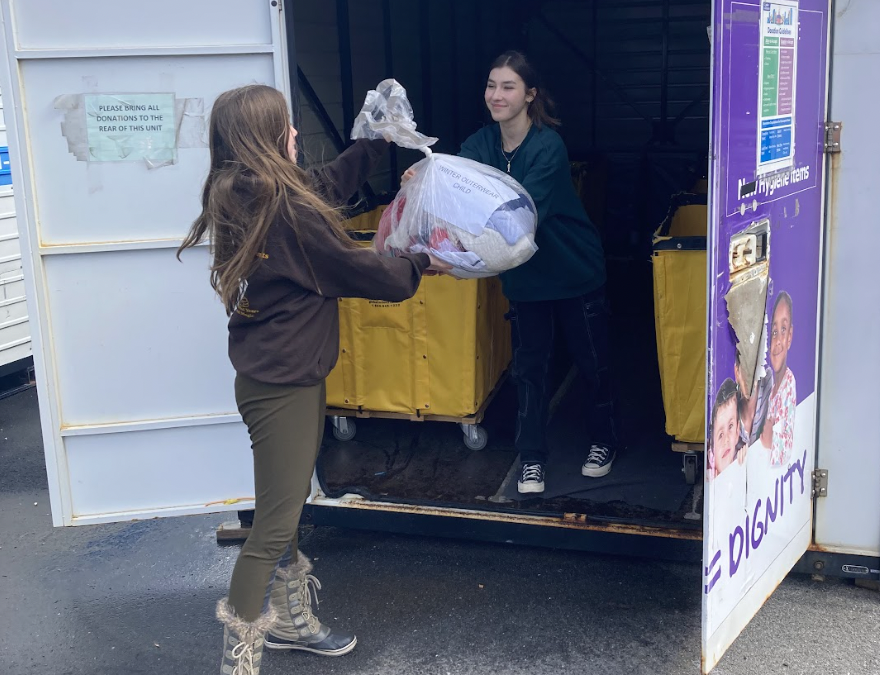
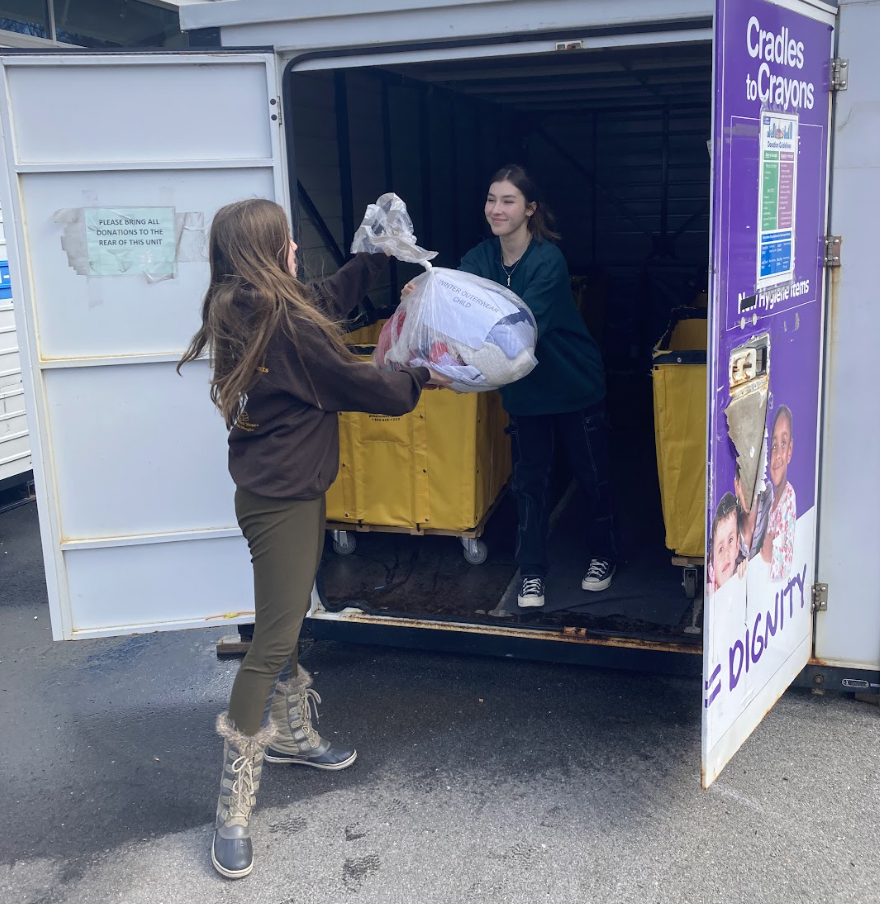
Harwin was a member of the awareness team, and gave presentations to World Language classes to generate more attention on the issue. Harwin and her team also reached out to all Brookline Public Schools to set up more donation centers. Despite only successfully connecting with Baker and Florida Ruffin Ridley school, she said that the team still managed to amass nearly twenty large bags of clothes, tents and blankets.
The class initially planned to send the in-kind donations to the Turkish embassy; however, their recently updated donation requirements forced the group to look elsewhere to donate. Harwin said that although she is disappointed with the unexpected change, she is still happy to know that they are able to donate everything to Cradles-to-Crayons and On-the-Rise, two local and dedicated organizations.
“It still feels so empowering because for most projects we do, we just talk and learn about big disasters in the world, but this felt so real because we’re actually going to make a difference for the first time,” Harwin said.
For junior Yoni Tsapira, a member of the monetary donations team, fundraising was also a new experience that he said will stick with him. His group managed to raise over $9,000 dollars through a GoFundMe page in two weeks and was only a few hundred dollars short of their ten-thousand dollar goal. He said that the GoFundMe is still active, but the class is planning to deposit their donations to UNICEF soon, a United Nations agency dedicated to providing humanitarian and developmental aid to children.
“It’s really cool to know that we as high school students can have a real impact,” Tsapira said. “If you think that you’re just a teenager and can’t do much, well, you can—because we just did something.”
Global Leadership teacher Roger Grande said that overall, he considers the fundraising efforts to be a major success for reasons beyond just the money raised.
“It was great that we achieved our goal, but it was so powerful because the students saw what they could do; it was both a real life effort and a classroom effort,” Grande said. “What I wanted them to take away from this project is what I want them to take away from this class in general: that they are insightful, their thoughts are real, and that they are powerful; that they are changemakers.”
The surge of the COVID-19 Omicron wave is threatening to shut down many businesses and school events. Despite the surge, Brookline Lens is adapting as they persist to fulfill their clients’ requests.
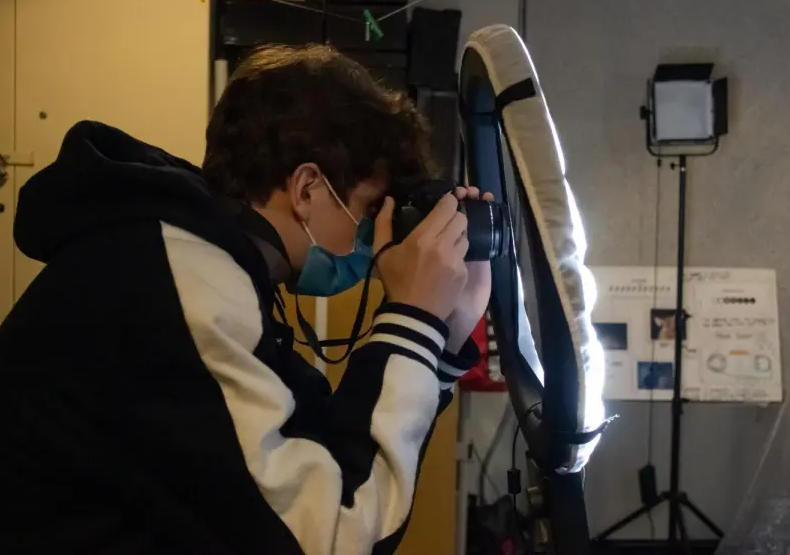
Launched in the fall of 2019, Brookline Lens is an optional semester or full year course which provides students the opportunity to produce free photo and video projects for the high school and the greater Brookline community.
These projects include an informational video on Tappan Green, a mini documentary for the Brookline Recreation Center and a video for the PTO.
On Jan. 12, Brookline Lens had to cancel their launch party for the second time in a row due to issues with COVID-19.
IMG_3984Gallery • 4 Photos
Bezawit O’Neill, a junior who is one of the project managers, said that the launch party was meant to advertise Brookline Lens to students interested in joining and future clients who may want their services.
“I was part of the group that was in charge of the slideshow presentation,” O’Neill said. “If people wanted some project done or seniors wanted their senior portraits, it was supposed to be an outreach for them to know that Brookline Lens is there to provide that help if they needed it.”
Lori Lynn, a teacher for the course, said it is difficult to plan a virtual launch party event because it was challenging enough to produce the projects.
“We really feel like it’s something that will be better in person. So this year, we’re attempting to do it. It’s tricky because we’re prioritizing our projects for clients,” Lynn said. “But we hope in the future to have some kind of in-person event where people can meet us and learn about what we do.”
Thato Mwosa, another teacher of Brookline Lens, said she hopes to reschedule and plan the in-person event when Omicron dies down.
“We feel like the next couple of months is really for promoting the things that we’ve always wanted to do,” Mwosa said. “We’re going to launch and make sure that people know that we exist, that we’re a great class and we offer students a great opportunity for hands-on learning and to contribute to the community.”
To compensate for the lack of a launch party, Brookline Lens has found other avenues to advertise. Students in the social media team and marketing and advertising team have been working closely to promote Brookline Lens on Instagram, Facebook, Tiktok and Twitter, while the website management team has been organizing Brookline Lens website.
“We are thinking of ways that we can advertise what we do and get the word out,” Lynn said. “We want people to know that if they have a project in mind or need help with photos or videos, they can come to us. We’re getting there. But I think there’s still a lot of people that need to learn about us.”
Senior Kamini Bhadauria, a student in Brookline Lens, said COVID-19 caused delays in her project.
“It has slowed down the process of the projects. We’re heading into filming our Brookline Rec video project, but because of COVID-19, we’re very unsure about when we’ll be able to film and interview people,” Bhadauria said.
Despite COVID-19 affecting the students’ experiences in Brookline Lens, students said they are glad that they are able to learn about photography, filmmaking and how to communicate with clients.
“It’s a great experience that you can use in any field that you’re going to do when you move on with different levels of high school or also college,” O’Neill said. “I think for any student, if you have any interest in filmmaking or photography, or even if you don’t and you just want to experience something new, I’d definitely say Brookline Lens is a great experience.”
Lynn and Mwosa said they hope that Brookline Lens grows and that they can be a pillar for those who may need their services.
“We have so much potential, and we hope that more and more people come to us,” Mwosa said. “We want people to just know that we’re here to help and understand that when they come to us, they’re also giving students an opportunity to learn, to work with clients and to develop their skills.”
Brookline Lens provides clients with free photography or videography services. Clients can offer to pay a stipend. To request their services, reach them at brooklinelens@gmail.com or at their website Photo Video Productions House | The Brookline Lens | United States
Brookline Lens seeks to be flexible amid COVID-19 issues and cancellations
Allen Yu, Staff Writer|January 25, 2022
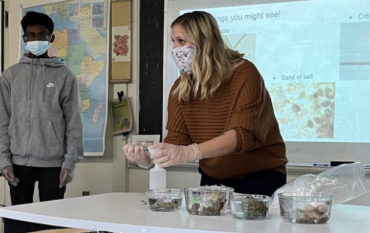
Students learned about the threat of microplastics in the environment and specifically in water supplies with a lab on Nov. 15.
Four thousand miles is not enough to stop the Global Leadership class from connecting with Brookline’s sister city, Quezalguaque, Nicaragua.
Global Leadership aims to help students gain more experience and knowledge in solving world issues. On Jan. 31, they will begin the Tap Challenge, which lasts for 10 days and encourages students to use reusable water bottles instead of plastic, single-use ones.
Global Leadership teacher Roger Grande said before the start of the Tap Challenge, students learned about Quezalguaque and its specific water-related needs.
“We learned about their water insecurity: that many people in one of the hemisphere’s poorest nations do not have regular and easy access to potable, clean water,” Grande said.
Junior and Global Leadership student Agnes Shales said although Brookline and Quezalguaque are many miles away from one another, the Tap Challenge brings the two together. Money donated to the Tap Challenge will be given to a fund in Quezalguaque to help with their water security efforts.
“We’re a city in possibly one of the areas of the world with the best water. We are so incredibly lucky that we aren’t forced to pay for water in the same way that they do there,” Shales said. “As their sister city, we can take responsibility for improving the planet and helping out. We try to do this by reducing our use of plastic water bottles because it’s an example of our privilege, damaging the Earth in ways we don’t need to be.”
Junior and Global Leadership student Zoe Raybould said the Tap Challenge allows students to practice leadership skills as they each have individual roles.
“We’re learning to be leaders on a global scale and to have the outreach that affects people all over the world, not just in our small community. But at the same time, we want to make a real difference in both of our communities,” Raybould said.
Shales said the Tap Challenge permits her to help another community while honing leadership skills for the Global Leadership class.
“We are a class that focuses on development and leadership skills and issues facing the international community. I think that finding a way in which our lives tie into that, through the sister city project, is a super interesting take on that,” Shales said. “Usually projects are about areas that we didn’t have a real impact on before. I think this is a way to make an impact through the global lens that we’ve been trying to cultivate in our class.”
The Global Leadership class conducted a lab with the help of two Boston University graduate students, Caroline Fleming and Jenna Rindy, on Nov. 15. The lab centered around small plastic debris called microplastics and their negative role in the environment.
Rindy introduced the microplastics lab by explaining how chemicals enter the environment through plastics not being disposed of properly.
“Plastics are made of chemicals and as they get exposed to things like rain, they release chemicals into our environment. A lot of those chemicals are really toxic,” Rindy said. “The issue is that they can enter our soils and be really harmful for what grows and lives there. These plastics are also harmful for animal life, land and sea.”
According to Grande, the purpose of the microplastics lab was to demonstrate the danger plastics pose to coral, which connects back to the Tap Challenge.
Junior and Global Leadership student Dan Hernan said that the microplastics lab prepared students for the Tap Challenge because they learned about microplastics’ harm to the environment.
“The microplastics lab we did was almost like a smaller version of what we’re going to do with the Brookline High School community,” Hernan said. “It was bringing awareness to students in the class about the prevailing and dangerous force of microplastics in our own water supply.”