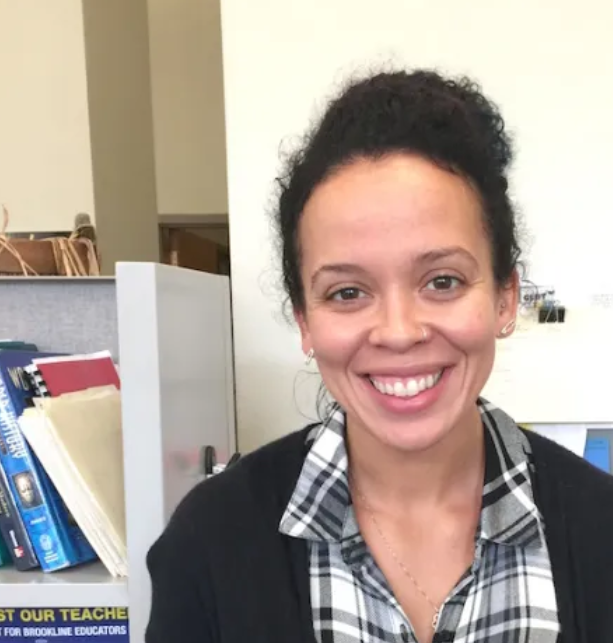
Social studies teacher Stephanie Hunt has taken on the additional role of teaching in the African American Latino Scholars Program. Hunt carries an enthusiasm about the program as she prompts her students to think about their own identity as scholars.
What is your position?
I am part time in the social studies department and part time working with the scholars program. I am currently teaching the sophomore scholars seminar.
What was the process of getting selected for that role?
I had applied for the scholars coordinator position and it worked out where Dr. Lemel was hired and there was money in the budget to bring on another teacher in a part time fashion so my love for scholars was alive and it is still present so it made sense for me to take this opportunity and even though it wasn’t the opportunity that I had initially sought, it was a great opportunity to still be connect with the program.
What do you do in a day to day class?
The sophomores get PSAT help twice a week and then the other two meetings they are with me in seminar. Currently we are looking at the identity of a scholar and my goal is to provide them with a more comprehensive view on what a scholar looks like and to provide them with examples of scholars that look like them and that have similar experience, obstacles, and successes that they do. So right now it’s all about exposure and defining or even redefining what it means to be a scholar and what it means to be a pioneer in your community
Do you think teaching scholars classes has affected how you teach your other classes?
I think what has had an effect on me is last year Dean Poon and Ms. Ramos came up with this idea of the identity curriculum. It’s about getting the students more connected with what they are learning whether it be in history, english, math and science. The goal is for students to feel like they are connected and represented in what they learn in the classroom and I think that has definitely impacted my view of curriculum. With scholars I have more flexibility to play with things, but even with my modern world history classes I feel like when I am looking at my curriculum I am thinking “Okay, in what way can we bridge the past and the present. In what way can we bridge these subjects with who our students are”.
What are you hopes for the future of scholars?
My hope is that more students know what the scholars program is. I fear that the broader community only knows it by name and does not know enough about what they do, who they are, and what their accomplishments are. My hope is more visibility. I would love scholars to get involved in other programs as well. I want the program to grow. If the program grows, that means that more and more students are hitting the requirements. Our expectations aren’t lowering, but students are meeting them and that’s a testament to the support staff that work with scholars and a testament to the students that continuously are bringing each other up and helping each other succeed.
Lauren Mahoney, Sports Writing Editor
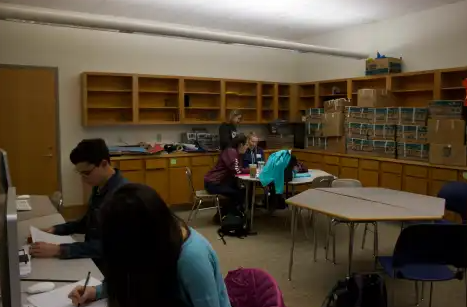
Teachers help students with their math homework in Math Center on March 16. Math Center is held prior to school every morning in multiple rooms, one of them being room 144.
It’s 6:30 a.m. and your alarm is ringing. A half an hour later, you’re out the door and on your way to one of the many help centers the high school has to offer.
For sophomore Claudia Marza, waking up early can be the deciding factor of whether or not to go to Math Center.
“I would much rather go in the afternoon for 15 minutes or half an hour than go in the morning,” Marza said. “Teenagers already get too little sleep as it is, so I think that having it in the afternoon would be better.”
Sophomore Jackie Mundis said that she doesn’t get the help that she needs when she goes to Math Center due to the distraction of other students.
“I like the idea of getting extra help,” Mundis said. “I’ve been a couple of times but, when I went, I found that I didn’t really end up getting the help that I needed. I think that it was a good idea to meet with my teacher, but I don’t think that I got enough help because I was pretty easily distracted by some of the other students who were there.”
According to Mundis, one of the biggest problems with Math Center, in addition to distracted students, is that there simply are not enough teachers to help all of the students who come.
“I think the main problem is that there is only one teacher in the room,” Mundis said. “Since there are a lot of students, you can’t really get one-on-one help.”
Marza also said that the lack of teachers present is a problem.
“I think that there should be more teachers there,” Marza said. “It’s like six kids to one teacher, which can make it really hard to get help.”
Math teacher and Math Center Supervisor Lisa Rodriguez said that she understands why students would not want to come to Math Center due to its timing, but feels that the program is run well.
“People don’t like how early it is, and certain kids don’t want to get up so early, even if they need help,” Rodriguez said. “I don’t think there are problems with how Math Center is organized, but I do think that, even if kids don’t want to wake up, they should try to come to Math Center for help if they need it.”
Rodriguez said it can be hard to have so many students and not very many teachers.
“In the upperclassman Center, there are a lot of kids who come in, but only three teachers,” Rodriguez said. “Some kids don’t like to work together and talk to each other, which makes it so that I often have to answer the same question like 10 different times, which makes it hard for me to get to all the kids. I can totally see that being a reason why some people don’t want to go to Math Center.”
Rodriguez said that she wants to get the word out to more students about Math Center so that more kids, especially those in standard level classes, can come and get help.
“It needs to be advertised more so that more students can take advantage of it,” Rodriguez said. “Not a lot of standard kids end up coming to Math Center. Usually, the room gets really packed with honors and advanced students, but I wish we could get more standard students to come.”
Senior and founder of the Science Center Aria Wong also said that not enough students know about the help centers.
“I think the reason that some kids don’t come is because they don’t know about it,” Wong said. “We haven’t done enough outreach and marketing.”
Wong said that she wants to spread the word about science center by making announcements, talking to teachers and putting up posters around the school.
Students work at the Writing Center prior to the school day. Senior Ben Groustra, who works at the Writing Center, said that there aren’t a sufficient amount of students who know about the program.
Petra Huang for the Sagamore
Students work at the Writing Center prior to the school day. Senior Ben Groustra, who works at the Writing Center, said that there aren’t a sufficient amount of students who know about the program.
Senior and Writing Center worker Ben Groustra was recommended for his place in the Writing Center by his history teacher and the teacher supervisor to the Writing Center Michael Normant. Groustra said that there are not enough students who know about the Writing Center.
“It can get very quiet in the Writing Center, and I feel like it is very under-utilized,” Groustra said. “A lot of teachers don’t have time to look over papers as much as they would like to or as much as some students need, and writing center is a great place for people who need someone to edit their paper when their teacher can’t.”
However, Andrew Kimball, who runs the Language Center, which meets Mondays and Tuesdays before school, during X-block and Thursdays and Fridays after school in room 206, where kids go to retake quizzes, get practice and ask for clarification, said that X-block is the most popular time for students to visit the Language Center.
“Attendance is equal before and after school,” Kimball said. “X-Block is easily the most popular time. We try to balance the hours before school and after school because lots of students have commitments after school.”
Groustra said that he understands it can be early to wake up, but feels that the mornings are the best time to get help and that it is well worth it.
“I don’t think there’s really a better time to do it,” Groustra said. “You need a time where everyone would have a free block, which wouldn’t really work, and people have stuff to do after school. Coming in before school for 10 minutes isn’t too bad, and that’s when everyone has free time.”
Petra Huang for the Sagamore
Infographic by Ben Mandl
The high school’s help center vary in time, room number and aid provided. This infographic relays this information.
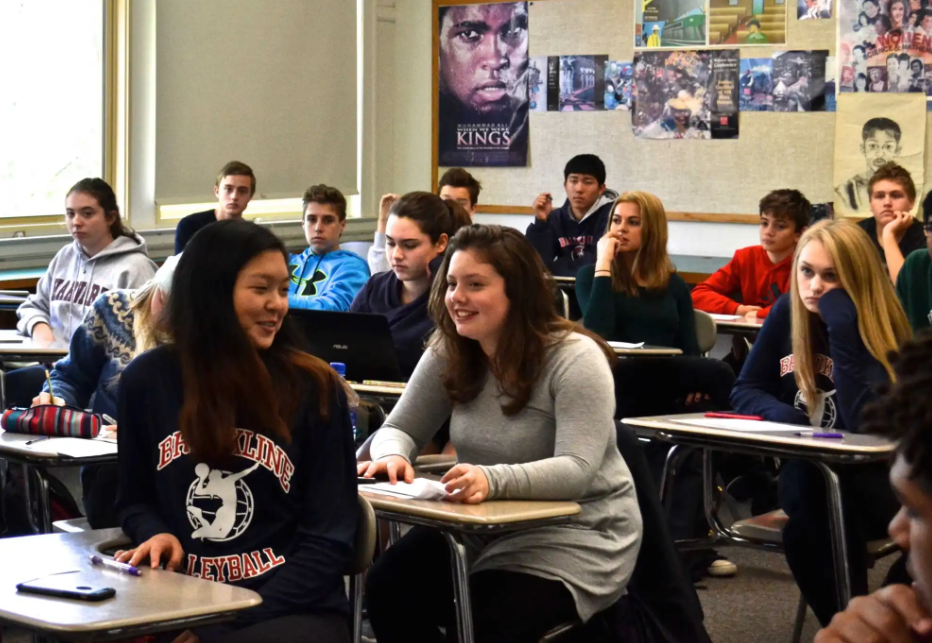
Advisory is the only class at the high school which every student participates in. In response to feedback from advisers, mentors and students, history teacher and Advisory Curriculum Coordinator Jennifer Martin decided that it was time to change major parts of advisory.
According to Martin, she and a team of teachers spent part of the summer working on revising parts of advisory. The changes they made included installing a wellness program.
“We’ve trained about a dozen teachers and they are coming into junior advisories,” Martin said. “They’ll do six T-blocks in a row of mindfulness, so learning how to destress and become less anxious before tests, and it’s going to be really cool that that’s going to be now part of advisory.”
According to Martin, the program will be unveiled for the juniors this year, and will roll out into every grade as the years progress.
Spanish teacher and Mindfulness Program co-creator Elizabeth Gorman helped write the grant that brought the Mindfulness Program into being. Gorman believes many students and teachers create unhealthy stress which negatively affects their lives.
“As a teacher you are empowered to replicate this intense culture that is out there in society that says do more and achieve more, or you can create the culture of educating ourselves and students in a proactive way to be able to understand stress and the impact it has on us,” Gorman said.
According to Gorman, the constant stress many students feel led her and others to create the Mindfulness Program. One of the main goals of the program is to empower students to use the techniques they learn to help alleviate stress.
“One of the goals of the curriculum is to educate students about stress and that’s nice, except that everyone sees themselves as chronically stressed and then they’re stuck,” Gorman said. “So there are actually all these tools to teach yourself to not only identify stress, but to recover from it.”
Junior Mentor Jake Sternlicht believes that having a strong wellness program is important at the high school.
“I’ve always thought of wellness as being important, because of many of the things that I have seen at the high school,” Sternlicht said, “So, I think the changes are positive.”
Another major change that will begin this year, according to Martin, is the new way advisories deal with community service requirements.
“We’re no longer doing the one hour community service requirement and that’s going to get replaced with something that is going to happen next year, not this year, because we need some time to do it. It’s going to be morphed into no longer being, ‘You need to do this amount of community service,’ but rather that the advisories will find a community service club in the building to sponsor and help raise awareness around those issues as a group,” Martin said. “So it’s not like you go out and do something for someone else, but more of we as a group do something together to help out a club, and hopefully it will encourage kids to join community service clubs.”
The Ithaka Cup, which is an annual competition for freshmen and sophomore advisories to gain points through events and determine the winning advisory in a grade, will also undergo major changes this year, according to Martin.
“For freshmen, instead of having four tournament events, we want to do something where every freshmen comes, and it’s awesome because you see your friends from other advisories,” Martin said. “Whereas when we used to do it, you’d end up with just two advisories in a room and it’s kind of cramped. It’s not as fun as everybody together in the gym. So as of right now there will be two events for the freshmen, one each semester.”
According to Martin, the process for changing the advisory curriculum began nearly two years ago. She already had a significant amount of data compiled, and worked to get more so she could understand how to best improve the program.
“When you run something for seven years, you hear people say when they don’t like a lesson, so I have this document where I keep notes on all those things,” Martin said. “I surveyed the Junior and Senior Mentors all last year to see which lessons needed go and which ones were still good for the the 9th and 10th grade, and then I used the adviser’s opinions about what was going on in the upperclassmen advisories to figure out what we should do.”
Sternlicht thinks that the changes in the advisory curriculum will be beneficial to the program as a whole. He said that many of the topics covered in the old advisory program were also taught in middle school, and therefore became monotonous.
“I am happy about the changes because it was always hard to get kids integrated and interested in what we’re talking about because it was often repetitive and very boring because we had already done all that stuff before,” Sternlicht said. “The freshmen have seemed relatively interested in what is going on so far.”
Louie Goldsmith, Opinions Editor
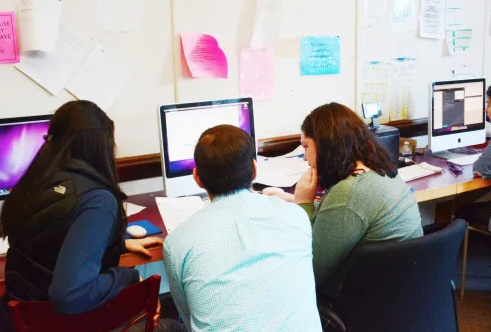
Students work together on homework in a Tutorial class. Tutorial can help students stay organized and study for classes.
I have been in Tutorial since my freshman year and it has been very helpful for me. I use Tutorial as a block to do some of my homework from the night before or to study for tests and quizzes that I have that day.
Everyday, I plan out when I’m going to do my homework and how much time I should spend on each subject. There have been times where I have forgotten to do an assignment. For example, a few weeks ago I had a two-day project due the next block, and I had to do some edits on it. I was lucky that I had Tutorial before that block, so I had the chance to get it done.
It is nice to have an organized class where I can sit down without any distractions and get my work done. During the school year, especially in the spring, managing time can get very difficult due to sports and other commitments, which is why I love having Tutorial in my schedule.
It’s also nice to have two teachers in the room, because I can get help on the subjects that they specialize in. During my three years that I have been in Tutorial, I had the chance to work with many teachers in different subjects.
In freshman year I had Mr. Cawthorne, who helped me with history, and Ms. Hitchcock, who helped me with math. In Sophomore year I had Ms. Longmire and Mr. Mallory, who taught history and math, respectively.
This year, I have Ms. Grubb and Dr. Weiffenbach, who teach history and biology respectively. Having a block where I can brush up on the information that we went over in class is very helpful. Taking Tutorial has been great and I am glad I chose to take it.
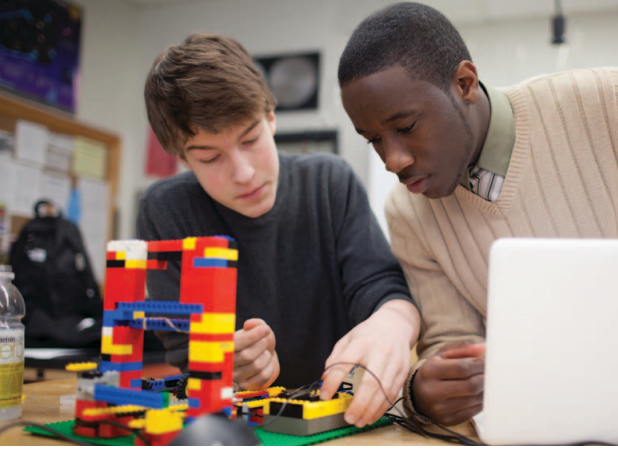
 Strapped for cash, a Massachusetts high school starts its own venture fund to grow teacher leaders and encourage innovation.
Test score gains and higher teacher satisfaction result.
In June 1998, two veteran teachers at Brookline High School stood before Headmaster Robert Weintraub’s desk asking for money. Gayle Davis and Margaret Metzger requested funding for an innovative teacher mentoring program, which promised to provide skills and institutional knowledge to the next generation of BHS instructors.
To Weintraub, Davis, and Metzger, this idea was a no-brainer. Veteran teachers were retiring from BHS in large numbers, leaving the school in the hands of young and inexperienced newcomers. Weintraub agreed that a program for new teachers was essential, but said the school simply did not have funds for mentoring. Limited funding also stymied efforts to address other critical problems at the school. Class size and an achievement gap in its diverse student body were constant challenges. Located in a large town on the outskirts of Boston, the school’s 1,800 students came from 76 countries, spoke 36 languages, and spanned the socioeconomic spectrum. An additional 5% of students commuted from Boston as part of a state- funded school desegregation program. Significant academic achievement gaps existed between white and Asian students and black and Hispanic students, yet the budget had insufficient funds to address this burgeoning problem.
In today’s economic climate, school leaders are no strangers to the predicaments Weintraub faced over 10 years ago. As some schools struggle to develop new programs to resolve pressing issues, others lack funding for even the most basic school supplies, technology, personnel, and building maintenance. School administrators frequently fill the void by developing creative partnerships with private donors, religious institutions, foundations, federal and state governments, and local businesses. While relationships between public schools and private sectors bring much needed funding, they also cause controversy. For instance, parents question whether private corporations like Coca-Cola or Nike should be allowed to advertise in school cafeterias and gyms in exchange for donations. In one case, parents in Nashville, Tenn., were irked when a local high school accepted $150,000 from the Tennessee Credit Union in exchange for opening a bank branch in the school’s cafeteria (Levitz & Simon, 2010). There is much to resolve about the nature of these public-private relationships.
An innovative solution
In 1998, Weintraub found himself gravitating towards a private-sector solution to Brookline High’s problems. After inviting 10 prominent community members to participate in a “think tank,” the concept of a 21st-century fund emerged. It called for successful community leaders to join school officials in developing a nonprofit venture capital organization based in the high school. Relying entirely on donations from alumni, parents, community members, and foundations, the fund would create and support innovative academic and social programs at BHS. The fund would allocate money to enable teachers to implement programs designed to solve serious problems at the high school, in the hope that successful teacher-initiated programs might eventually serve as models for other school districts.
But it was unclear how such a large sum of money could be collected. In the past, BHS received support from a few local philanthropists, its Parent Teacher Organization, and the Brookline Education Fund (BEF), but those donations weren’t enough to meet the school’s most urgent needs, nor were they directed to underwriting innovative programming.
Weintraub was intrigued by the fundraising capabilities of private schools and universities, which raised millions of dollars annually from alumni and constituents. Like those institutions, BHS was well-regarded by community donors; however, the school lacked the organizational structure to collect and distribute private funding.
To overcome these challenges, Weintraub sought buy-in from district leaders and start-up money. He invited the superintendent and members of the Brookline School Committee to participate in the fund’s design. A group of well-connected town residents, several with experience in philanthropic fundraising, planned a kickoff event for December 1998. This steering committee gained financial commitment from many local alumni before the event and raised over $500,000 for what became the 21st Century Fund, which registered itself as a 501(c)(3) nonprofit organization capable of providing tax exemptions to donors. The committee crafted a mission statement to make clear that the 21st Century Fund would provide venture capital to pilot innovative programs — designed by BHS teachers and Brookline community members — responding to national problems in public education. Brookline High would be a beta site, a laboratory for innovation in public education. Money in hand, the 21st Century Fund established an office in the high school and prepared to select the organization’s founding programs.
Teachers were empowered to consider the challenges they faced daily and to propose solutions to Weintraub and his team. Over time, a formal process for selecting programs evolved, a democratic system of approval was established, and more people took ownership of the organization. A program committee consisting of parents, community leaders, and school administrators was organized to vet proposals and support teachers through the application process. Teachers were required to submit realistic budgets for their programs, along with descriptions of how proposed initiatives would solve problems at BHS. The process was competitive, with only the most impactful proposals selected by the program committee. If chosen, teachers presented their ideas to the superintendent and central office officials to assure consistency with district goals. Next, proposals went before the 21st Century Fund’s board of directors, and ultimately the school committee for final approval.
Selected programs were designed to be financially supported for a three-year test period, and teacher leaders were relieved of one or two classes for program development and implementation. Time is an important commodity for teachers, and partial release from teaching assignments was a valued and essential component of the fund’s projects. With released time came high expectations for performance; teacher leaders were required to use valid research techniques to document the program’s success. Teachers presented data to the 21st Century board and district administrators, who closely examined whether programs met their objectives and determined whether to incorporate them into the
system’s long-term budget. An unsuccessful program received no further funding and was discontinued.
In September 2000, the 21st Century Fund financed its first program. Davis and Metzger launched their Teachers Mentoring Teachers program to promote teacher retention and professional growth. Over the next 10 years, the fund added 15 programs. A tutorial program established in 2002 provides individualized, content-based support to enhance the academic performance of students with mild learning disabilities. In 2003, the fund helped develop the African-American Scholars program to narrow the achievement gap by establishing and nurturing a corps of academically outstanding African-American students. More recently, a Social Justice Leadership Program was established to provide students with the skills needed to become active agents of change in a deeply divided world. Each of these programs sought to improve the lives of students at BHS while providing teachers with authentic opportunities for leadership.
Implementation challenges
The 21st Century Fund encountered significant challenges in its early years and is still a work in progress. One early controversy involved leadership. Some school officials and parents expressed concern that private donations might end up in an unregulated “slush fund” for the headmaster. Others questioned whether community leaders with expertise in business and academia, but limited experience with education might support programs inconsistent with the district’s goals. To address both concerns, the fund developed a highly inclusive governance structure. Multiple boards consisting of parents, community members, alumni, school leaders, and elected officials regulate donations and select new
programs. This inclusiveness ensured that the 21st Century Fund was a unified democratic effort, supported by all.
Another challenge is integrating successful programs into the regular school budget. Teachers Mentoring Teachers, for example, costs about $30,000 per year (the cost of two teachers relieved of one class each). School administrators must somehow find the money for the program, usually by reallocating resources to support the new successful program. This process became particularly daunting when the school district experienced increased enrollment at a time of economic contraction. To address this issue, Weintraub and Brookline Superintendent William Lupini look ahead when reviewing program proposals.
“We only want the 21st Century Fund to establish programs that will be sustainable under the regular budget after the three-year process has run its course. Otherwise, we might run into a situation in which excellent programs can’t be funded,” Lupini said.
The unpredictable economy makes planning difficult and requires Weintraub and Lupini to modify the budget frequently when adopting new 21st Century Fund programs. Over the first 10 years, BHS incorporated about $900,000 in programs, while reducing the rest of the budget by nearly that amount.
This is an essential component of the whole process; without incorporating successful programs, there would be no motivation to innovate.
Finally, the 21st Century Fund created some initial tension with existing local education groups and foundations. Before the fund’s inception, the high school PTO and Brookline Education Foundation (BEF) were the primary fundraising entities for Brookline schools, and there was concern that the new organization would compete for limited donations. To quell tensions, leaders of the fund and BEF agreed to create separate spheres for fundraising. The 21st Century Fund would exclusively seek donations from parents of high school students for innovative programming, while BEF could access K-8 families and fund teachers’ professional development. As a result of this productive communication, Brookline’s fundraising organizations developed a respectful and stable collaboration.
Fund benefits
Over 10 years, the benefits of the 21st Century Fund have become very clear to Brookline educators.
#1. Brookline is a leadership factory.
Since its inception, the 21st Century Fund has transformed the professional lives of BHS teachers. The leadership opportunities created by the fund’s programs engage, challenge, and invigorate faculty members.
“Developing a program from scratch and being selected to lead it was both validating as a professional and a tremendous professional growth opportunity for me,” said Davis, a coleader of Teachers Mentoring Teachers.
Christien Polos, teacher leader of an arts program for at-risk teenagers, agrees. “The 21st Fund has enabled me to work through, cultivate, and then realize an innovative idea that could possibly change a child’s path in life. Professionally, a person couldn’t ask for more validation from their workplace.”
Being selected as a teacher leader convinced some of the finest teachers at BHS to remain in the profession many years beyond their expectations. Metzger was ready to retire in 1998 after a 25-year career teaching English. Coleading Teachers Mentoring Teachers compelled Metzger to stay an extra 12 years. “I loved having ownership over an exciting new program and a new purpose. This opportunity was very affirming and made me feel extremely connected to the school,” Metzger said.
The 21st Century Fund also prepares the school’s next generation of administrators. While many teachers are content to be program leaders, others use newly acquired leadership skills to assume administrative positions. English teacher Mary Burchenal used 21st Century funds to develop an interdisciplinary program, The Good Citizen in a Good Society. Later, Burchenal was selected as English department chair. Brian Poon, a social studies instructor who also developed the Good Citizen program, became an associate dean and now directs an alternative program for at-risk students at BHS. “Good Citizen was really an entry point for me into how schools make change both on the institutional and the district level. I cultivated an appreciation for how a person gets things done in schools,” Poon said.
By providing leadership opportunities, the 21st Century Fund allows BHS to nurture and retain some of its brightest assets.
#2. The fund expanded student learning opportunities and produced impressive achievement results.
Students appreciate access to unique and innovative programs each year. “The 21st Century Fund provides us with so many interesting class and program options unavailable in other schools. . . . I love being a student here,” said one junior.
Students value the access to additional academic support, and they praise the 21st Century Fund for increasing classroom engagement. For example, the Engineering by Design course launched by the fund is popular among students who want a hands-on approach to the sciences. “I have a hard time keeping focused when I am lectured to all day. After doing this program, I feel like I can fix, design, or build anything. My favorite part of this program has been putting my creative mind into physical things,” said one student.
Increased student engagement coupled with new academic support programs have narrowed the achievement gap at BHS. Between 2005 and 2010, the number of African-American and Hispanic students scoring proficient/advanced on the Massachusetts Comprehensive Assessment System increased 84% for language arts and 71% for math. Class of 2011 students enrolled in the African-American Scholars Program (AASP) outpaced the national average on the SAT and outscored non-Hispanic white BHS students in the writing section. Most AASP students (68%) increase the number of honor and AP courses they take between freshman and senior year, and there was more than a 100% increase in the induction of AASP scholars into the National Honor Society in the last three years. While results demonstrate a significantly reduced achievement gap, there is still much work to be done. Future 21st Century Fund programs must remain committed to helping all students receive a challenging and meaningful education.
#3. The fund has deepened and expanded community involvement.
The fund also plays an instrumental role in involving parents in the school community. Research indicates that parental involvement in school peaks at the elementary level and tapers off as independence-seeking teenagers enter high school (Eccles & Harold, 1993). The 21st Century Fund invites parents to remain involved by participating behind-the-scenes on planning boards and committees and working on fundraisers. Each opportunity provides social interaction and a means for contributing to programming. This is a win-win situation: Parents connect to the school while contributing valuable resources and expertise.
In one case, volunteering for the 21st Century Fund inspired a parent to become a teacher. After chairing a 21st Century committee, Julie Joyal-Mowschenson was moved by “the tremendous efforts of BHS teacher-leaders to reduce inequalities at school and in the world.” Joyal-Mowschenson, a nationally respected nurse, earned a master’s degree in education, passed the Massachusetts teacher exam, and initiated a popular course at BHS called Medical Careers. She now also teaches that course at Boston’s Madison Park High School and plans to disseminate her curriculum in eight other Boston public high schools.
The fund provides exciting opportunities for another traditionally underinvolved group at the high school: alumni. Before the fund’s inception, the BHS alumni network was small and exclusively collected donations for class reunions. The fund expanded outreach to alumni by empowering them to raise money for venture capital programs. Many alumni enjoy sharing ideas and expertise from their professional lives with teacher leaders in developing new programs. For example, the Global Leadership Academy, a project currently under development, is receiving feedback from alumni leaders in business, law, and education. Through this involvement, many graduates have reconnected with their high school,
bringing valuable resources and ideas.
Finally, the fund attracts some of the community’s most generous philanthropists. Like parents and alumni, local donors have adopted leadership roles on various committees. They enjoy socializing with other community members and contributing expertise to support a good cause. As these philanthropists become more involved with the fund, they frequently make donations. Chobee Hoy, a local real estate agent and one of the fund’s most generous benefactors, said, “The fund inspires confidence and is a great draw for donors because it’s related to the school system, which is highly regarded and has excellent leadership.” The fund’s excellent reputation with the sponsors is especially critical in the current economic climate as aggregate charitable giving has declined or had only modest increases in recent years (Center on Philanthropy, 2011).
Conclusion
The 21st Century Fund model provides one formula for harnessing private funding in tough economic times. It is a luxury to raise funds for innovative programming at a time when other schools can barely afford teacher salaries and provide students with basic supplies. However, developing a local foundation is not something that is available only to the nation’s most affluent districts. Leaders of middle- and lower-income schools can also leverage the financial and human resources of their communities into powerful fundraising structures. While a town’s financial situation will inevitably dictate how much money a school can raise, all school leaders can create their own 21st-century funds.
Brookline’s 21st Century Fund continues to be a work in progress. Like any nonprofit organization, the fund regularly examines its mission and strategic plan to ensure future growth and success. The fund’s goal is to enable Brookline High to continue as a laboratory searching for innovative solutions to some of the nation’s most intractable educational challenges.
While problems such as teacher retention and the achievement gap can seem insurmountable, lessons from the fund’s successes and failures can contribute to national efforts for their resolution. As stated by one BHS parent and fund leader, “What inspires me about the 21st Century Fund is that it goes after major problems facing public high schools nationally, but it does so with very specific solutions that are applied and tested in one school. In the laboratory of innovation that is Brookline High School, we have
proven that you can attack some of these problems successfully one student at a time.”
References
Center on Philanthropy at Indiana University. (2011).
Giving USA 2011: The annual report on philanthropy for the year
2010. Chicago, IL: Giving USA Foundation.
Eccles, J.S. & Harold, R.D. (1993). Parent involvement during
the early adolescent years. Teachers College Record, 94 (3),
568-587.
Levitz, J. & Simon, S. (2010, June 14). A school prays for help:
Towns tap businesses, churches to shore up budgets. The
Wall Street Journal
By Daniel G. Green
kappanmagazine.org
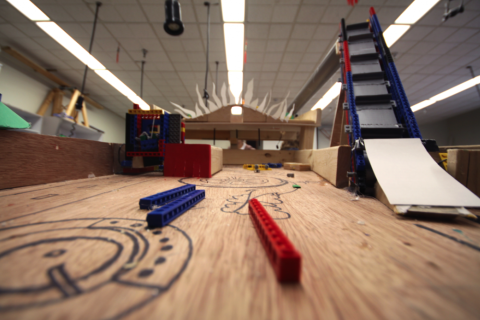
In Room 368, every table has a four-foot tall Rube Goldberg machine on it. In UA 11, saws, sanders and every other tool imaginable surround a few tables supporting the futuristic locker organizers students are building. These are the engineering rooms.
The school has two engineering classes: one run by the science department and one run by the career and technology education department. The two classes differ due to the role science plays in each class.
“Ninety-five percent of the time, the students are working and trying to solve problems,” said science teacher Aubrey Love, who teaches Engineering By Design, the science department’s engineering class. “I might be walking around and help a little bit here and there, but it’s really about what you can come up with through trial and error.”
Both classes focus on engineering, but Engineering By Design is more math- and physics- based than the elective class, Engineering the Future, according to Ed Wiser, the science department curriculum coordinator.
“It’s more hands on,” said Glen Gurner, of his Engineering the Future class. “I try to bring a little science into it. It’s more project-based, and it’s about making things and how to put things together.”
Both of the engineering classes follow the same design process of figuring out the problem, planning out what they are going to do, making a model, doing tweaks and then creating the final product, according to Wiser.
The Engineering By Design projects, however, require equations to help plan out every detail, according to senior Marshal Rekovskyson.
“Its a lot of physics,” Rekovskyson said. “Engineering requires a lot of physics because you need to know about the force needed to do something. We aren’t going to do calculations on the fly. Understanding the forces in effect, gravity and friction, definitely helps us make better machines.”
There is also a difference between the two classes in their access to large tools. The Engineering the Future class has access to all of the advanced tools in the basement of the Unified Arts Building, while the Engineering By Design class only uses the tools they have in their classroom and what the career and technology education department will give to them.
According to Wiser, Engineering the Future introduces fundamentals of engineering while Engineering By Design does projects that require more in-depth knowledge of engineering. Both aim to help students figure out whether or not engineering is something they want to pursue later in their life.
“We are given the freedom to do whatever we want and to add our own spin,” said Rekovskyson. “Most projects have strict guidelines and have a strict goal, but in this class, we just build.”