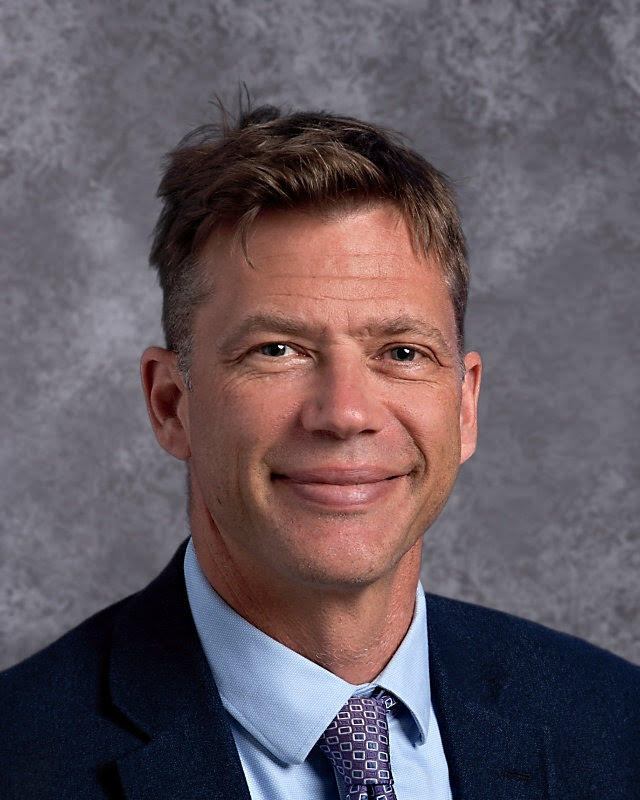
Interview with Superintendent Andrew Bott
Jessica Eber: As a high school parent, I’m most interested in hearing you talk about your vision for BHS. I’d like to start by asking you to describe it.
Andrew Bott: The Education Plan for the high school spelled out a vision for BHS through a couple of different lenses. First we identified the things that are working really well at the high school, and looked at how we could maintain that level of success as the school continues to grow. Then we asked: What are areas in the high school that are not working really well for everyone? Who are the students who aren’t connected with the school? Where do we have outcomes for students that are not equitable — students taking AP classes, for example — and how do we grow in a way that increases both access and successful outcomes, and do that as the high school is growing?
One way is by making sure that, as the school grows from an enrollment of 2000 to one of 2700, we create a small-school feel, so that students are connected. We’re looking for opportunities to create what Anthony [Meyer] calls “havens” — like SWS, for example. We’re looking for other ways to create the kind of community that SWS creates. Is there perhaps a Global Leadership pathway? This is actually a perfect example of the impact of the 21st Century Fund, since Global Leadership started as a 21st Century Fund course and is very much on a trajectory to become a pathway within the high school, where a cohort of students with a shared interest can become connected with that particular area of interest.
Another really important piece of the Education Plan concerns providing more opportunities for interdisciplinary, project-based learning. And again, I don’t bring this up just because we’re here talking about the 21st Century Fund, but there have been some really incredible examples of interdisciplinary courses launched by the Fund that have become part of the curriculum. And so you start thinking about how to create these interdisciplinary, cross-curricular connections and opportunities for students, and then you need to figure out: what do we need, physically — what spaces do we need — to support teacher preparation, student work, etc. The Educational Plan really ties all of it together. It’s about identifying the traditional silos. Where is it that we need to head in math, in science, in social studies, world languages, the arts? And what are the ways that they’re interconnected? What’s the matrix? Think of the DNA double helix, where it’s all coming together in that interconnected way. And how do we support that as a high school?
I will say one last thing. I think that the courses for next year that have been vetted and are now in the course catalog are a great example of a first step in implementing our vision before the building project is even decided upon. Because this is what we believe is good for the high school. We need to start doing that work now. So we’re adding new coding classes and starting to think about how to integrate the skills and learning connected to coding within the math disciplines. We’ve also added a new history class (Human Geography, a fascinating AP class) and the new engineering and design class [Engineering Innovation and Design]. They’re a real first step in moving toward that vision. And what’s really amazing about the new engineering class is that the department has designed it sort of like an AP course in terms of class time and planning time, but there are multiple pathways into the course. Students may come from an engineering class, or it may be an art class as a prerequisite, or a math class … I think that’s a really important way to think about our course offerings, so each course doesn’t just have one way in.
Think about Global Studies. It may be that a student is really interested in taking a course and learning more about Global Studies. Well, there are a lot of courses already offered at the high school that are a part of Global Studies. As so, if we start identifying those courses for students, we can create a pathway within the existing structure. We want to be identifying those havens — those spheres of interest. Of course students need to be able to move among the spheres. We certainly never expect a ninth-grader to know exactly what he or she wants to do.
I think the Education Plan is fantastic. For folks who want to learn more about it, I would say that the Executive Summary — the first five or six pages, really captures the vision very powerfully.
JE: I was planning to ask you about the role of innovation in education, but it seems like a lot of it is described pretty clearly in the Executive Summary, where it talks about the goal of engaging students more and encouraging cross-disciplinary collaboration. Can you talk about what some of the challenges are in introducing innovation into the public schools? I imagine budget is one very big constraint. I was particularly interested in your recent email regarding the fact that more hiring needs to happen to keep up with growth, and that cuts need to be made to counterbalance that increased spending.
AB: You know, it’s budget and space challenges. You can’t continually add courses, so we assumed, for example, in adding Human Geography, which is an AP class, that fewer students are going to take one of the other AP history classes. So we are assuming that we will see a shift of students, and sometimes you have to take that risk in adding a course and trying something that is innovative. Then there’s the cost. We have to think about how are we’re adding courses and what are the budget implications. And the other challenge that’s very real for Brookline is space. When you’re talking about cross-disciplinary classes: Where do they meet? How do they meet? Our classrooms all work, but they’re small by today’s standards, certainly for cross-curricular work. If you are engaged in a design project, how do you leave all of your design work out until the next day? Where’s the space for that? Part of the design process is, you can’t clean it up. The messiness needs to stay as your team is problem-solving. And there’s a similar challenge in elementary schools, as we think about how to create makerspaces and interdisciplinary learning spaces in schools that have huge facilities constraints. It’s hard. That’s the most challenging thing. The will to innovate is huge in Brookline. The educators here have been incredible in their drive to innovate, their creativity and passion to try new things. It’s not the desire; it’s how to support it, financially and physically.
JE: And so how does the 21st Century Fund fit into the overall plan?
AB: Well, it’s a way to vet ideas. At my first meeting with the Fund I saw the large number of classes and initiatives over the years that have been funded. Some of them have become institutionalized and have been transformative in the high school, and some of them didn’t. But even when a class doesn’t become part of the curriculum, the learning that results from having tried it informs something else. The Fund provides that additional bit of flex through the funds, the dollars, that are available in support of innovation. It allows BHS to try things. And as they are being tried, the Fund helps us understand the impact so that we can decide whether this is something that should continue for the long-term or something that discontinues, but has helped us understand XY and Z. It’s an incredibly powerful and important partnership.
JE: I wonder if you can speak to the question of how what we’re doing here in Brookline to support innovation compares to what’s happening in other towns?
AB: I think that there’s a real tradition in Brookline of innovation coming out of individual schools. What Brookline has, which is in place in some but not all communities, is a very strong team of curriculum coordinators. Our elementary history coordinator, for example, works incredibly closely with educators throughout the system so that there’s an understanding of and common expectation for what students are learning in Brookline at a given time. So for example second graders throughout Brookline have a unit on Ghana. But there’s some flexibility, so within that a teacher can say, “Well, could we try this?” There’s a school that does an artist study as a part of the nonfiction reading and writing component of the Ghana unit. They started it many years ago, and it has become ingrained in the faculty of the school. So I think that’s one way in Brookline that we support innovation. And the 21st Century Fund is a great example of that at the high school. People can have an idea and get support for it. That kind of thing is not necessarily embraced in every community.
JE: I know there has been some controversy about the idea of raising private funds for public schools, which is of course exactly what the 21st Century Fund does. What do you think about it?
AB: It’s a balance. You want to make sure that the money has an equitable impact within the schools. That’s where the School Committee weighs in. I think that private funding can be very supportive. There are many examples of how it has effectively, and in important ways, impacted BHS over the years. Private funding from the 21st Century Fund has impacted educators, students and families in very positive ways. So yes, there is a really important place for private fundraising, but the key is to make sure that it has an equitable impact.
JE: How exactly does a course get approved for funding by the 21st Century Fund? Does the School Committee review teacher proposals?
AB: Ultimately, yes. Nothing goes into the course catalog until the School Committee says it’s OK. It’s really the fiduciary responsibility of the School Committee to say whether a particular course is going to be funded.
Elizabeth Zachos, 21st Century Fund Board Chair, explains the funding process:
The proposal goes from the teacher to the curriculum coordinator to Anthony [Meyer, BHS Headmaster] and the Fund at the same time. Simultaneously, but not talking about it with each other, Anthony and his administration figure out if they think it will work. If the Fund’s Program Committee also thinks it will work, it goes to the Curriculum Subcommittee of the School Committee.
Click here to read more about how the 21st Century Fund supports innovation at BHS.