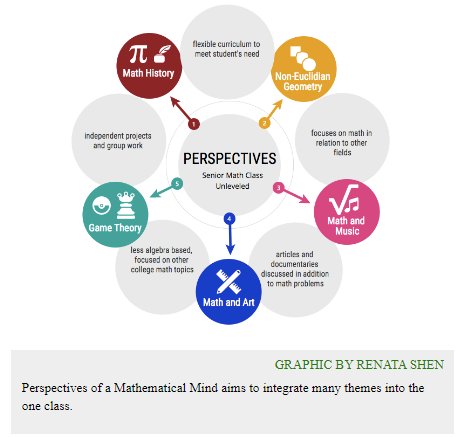
Perspectives of a Mathematical Mind aims to integrate many themes into the one class.
By the end of high school, an average math student can write a geometric proof, solve a quadratic equation and maybe even calculate a derivative. Give the student a traditional math textbook and a sheet of lined paper, and they’ll know exactly what to do — but ask that same student about non-euclidean geometry, game theory, the history of math, or real-world applications of operations and formulas, and you will likely receive a blank stare.
That is, unless you ask students from a senior math class, Perspectives of a Mathematical Mind, which introduces non-algebraic college math and connects concepts with other disciplines such as art, music and history. Through taking the class, students incorporate their own interests with math projects, which deepens their engagement and understanding of the material.
Math teachers Betty Strong and Grace Wang brainstormed the idea for the class after observing a lack of student interest in other algebra-based math classes.
“We would sit around and just be like, ‘it’s such a bummer that students don’t get a chance to see all of this really cool stuff about math,’” Strong said.“There’s so much more to math that kids don’t see.”
After submitting a proposal to the Innovation Fund, then called the Twenty First Century Fund, Strong and Wang received a grant to run the class for three years. After this trial period, the funding for the course was incorporated into the school’s math department budget. The class now covers topics such as tessellations, fractals, art, music and more. Although the class includes some mathematical calculations, the bulk of the class is spent completing other activities.
“We do a lot of group work and presenting, we watch videos, we read articles, we do a lot of discussions, we do a lot more in-depth math investigations,” Strong said.
Although she was already on the advanced math track freshman through junior year, senior Damani Gopal chose to take Perspectives this year, in addition to Advanced Placement calculus.
“I want to study computer science when I’m in college, so obviously the STEM fields are really big in my life,” Gopal said. “Taking a second math was a big benefit.”
Senior Noah Sesling chose to take the class after a presentation given to his Trigonometry and Analysis class junior year. Prior to taking the class, he had struggled to connect class material to his daily life.
“I liked the idea of taking a math class that actually could teach me things that I could apply to the real world,” Sesling said.
For Gopal, learning about other aspects of math has allowed her to extend her existing knowledge of STEM. She particularly enjoyed a unit on game theory, a field of study that is heavily rooted in human psychology.
“It’s the analysis of how two or more parties choose to play a certain game, so it can be like applied to fights like wars, or it can be applied to games,” Gopal said. “There’s a lot of connection to computer science to that. I’ve done game theory independently, so it was lot of fun to do it in school.”
During a unit on math and art, Gopal was able to apply her interest in coding to an end of unit project.
“I made a computer program that depicted tessellations and fractals, so involving coding with math,” Gopal said.
Sesling has incorporated his interest in music with math class. At the high school, Sesling participates in both Camerata choir and the a capella group, Testostatones. For one of his projects, Sesling studied twelve-tone serialism, a form of music composition.
“It basically uses numbers to create melodies,” Sesling said. “I found that really interesting, the way that Perspectives taught me and gave me the resources, and opportunities and open-endedness to actually explore how math and music come together.”
According to Strong, a unique aspect of the class is that it is non-leveled, allowing students who normally don’t interact an opportunity to learn together.
“There’s not a lot of prerequisite knowledge that students need, so we take kids from the college prep level all the way up to the advanced level,” Strong said, “the course is based on each student reaching their own level of mastery, so there’s a lot of individualization.”
For Sesling, taking the class has helped him recognize the significance of mathematical concepts.
“[Before Perspectives] I spent a lot of time memorizing and just trying to think of concepts that didn’t have a meaning to me. This idea of just 1+1=2,” Sesling said. “But with perspectives, it’s a lot more [of] much larger concepts rather than simple small ideas or equations. It’s not like anything you have to memorize, it’s just concepts, like how math would relate to everyday experiences or other forms of art.”
Renata Shen, Staff Writer
Jessica Eber: As a high school parent, I’m most interested in hearing you talk about your vision for BHS. I’d like to start by asking you to describe it.
Andrew Bott: The Education Plan for the high school spelled out a vision for BHS through a couple of different lenses. First we identified the things that are working really well at the high school, and looked at how we could maintain that level of success as the school continues to grow. Then we asked: What are areas in the high school that are not working really well for everyone? Who are the students who aren’t connected with the school? Where do we have outcomes for students that are not equitable — students taking AP classes, for example — and how do we grow in a way that increases both access and successful outcomes, and do that as the high school is growing?
One way is by making sure that, as the school grows from an enrollment of 2000 to one of 2700, we create a small-school feel, so that students are connected. We’re looking for opportunities to create what Anthony [Meyer] calls “havens” — like SWS, for example. We’re looking for other ways to create the kind of community that SWS creates. Is there perhaps a Global Leadership pathway? This is actually a perfect example of the impact of the 21st Century Fund, since Global Leadership started as a 21st Century Fund course and is very much on a trajectory to become a pathway within the high school, where a cohort of students with a shared interest can become connected with that particular area of interest.
Another really important piece of the Education Plan concerns providing more opportunities for interdisciplinary, project-based learning. And again, I don’t bring this up just because we’re here talking about the 21st Century Fund, but there have been some really incredible examples of interdisciplinary courses launched by the Fund that have become part of the curriculum. And so you start thinking about how to create these interdisciplinary, cross-curricular connections and opportunities for students, and then you need to figure out: what do we need, physically — what spaces do we need — to support teacher preparation, student work, etc. The Educational Plan really ties all of it together. It’s about identifying the traditional silos. Where is it that we need to head in math, in science, in social studies, world languages, the arts? And what are the ways that they’re interconnected? What’s the matrix? Think of the DNA double helix, where it’s all coming together in that interconnected way. And how do we support that as a high school?
I will say one last thing. I think that the courses for next year that have been vetted and are now in the course catalog are a great example of a first step in implementing our vision before the building project is even decided upon. Because this is what we believe is good for the high school. We need to start doing that work now. So we’re adding new coding classes and starting to think about how to integrate the skills and learning connected to coding within the math disciplines. We’ve also added a new history class (Human Geography, a fascinating AP class) and the new engineering and design class [Engineering Innovation and Design]. They’re a real first step in moving toward that vision. And what’s really amazing about the new engineering class is that the department has designed it sort of like an AP course in terms of class time and planning time, but there are multiple pathways into the course. Students may come from an engineering class, or it may be an art class as a prerequisite, or a math class … I think that’s a really important way to think about our course offerings, so each course doesn’t just have one way in.
Think about Global Studies. It may be that a student is really interested in taking a course and learning more about Global Studies. Well, there are a lot of courses already offered at the high school that are a part of Global Studies. As so, if we start identifying those courses for students, we can create a pathway within the existing structure. We want to be identifying those havens — those spheres of interest. Of course students need to be able to move among the spheres. We certainly never expect a ninth-grader to know exactly what he or she wants to do.
I think the Education Plan is fantastic. For folks who want to learn more about it, I would say that the Executive Summary — the first five or six pages, really captures the vision very powerfully.
JE: I was planning to ask you about the role of innovation in education, but it seems like a lot of it is described pretty clearly in the Executive Summary, where it talks about the goal of engaging students more and encouraging cross-disciplinary collaboration. Can you talk about what some of the challenges are in introducing innovation into the public schools? I imagine budget is one very big constraint. I was particularly interested in your recent email regarding the fact that more hiring needs to happen to keep up with growth, and that cuts need to be made to counterbalance that increased spending.
AB: You know, it’s budget and space challenges. You can’t continually add courses, so we assumed, for example, in adding Human Geography, which is an AP class, that fewer students are going to take one of the other AP history classes. So we are assuming that we will see a shift of students, and sometimes you have to take that risk in adding a course and trying something that is innovative. Then there’s the cost. We have to think about how are we’re adding courses and what are the budget implications. And the other challenge that’s very real for Brookline is space. When you’re talking about cross-disciplinary classes: Where do they meet? How do they meet? Our classrooms all work, but they’re small by today’s standards, certainly for cross-curricular work. If you are engaged in a design project, how do you leave all of your design work out until the next day? Where’s the space for that? Part of the design process is, you can’t clean it up. The messiness needs to stay as your team is problem-solving. And there’s a similar challenge in elementary schools, as we think about how to create makerspaces and interdisciplinary learning spaces in schools that have huge facilities constraints. It’s hard. That’s the most challenging thing. The will to innovate is huge in Brookline. The educators here have been incredible in their drive to innovate, their creativity and passion to try new things. It’s not the desire; it’s how to support it, financially and physically.
JE: And so how does the 21st Century Fund fit into the overall plan?
AB: Well, it’s a way to vet ideas. At my first meeting with the Fund I saw the large number of classes and initiatives over the years that have been funded. Some of them have become institutionalized and have been transformative in the high school, and some of them didn’t. But even when a class doesn’t become part of the curriculum, the learning that results from having tried it informs something else. The Fund provides that additional bit of flex through the funds, the dollars, that are available in support of innovation. It allows BHS to try things. And as they are being tried, the Fund helps us understand the impact so that we can decide whether this is something that should continue for the long-term or something that discontinues, but has helped us understand XY and Z. It’s an incredibly powerful and important partnership.
JE: I wonder if you can speak to the question of how what we’re doing here in Brookline to support innovation compares to what’s happening in other towns?
AB: I think that there’s a real tradition in Brookline of innovation coming out of individual schools. What Brookline has, which is in place in some but not all communities, is a very strong team of curriculum coordinators. Our elementary history coordinator, for example, works incredibly closely with educators throughout the system so that there’s an understanding of and common expectation for what students are learning in Brookline at a given time. So for example second graders throughout Brookline have a unit on Ghana. But there’s some flexibility, so within that a teacher can say, “Well, could we try this?” There’s a school that does an artist study as a part of the nonfiction reading and writing component of the Ghana unit. They started it many years ago, and it has become ingrained in the faculty of the school. So I think that’s one way in Brookline that we support innovation. And the 21st Century Fund is a great example of that at the high school. People can have an idea and get support for it. That kind of thing is not necessarily embraced in every community.
JE: I know there has been some controversy about the idea of raising private funds for public schools, which is of course exactly what the 21st Century Fund does. What do you think about it?
AB: It’s a balance. You want to make sure that the money has an equitable impact within the schools. That’s where the School Committee weighs in. I think that private funding can be very supportive. There are many examples of how it has effectively, and in important ways, impacted BHS over the years. Private funding from the 21st Century Fund has impacted educators, students and families in very positive ways. So yes, there is a really important place for private fundraising, but the key is to make sure that it has an equitable impact.
JE: How exactly does a course get approved for funding by the 21st Century Fund? Does the School Committee review teacher proposals?
AB: Ultimately, yes. Nothing goes into the course catalog until the School Committee says it’s OK. It’s really the fiduciary responsibility of the School Committee to say whether a particular course is going to be funded.
Elizabeth Zachos, 21st Century Fund Board Chair, explains the funding process:
The proposal goes from the teacher to the curriculum coordinator to Anthony [Meyer, BHS Headmaster] and the Fund at the same time. Simultaneously, but not talking about it with each other, Anthony and his administration figure out if they think it will work. If the Fund’s Program Committee also thinks it will work, it goes to the Curriculum Subcommittee of the School Committee.
Click here to read more about how the 21st Century Fund supports innovation at BHS.
 Q: In your view, what is the Fund’s role at BHS?
A: I think the Fund’s role is to spur and foster innovation at the high school. To me that means supporting teachers and supporting really interesting ideas that would benefit kids. It could be regular classes, particular curricula, or it could be grants and programming. The Fund does that, in part, by putting really smart parents and community members in partnership with Brookline High and district staff, so we get the perspectives of smart parents and smart people in all kinds of different disciplines and industries, and that helps us think about the work that we do. When we had our breakfast Elon [Fischer] was talking about his very interesting work as Innovation Fellow, and what he heard in return were several ideas about how that work could be improved or looked at differently, and really, at the end of the day, supported. We had two premier design thinkers [at the breakfast] who’d done a whole lot of work. So, is it possible that Elon would have stumbled upon those people? Yes. Is it much more likely that the Fund helped put those people together? Yes. There’s a tremendous amount of energy and expertise in this community, and I think the Fund provides a key way to support the school using that energy.
Q: So that’s a way of bringing parents in, connecting them with teachers. In terms of drawing talented teachers into the school, is the Fund something that helps you in the hiring process?
A: Absolutely. We had a very specific example of that this year. We had a teacher who was set to co-teach Film as History/History as Film — this teacher left the school and district in the late spring/early summer — it was late in the game. It seemed like bad luck. We had a very interesting candidate for the position, but we were asking her to take less FTE to be here. The fact that one of her teaching assignments was going to be this very interesting co-teaching opportunity was an incredibly powerful draw. She ended up coming.
But to answer your question more broadly, there are so many incredible teachers here, and what has been clear throughout — at least in my history with the school, and what I’ve seen and heard — is that we find different ways for teachers to improve and increase their leadership skills. One of those ways is by creating a course or leading a program, supported by the 21st Century Fund. So Elon Fischer is a leader in this school, and the Fund’s Innovation Fellowship is a perfect way for him to work on and demonstrate that leadership. That to me is under the umbrella of retention. I absolutely believe that opportunities with the Fund help us attract and retain talented, committed teachers and support them to help lead the school. With a faculty and staff of this size you need all kinds of leaders.
Q: What challenges currently face BHS, and how does the Fund help to address them?
A: I think we need to look at all of our collaborations, all of our partners, and all the work that we do to focus on challenges. There are several challenges that come to mind. I would say the biggest is that we have a group of students who struggle here to engage, struggle to achieve in the ways we believe they’re capable of achieving. It’s not surprising that it’s the historically underachieving populations of students who don’t do as well here on various measures. It’s certainly not true of everybody in those populations, and it’s not unique to Brookline, but it’s true enough that we have an achievement gap. As we look forward to addressing that, we need to think about how to do it: How does our student support, how does our monitoring of kids increase and improve so that the net is raised higher, and the net is tighter? We need to think, instructionally, about how we’re making sure that excellent instruction targets kids who really struggle to engage. These are not novel ideas — they’re things that an institution like this is always engaged in. And I think there are opportunities with Fund courses — we can look at things that have already been experimented with in the Fund, and also programs and courses that we might want in the future, and ask how can they affect as many students as possible.
Tutorial is a really good example. To me there’s a tremendous opportunity that we’re embarking on to reconsider tutorial and think: OK, this has been a really important model. How do we use it even better and differently to make sure that we’re catching kids sooner, that we’re being flexible in the structures we’re using, and then zeroing in on re-teaching or supporting kids in what they need content-wise, as well as habits of learning? That’s what I’m interested in thinking through with the Program Committee and others: We have this course proposal, or we’re thinking about these courses — what will be the impact for the students in that course or in that program, and in what ways can those experiences be offered to more kids? It becomes an access issue. The Makerspace is a great example. It is overdue and so appreciated to have the Fund’s support to have Aubrey Love and Andrew Maglathlin work on a Makerspace. And it’s going to be a space for Engineering Innovation and Design, but then we think if we have this incredible space, and the district comes in and helps improve it also, how do we make sure that that space is accessed by as many kids as possible?
Another long-term benefit of the 21st Century Fund is that these courses might run for X number of years, but it’s safe to say that the experience of developing these courses should have long-term impact: What did we learn about how kids learn? Film as History/History as Film is not only a terrific opportunity for the students who are enrolled, but: What are we learning about interdisciplinary studies? We believe that more kids should experience that, so how do we build on this model? Many examples come to mind, but those are a few. To me, the central challenges right now are issues of equity and access.
A second and parallel issue is space. We’re moving towards a building renovation, so we’re thinking about how we organize a school that, in five years, will be over 2500 students. What does that mean about how we organize ourselves? What does it mean about the opportunities and supports we want to make sure all kids have? Then there will be the challenge of a school in the midst of a renovation: How do we continue to do what we do while having our spaces changed?
A third challenge is that there’s been a significant transition in leadership. All of these are real opportunities, and that for sure is an opportunity. It’s been great to welcome Andrew Bott and Nicole Gittens. Across the board, there’s quite a bit of change.
Q: So, tell us something about your personal interests. If you could take one of the 21st Century Fund’s classes, which would you choose?
A: Historically, if I could have taken Good Citizen in a Good Society, I think I would have loved that project-based class. It was a really interesting approach to English and History. The discussion about really meaty issues and ethics would be really interesting to me. It was thematic, so they would read things like the Tracy Kidder book Mountains Beyond Mountains, the one about Paul Farmer [of Partners in Health], and were essentially looking at: What does it mean to be good? What does it mean to make decisions that are mindful of others? What does it mean to foster those same values in a community or in a society? Also certainly the Racial Awareness Seminar. Having the opportunity to be guided and supported around thinking about identity and racial identity — to do it in a highly supportive, small community, very intentionally doing work that we all pay lip service to — would be really incredible. Frankly, seeing the super-motivated young people who are involved, I would want to be a part of those classes, not only because Malcolm Cawthorne and Kate Leslie are awesome teachers, but because cool, smart, thoughtful students are working to wrestle with really important topics. Also Film as History would be really neat. I don’t have any technical skills, and I would love that. It’s a co-taught history and art class, and I think many kids are probably coming to it from one side or the other, but to have a passion for history and story, and then be able to learn some of the technical skills behind film-making would be awesome.
Q: OK to finish up — and I hope this isn’t too personal — but the Gala-Rama is coming up, with bowling at Jillian’s. I assume, being a mid-westerner, you’re a pretty good…
A: Oh, I can bowl! In fact there was a bowling alley in Minneapolis that Earl Anthony owned — he was one of the great bowlers of the ‘80s. I used to go there when I was in high school, and I joked that I was “the real Anthony.” I wasn’t in a league, but my high score was probably somewhere in the higher hundreds — 160, 170. But that was in my high school days. I think now I’m… beatable.