Roger Grande and Briana Brown have worked together to design a course that helps students fight climate change through both scientific and historical education.
Only 42 percent of teachers across the country are teaching about climate change, according to a NPR poll from 2019. However, science teacher Briana Brown and history teacher Roger Grande are pioneering climate change education at the high school with their new class on climate science and social change.
Brown and Grande started teaching the new Climate Science and Social Change class this fall. The class addresses the urgency of climate action: it gives students the political skills to make change in the community and a richer understanding of the climate crisis by covering historical and scientific content.
The class is the product of frustration from both teachers who are passionate about helping younger generations fight for their future. Brown said she was losing hope after teaching about climate change in her science classes for 12 years without significant change in the news.
“Collectively as a species, we really have not done anything that we need to do. There’s a little progress here and there. I was starting to feel really pessimistic,” Brown said.
Grande said he felt a personal sense of urgency in combating climate change.
“I think about how [my daughter’s] future is going to be a very different experience than my life so far and climate change is a major driver of disruption that she’ll be experiencing,” Grande said.
Brown said that the class develops both scientific and political skills. On some days, students learn about the science behind climate change’s effects while on others, they learn tactics to convince lawmakers to make policy changes.
“We really want to approach climate science from multiple dimensions,” Brown said.
Senior and student in the class, Evan Guttel, said the Climate Science and Social Change class is unlike any other class he has taken because of its historical and scientific duality.
“I think even in a town like Brookline where a lot of people are very cognizant of the issues surrounding climate change, having a class on it is very necessary and applicable because it’s going to affect all of our lives,” Guttel said.
According to Brown and Grande, climate change requires social action so teaching political skills is necessary to tackle the climate crisis.
“It’s not about the science that’s going to persuade people: it’s the politics,” Grande said.
From the class, Grande said he wants students to have a solid understanding of the science behind climate change as well as the skills to talk about it in a more political setting.
“I want students to become confident and competent climate communicators,” Grande said.
Both Grande and Brown are working hard to increase their influence on the community through training activists who can educate the school community on the climate crisis.
“I feel better that I’m going to be training people to be activists for change,” Brown said. “I can magnify my impact because hopefully a few people at least will go out into the world and start to do these actions that need to be done.”
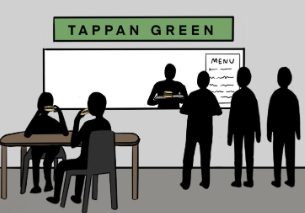
The school restaurant will reopen in the fall of 2021 with the name Tappan Green.
The mouthwatering scents of freshly made food from Restaurant 108 have long been absent from the school hallways. Amidst the many challenges brought on by the pandemic and school construction, the high school’s student-run restaurant has endured a long period of uncertainty.
Preparations for the new restaurant are currently underway, with plans to present opportunities for learning through revised culinary courses and a wide range of new food choices for students. According to Career and Technology Education Curriculum Coordinator Brittany Stevens, the school restaurant, with the new name Tappan Green, will return next year.
“The restaurant went on hiatus this year, in part because of the new space being built and in part because of a teacher’s retirement and the pandemic,” Stevens said. “What’s been happening behind the scenes is that a group of us are planning to reopen the restaurant with a new look and feel.”
Construction for the new restaurant space is scheduled to be completed in July of 2021, but students and staff have already been preparing for the opening of the restaurant in the fall.
Culinary teacher Elizabeth Ricardelli said Tappan Green will open with many changes, including a focus on rebranding.
“Nothing is a hundred percent set in stone. I’m excited for all the planning that’s going around it. I think that there’s so much we can do.” Ricardelli said.
Sophomore Martha Bialek is among a group of students currently helping Ricardelli with efforts to experiment with possible menu items.
“We are trying to make up new recipes for when we do get to work in the new kitchen. Every recipe is split into two weeks. One Wednesday we’ll talk about what works together, what recipes we think are good and we’ll test them,” Bialek said. “The next week, we’ll ask teachers if they want to try the food we’ve settled on to make. Then, they’ll give us feedback on what’s good or not.”
Other than the rebranding of the restaurant and a new menu, Ricardelli said the culinary teachers are revising the course sequence offered to students involved in running the restaurant.
“We are working towards creating a program where students can learn how to cook and run a restaurant, all aspects of it,” Ricardelli said. “We’d like to have the restaurant follow a pathway so that students could get the necessary experience they would need if they wanted to go on to culinary school or have a career in the industry.”
Stevens said the restaurant courses previously offered were very different from the restaurant pathway that will be available for students to take next year.
“As it has historically existed, the restaurant was focused on teaching students cooking skills. You sign up to be in the restaurant class, and you learn to work the point of sale, help customers, and make food,” Stevens said. “In our reimagining, our ultimate goal is to break down the wall between the restaurant as a class and the restaurant as a business.”
According to Stevens, the restaurant pathway presents multiple real world learning opportunities for students to expand their knowledge of running a business.
“We’ll talk about all of the things that real restaurants talk about in terms of how we’ll create a brand identity so we are recognizable to people in the school. Those are things we’re going to hope that students will help us with,” Stevens said. “We want to get students involved in thinking about the menu items we should offer, local vendors we could get stuff from, how to price items, and learning about trends in the restaurant industry.”
Stevens said culinary teachers are prepared to bring students into the fold of making management decisions for Tappan Green as the pathway launches soon.
“It’s been a few years since we’ve had a core base of students working there, but once we started to have students who’ve been with us for a couple years, we want them to show us how they want to learn from the restaurant,” Stevens said. “It’s a lot of exciting work, and we’re just going to take baby steps. Next year, you’ll see us open with a pretty standard menu. Then, each year after that you’re going to see us expanding.”
We are excited to announce upcoming investments in teaching and learning at BHS: two brand new courses will launch, four courses will continue through their final year of funding, and faculty will have the opportunity to reflect on pedagogy in the pandemic year at an upcoming summer summit. We are grateful to our generous donors whose support enables us to work with BHS leadership and faculty to fund these important programs.
Rethinking the Restaurant: Creating Community through Social Impact (NEW COURSE) $66,000 Year One Investment
Rethinking the BHS restaurant will integrate the program more cohesively into curricular and co-curricular experiences for the entire BHS community, with students taking the lead in running its business operations in meaningful and creative ways. Faculty are excited by the multifaceted opportunities for innovation where the restaurant has potential as a lab for interdisciplinary learning with a social impact lens. For example, the restaurant could be a place where English Language Learners could introduce dishes from their home cultures as a special menu item; World Language teachers and students could work with the culinary program to design “take-over” menus for cultural observations or holidays; and students in Social/Food Justice or Environmental Action clubs could team with our culinary program to understand and improve how to sustainably run our business. Rethinking the Restaurant opens up outstanding experiential learning opportunities for students not only in the restaurant itself, but also for a diverse range of students in clubs, courses, and throughout the campus. Faculty lead: Britt Stevens, Chair, Department of Career and Technical Education
Climate Science and Social Solutions (NEW COURSE) $43,000 Year One Investment
Climate Science and Social Solutions is an interdisciplinary team-taught elective with instruction from both the scientific and historical perspectives. The course will enable students to engage in project-based learning by analyzing real world policy options related to climate change, and then research and posit definable and effective solutions. The goal is to have seniors engage in advocacy campaigns designed to shape perceptions on climate change and encourage personal mitigation strategies. Faculty leads: Briana Brown (Science) and Roger Grande (Social Studies)
Faculty COVID-19 Reflection Summit $10,000 for BHS faculty to convene this summer to reflect on lessons learned through the pandemic and how their important work funded by our COVID-19 Teaching and Learning Response Grants this year can inform pedagogy for 2021-22.
Continued Funding for Ongoing Courses $186,000 for continued funding for four pilot programs through their final year in 2021-22: Experiential Physics for Ninth Grade; Brookline Lens; Hub; and Coding @BHS. Learn more about these programs here.
As we wrap up the last of the end-of-year BHS traditions, congratulate the Class of 2021 and look forward to the summer and together-time with friends and family, I just want to take a moment to reflect on this extraordinary year.
This past year—my last as Chair of the Innovation Fund—was both challenging and rewarding. Fund volunteers have been working harder than ever to use the time and space that we were given to think differently about how we engage our donors in a remote environment, and how we expand on the funding that we give to BHS faculty to support teaching and learning at the high school.
Our primary focus this year has been on our COVID-19 Response Grants. Our COVID grant work started last June to prepare faculty for the upcoming school year and continued through the winter to support the shift to hybrid teaching and learning. It will culminate this summer with the COVID-19 Reflection Summit. The best practices and insights gleaned during the three phases of the COVID-19 grant will be carried forward to continue to positively impact students.
Our collaborative work with faculty has yielded stronger relationships and set up scaffolding for school-wide student success moving forward in a post-COVID classroom environment. A cohesive, new standard approach with all faculty using Canvas improved communications with students and made a huge difference in “equalizing” everyone’s experience. This work led to the creation of multiple progress reports for check-in with parents/guardians throughout the year. Intentional instruction on Executive Functioning (EF) helped students develop the skills needed both online and moving forward to in-person learning. And finally, an emphasis on SEL (Social Emotional Learning) and community building online made being back together now very meaningful.
The COVID-19 Response Grants allowed faculty to innovatively rethink teaching, curriculum development, and school culture as they responded to challenging logistical scenarios throughout the year. Interdepartmental collaboration last summer was groundbreaking and culture-shifting for BHS. Now as faculty emerge from remote and hybrid teaching, annual assessment of student content, SEL and EF are much more collaborative across departments and are more efficient and effective. The three phased COVID-19 Grants provided the faculty with the time and space to think and plan which was the impetus to this change. This time also provided an opportunity to reevaluate curriculum and to think about what worked and what didn’t. These are conversations that faculty will continue to have during the upcoming summer COVID-19 Reflection Summit.
As we look forward to the Fall, the investment in teaching and learning will continue. Two new programs were accepted for funding and will launch in the 2021-2022 school year. Briana Brown (Science) and Roger Grande (Social Studies) will lead Climate Science and Social Solutions; and Britt Stevens, Department Chair of Career and Technical Education, will launch Rethinking the Restaurant: Creating Community through Social Impact.
Climate Science and Social Solutions is an interdisciplinary team-taught course with instruction from both the scientific and historical perspectives. The course will enable students to engage in project-based learning by analyzing real world policy options related to climate change, and then research and posit definable and effective solutions. The goal is to have students engage in advocacy campaigns designed to shape perceptions on climate change and encourage personal mitigation strategies.
Rethinking the Restaurant will launch the restaurant program as a lab for interdisciplinary learning with a social impact lens. This is a space where English Language Learners could introduce dishes from their home cultures as a special menu item, where World Language teachers and students could work with the culinary program to design “take-over” menus for cultural observations or holidays, and where students in Social/Food Justice or Environmental Action club team with our culinary program to understand and improve how to sustainably run our business. These are only some of our curricular aspirations.
So, as you can see, the BHS Innovation Fund continues to have a broad and meaningful impact at BHS, despite the challenges of the past year. It is because of the incredible support of donors and volunteers that we were able to meet and exceed our fundraising and programmatic goals. I look forward to handing the leadership of this amazing organization over to Maureen Fallon and Masu Haque-Khan who will continue the work that was started more than 20 years ago. While I will be stepping down as Chair, I will continue to play an advisory role in the growth of the Fund.
I wish you all a wonderful, peaceful and safe Summer and send a hearty congratulations to the Class of 2021!
Warm Regards, Ellen Rizika, Chair, BHS Innovation Fund Board of Directors
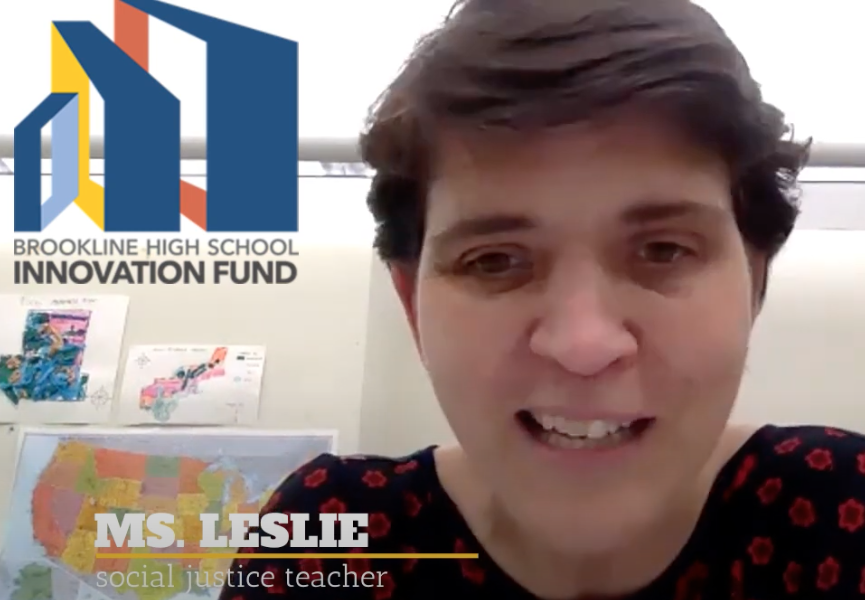
Kate Leslie, who teaches Social Justice, updated the BHS Innovation Fund recently about the course. First launched over fifteen years ago with a grant from the Fund, the Social Justice elective explores issues of equality and discrimination with regard to race and sexuality, and prepares students to become social justice activists. Social Justice is open to students in 10th-12th grades. Read more about this on our Programs page and in the BHS Course Catalog.
Video by BHS student Sasha B. for the Brookline Lens class. Brookline Lens is a student-run business that provides photo and video production services to BHS and the community. Lens is currently in its second year of grant funding from the BHS Innovation Fund.
Q: What excites you most about the course?
KL: There are special issues affecting the world right now that are constantly changing. Every year they are different so there is always something new to discuss which grabs students’ attention, issues they really care about. Often students find their passion and in turn their careers.
Q: Do students learn certain skills and information that they can apply to the real world?
KL: Students in the course hold many different beliefs and perspectives and care deeply about different issues. The course teaches students how to have difficult conversations in a constructive way and respect different ideologies which are crucial life skills.
Q: Do students need to meet certain requirements in order to take the course?
KL: Students have to apply to the course and write two paragraphs; one describing an issue they care about and one describing something they followed through on. I am looking for students who are reliable, would be good ambassadors, feel passionate about certain issues and want to learn. I also want a well rounded group with varying interests and who bring different viewpoints to the table.
Q: What do you think former students would say is the most important thing they learned from your course?
KL: I think former students would say that social justice can be applied through various passions, such as through business, art, theatre, science, etc. Carrying the social justice work on can mean different things, it doesn’t just mean holding a placard at a protest. Also, social justice takes time to achieve change; it requires patience and often the process takes longer than expected. This is an important lesson for students to learn, especially in a society where we are used to and often expect instant gratification.
This winter, the BHS Innovation Fund is raising $50,000 to support the next phase of our COVID-19 Teaching & Learning Response Grant program in 2021. We can respond to these kinds of emergency requests from our school leadership and teachers thanks to your continued financial support. We are so grateful to those who have donated to the Fund in the past and recognize the value of investing in public education.
The next phase of grants will be used to support teachers as they continue to provide a positive and successful remote/hybrid learning experience for students at BHS.
The first new grant provides funding for faculty to augment and enhance the BHS Remote Learning Toolbox Website, a teacher-created online resource designed to help staff educate students effectively in a remote classroom environment, and to identify additional innovative pedagogical tools and ideas in response to the changing academic environment and shift to a remote/hybrid classroom. The Toolbox was a direct outcome from our initial COVID Response Grant, and has quickly become an invaluable resource for teachers. It will be a critical asset moving forward.
The second grant will support individual faculty with innovative ideas that will contribute to their individual teaching and will be shared with colleagues across BHS.
By contributing to the BHS Innovation Fund, you are supporting our teachers as they continue to deliver a BHS education that fosters flexibility, resilience, curiosity and inspiration in the classroom. Your support is so meaningful, especially right now when creative and thoughtful approaches in education matter. We hope you will consider making a contribution this year.
A donation in any amount makes a difference and demonstrates your commitment to academic innovation at BHS. Please help the BHS Innovation Fund respond to teachers’ needs by donating now to help us fund the next immediate phase of our COVID-19 Teaching and Learning Response Grant. Thank you!