In 2019, BHS launched
Experiential Physics, a three-year pilot program to develop a new curriculum for 9th grade Physics, supported by a grant from the BHS Innovation Fund. The redesigned course develops scientific, engineering, and entrepreneurial skills and teaches students collaborative, real-world approaches to designing solutions to today’s scientific problems. We caught up with three physics teachers,
Julia Mangan,
Jennifer Spencer, and
Stacy Kissel, who shared their views on the new Experiential Physics course curriculum and teaching approach. Their collective insights are captured in the Q&A below.
Q: Why was it important to redesign the physics curriculum?
State standards and practices now call for an increased focus on the skills students develop in 9th grade physics. As a result, we were inspired to reimagine learning in 9th grade physics to be more applicable to physics in the real world! Our approach has become less teacher-driven and more student-focused. We attended two intensive training seminars to learn more about the Modeling Approach to teaching physics and how to teach students to work together collaboratively, take risks, and communicate productively.
Students will participate in a variety of projects, activities and labs to give them a broad sense of what it means to “do” science—this emphasis was missing from our previous curriculum. We are developing the “story of physics” through multiple lenses including student learning through content, skills development, and the many different “hats” students wear throughout the year.
Q: What are some of the new ways you are covering physics material?
We wanted students to learn physics through doing and not just learning facts, placing greater value on the process of science. We’re spending more time teaching students more explicitly how to ask questions like scientists do and how to answer them right in the classroom. We’ve added more hands-on experiments in which students test hypotheses and carry out procedures, analysis of data, and online research.
We have created and piloted a new project across the 9th grade asking students to apply content learned in the waves unit (sound, light, etc.) to explain how organisms use waves to communicate and sense the world around them. Students can take a deeper dive into how the content connects to the real world, both with how human ears and eyes work as well as how other organisms have evolved different ways to use sound waves and light waves for sensing and communication.
We will also be doing a unit on nuclear physics at the end of the year. This is a topic we have not previously taught to freshmen.
Q: How does the new curriculum impact the experience of students?
The goals for student learning are to push beyond learning about science and to focus on learning how to do science. This involves many skills that scientists employ, such as learning how to ask good questions, using discussion skills to make good predictions, designing experiments that answer their questions, using research tools to see what other researchers have learned, and creating mathematical and computational models that describe the real world for the purpose of answering questions.
We’ve received informal feedback from students that they love learning this way! We are regularly hearing students refer back to the common experience of each unit as they make new connections that push their understanding deeper.
Our activities and projects are designed to better meet the needs of all students regardless of background knowledge. For example, students who typically aren’t engaged in the learning of science, but loved tinkering with circuits, spent time creating a complicated device that worked in unique and challenging ways.
Q: What have you learned in the first few months teaching the new curriculum?
It has been so exciting to have the time and opportunity to be creative in defining this shift in science instruction!
We’re still trying to cover the same breadth of physics material but deeper learning requires more time for students to both learn and practice the skills of a scientist. Students seem excited to apply their knowledge through in-depth projects (so far, building a complex working circuit and researching an organism’s ability to create and use sound/light waves).
Rolling out a new curriculum has pushed us to collaborate more closely across our 9th grade physics teachers to create a more consistent experience for students. We’re creating a central place and strategy for documenting the what, the how, and the collective wisdom of the physics department. We have managed to capture most of what teachers are doing in their classrooms and, in year 2, we will evaluate and refine this documentation.
Q: How will the BHS expansion with updated classrooms and the new STEM wing support this course?
The new classrooms will be larger and more effectively designed than the previous ones at BHS. Desk seating will be in the middle of the room and tall lab tables will be located around the perimeter. Separate instruction and lab work areas will allow students to set up and leave long-term experiments, or exploratory stations, out and accessible in the classroom for longer periods of time. This will provide students with more opportunities to explore something in the beginning at the surface level, and then go back to it throughout the unit as they learn more and are able to ask deeper questions.
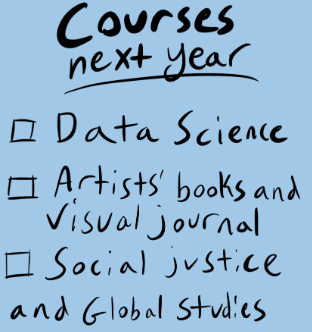
The School Curriculum Subcommittee met to discuss the implementation of future classes for the 2022-3 school year.
The Brookline School Curriculum Subcommittee Meeting convened virtually via Zoom on Jan. 18 at 4 p.m. to discuss the introduction of new courses and adaptation of current courses for the 2022-23 school year to improve diversity and access at the high school.
Mathematics Curriculum Coordinator Joshua Paris presented a proposal for a new course at the high school: Data Science and Social Justice, which would focus on social justice issues and introduce students to gathering related data, making models and presenting.
Paris said the aim of the course is to tie math into real-world application, something that students have expressed an interest in.
“A number of teachers have incorporated social justice lessons into their curriculums this year, and the feedback we are getting from students is really positive,” Paris said.
Paris said the course will be open to all students and taught using complex instruction, a type of teaching that focuses on group work and collaboration.
“Complex instruction is a way to make sure that all students have a social standing in a class. It’s a belief that all students have something to bring to a group,” Paris said.
Visual Arts Curriculum Coordinator Donna Sartanowicz presented a new visual arts course called Artists’ Books and Visual Journals. Sartanowicz said the course focuses on expression through creating visual journals which can provide students with an outlet for expression.
“A visual journal is a place where you can practice, you can collect images and think about things. You can experiment with your ideas, and it’s a very open way to work,” Sartanowicz said.
Sartanowicz said she found low enrollment numbers and course success from underprivileged communities after looking at data from other visual arts courses.
“We need to do some work on building the diversity of our classes. We want to make sure we are teaching all students; we are making a variety of moves to bring that diversity and equity about, and [the course] is just one of those moves,” Sartanowicz said.
Social Studies Curriculum Coordinator Gary Shiffman presented the concept of a pilot Social Studies class, Global Studies, for the 2022-23 school year as a 10th grade world history course.
Currently, all students in 9th grade take the unleveled World History: Identity, Status, and Power (WHISP) course and choose from either standard or honors World History II for 10th grade. Like WHISP, Global Studies would have students taking both standard and honors credits.
Global Studies would revolve around themes, and Shiffman said that although this can lead to confusion around the timeline of events, it allows for students to form personal connections with class content and understand impacts on the present day.
“In a thematic-based course, you can get to the present and teach the past as a precursor in a way that is illuminating that past for students,” Shiffman said.
According to Shiffman, the Global Studies course would allow differentiation within a class to be based on performance instead of pre-determined labels.
“Traditionally, students sign up for an honors or standard class and there is no way to make it not feel like identification. The fact is you’re buying a ticket, and you buy the premium ticket or the not premium ticket” Shiffman said.
Science Curriculum Coordinator Ed Wiser updated the subcommittee on the process of making AP Physics courses more accessible to students by merging two AP Physics: AP Physics I & II and AP Physics C. Wiser said additional planning is required for the start of the merged AP Physics course next fall.
“We’re trying to figure out how we can restructure those first few units of AP Physics so that we can make the onboarding a little more intentional,” Wiser said.
Students and teachers benefit from consolidating courses with multiple levels in the high school, Wiser said.
“Every single time that we’ve taken courses with many levels, as soon as we’ve collapsed those, scores were the same or even better, and access was increased,” Wiser said. “Every single time we’ve reduced the number of levels, we’ve always seen success, and the other interesting part of this is that you get teachers who are able to collaborate more.”
The subcommittee plans on voting on the proposed courses at their next meeting on Feb. 3.
Anisa Sharma and Nate Parry Luff | January 20, 2022
ROSA CARAMAZZA/SAGAMORE STAFF
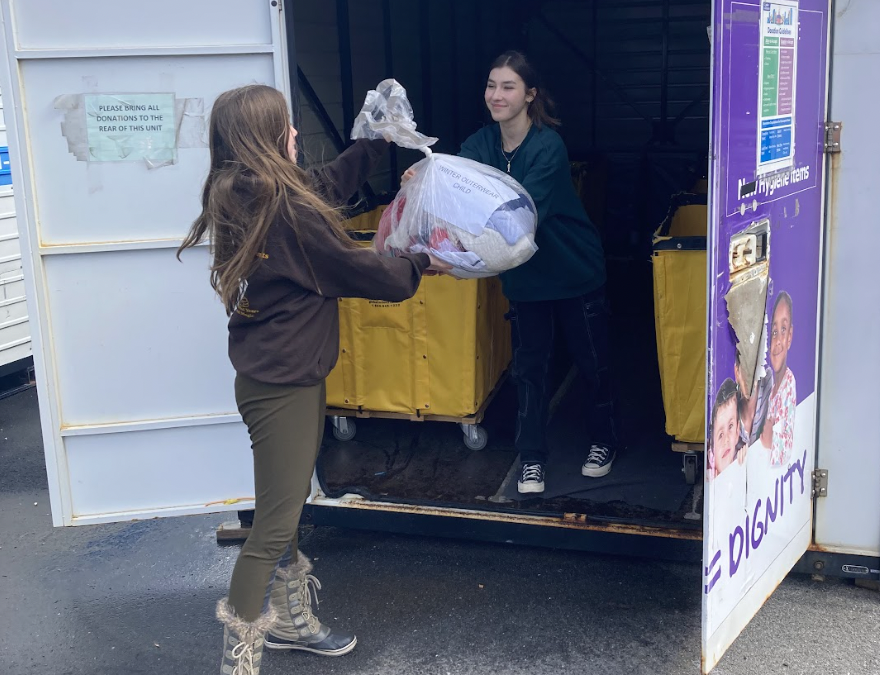
For members of the Turkish and Syrian diaspora, Feb. 6 will mark a day of mass destruction and devastation. The 7.8 magnitude earthquake along the Turkey-Syria border left millions displaced, thousands dead and put reconstruction costs in the billions.
Within a week of the disaster, students in Global Leadership, an elective course designed to educate students about modern-day challenges across the world, shifted their efforts to aiding the crisis. The class organized fundraisers, set up donation centers and spread awareness around the community.
Sophomore Sasha Harwin, a student in Global Leadership, said that despite the project being teacher facilitated, students took initiative and led the fundraising process.
“When we learned about the earthquake, we dropped everything else and immediately started to brainstorm ways we could help Turkey and Syria. Going in, we already knew there were going to be donation aspects, but we also wanted to put a big emphasis on spreading awareness around the school,” Harwin said.
Due to the urgency of the issue, the class had minimal time to prepare and organize logistics. They ultimately broke up into four separate groups to cover all bases: awareness, publicity, in-kind donations and monetary donations. Harwin said that each student was able to choose their own group, and everybody remained passionate about their work.
“The whole thing came together so fast and everybody stayed accountable,” Harwin said. “It’s a real and dire issue, so everyone was willing to help out in their free time.”
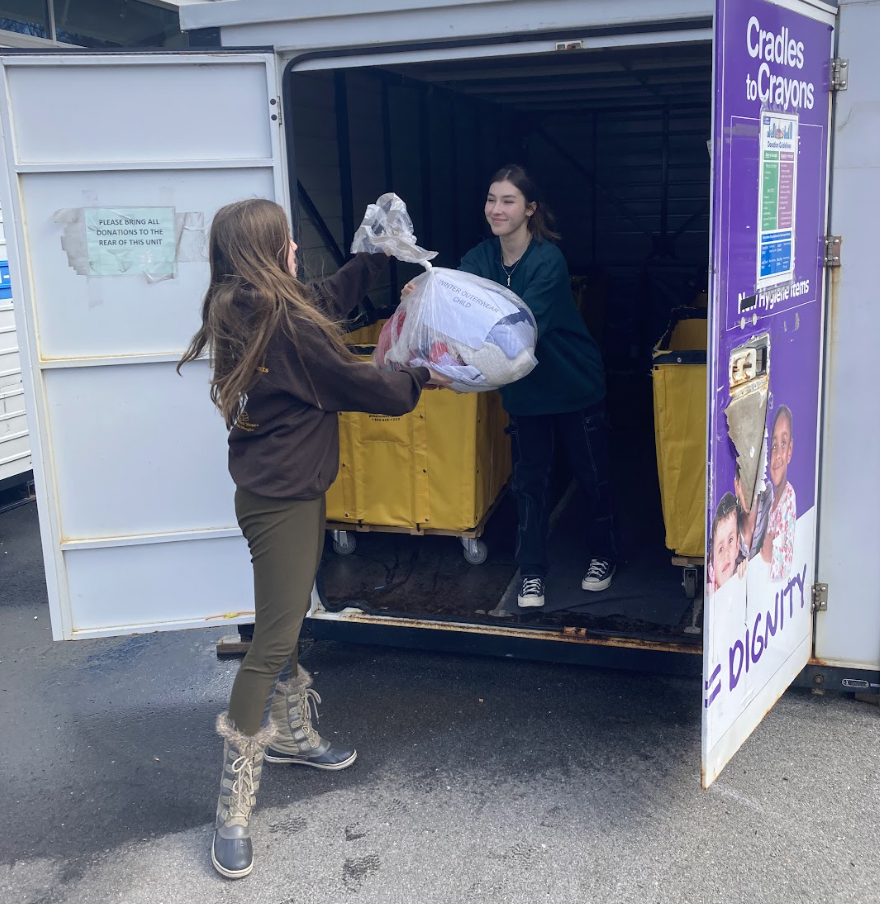
Harwin was a member of the awareness team, and gave presentations to World Language classes to generate more attention on the issue. Harwin and her team also reached out to all Brookline Public Schools to set up more donation centers. Despite only successfully connecting with Baker and Florida Ruffin Ridley school, she said that the team still managed to amass nearly twenty large bags of clothes, tents and blankets.
The class initially planned to send the in-kind donations to the Turkish embassy; however, their recently updated donation requirements forced the group to look elsewhere to donate. Harwin said that although she is disappointed with the unexpected change, she is still happy to know that they are able to donate everything to Cradles-to-Crayons and On-the-Rise, two local and dedicated organizations.
“It still feels so empowering because for most projects we do, we just talk and learn about big disasters in the world, but this felt so real because we’re actually going to make a difference for the first time,” Harwin said.
For junior Yoni Tsapira, a member of the monetary donations team, fundraising was also a new experience that he said will stick with him. His group managed to raise over $9,000 dollars through a GoFundMe page in two weeks and was only a few hundred dollars short of their ten-thousand dollar goal. He said that the GoFundMe is still active, but the class is planning to deposit their donations to UNICEF soon, a United Nations agency dedicated to providing humanitarian and developmental aid to children.
“It’s really cool to know that we as high school students can have a real impact,” Tsapira said. “If you think that you’re just a teenager and can’t do much, well, you can—because we just did something.”
Global Leadership teacher Roger Grande said that overall, he considers the fundraising efforts to be a major success for reasons beyond just the money raised.
“It was great that we achieved our goal, but it was so powerful because the students saw what they could do; it was both a real life effort and a classroom effort,” Grande said. “What I wanted them to take away from this project is what I want them to take away from this class in general: that they are insightful, their thoughts are real, and that they are powerful; that they are changemakers.”
Sophia Su, Staff Writer https://thecypressonline.com/ | April 7, 2023

Roger Grande and Briana Brown have worked together to design a course that helps students fight climate change through both scientific and historical education.
Only 42 percent of teachers across the country are teaching about climate change, according to a NPR poll from 2019. However, science teacher Briana Brown and history teacher Roger Grande are pioneering climate change education at the high school with their new class on climate science and social change.
Brown and Grande started teaching the new Climate Science and Social Change class this fall. The class addresses the urgency of climate action: it gives students the political skills to make change in the community and a richer understanding of the climate crisis by covering historical and scientific content.
The class is the product of frustration from both teachers who are passionate about helping younger generations fight for their future. Brown said she was losing hope after teaching about climate change in her science classes for 12 years without significant change in the news.
“Collectively as a species, we really have not done anything that we need to do. There’s a little progress here and there. I was starting to feel really pessimistic,” Brown said.
Grande said he felt a personal sense of urgency in combating climate change.
“I think about how [my daughter’s] future is going to be a very different experience than my life so far and climate change is a major driver of disruption that she’ll be experiencing,” Grande said.
Brown said that the class develops both scientific and political skills. On some days, students learn about the science behind climate change’s effects while on others, they learn tactics to convince lawmakers to make policy changes.
“We really want to approach climate science from multiple dimensions,” Brown said.
Senior and student in the class, Evan Guttel, said the Climate Science and Social Change class is unlike any other class he has taken because of its historical and scientific duality.
“I think even in a town like Brookline where a lot of people are very cognizant of the issues surrounding climate change, having a class on it is very necessary and applicable because it’s going to affect all of our lives,” Guttel said.
According to Brown and Grande, climate change requires social action so teaching political skills is necessary to tackle the climate crisis.
“It’s not about the science that’s going to persuade people: it’s the politics,” Grande said.
From the class, Grande said he wants students to have a solid understanding of the science behind climate change as well as the skills to talk about it in a more political setting.
“I want students to become confident and competent climate communicators,” Grande said.
Both Grande and Brown are working hard to increase their influence on the community through training activists who can educate the school community on the climate crisis.
“I feel better that I’m going to be training people to be activists for change,” Brown said. “I can magnify my impact because hopefully a few people at least will go out into the world and start to do these actions that need to be done.”
Lia Fox, Staff Writer|November 13, 2021
GRAPHIC BY LIA FOX
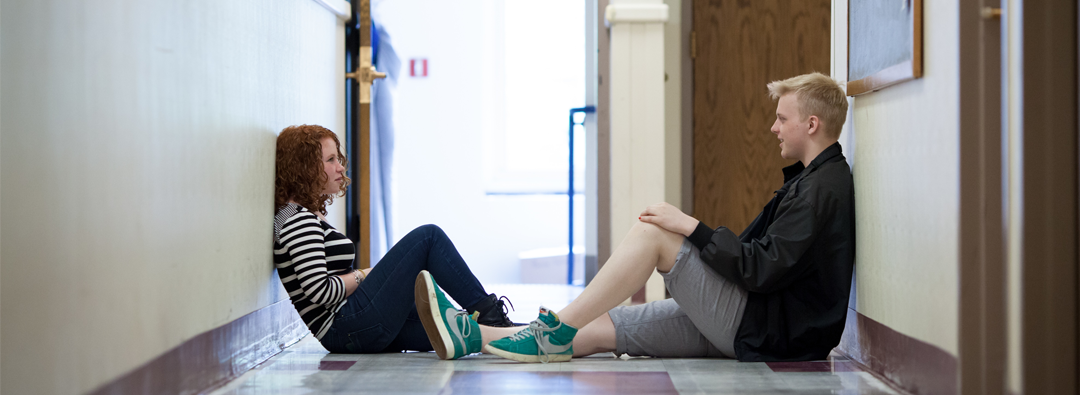
 Brookline High School alumna Maya Rozen interviewed current students about their experiences participating in BHS Innovation Fund courses. Hear the impact of the Innovation Fund at BHS in the students’ own voices.
Many of the courses offered at BHS revolve around a curriculum that students are required to take, which is why many students relish the academic opportunities that grant them more freedom to explore other areas of study more on their own terms. For students interested in engineering, Engineering by Design is a great class that allows students to explore different areas of engineering and design and to pursue projects that they are passionate about. Other classes like Social Justice and Racial Awareness provide a safe space for students to learn about important topics with the freedom to share their own thoughts, experiences, and beliefs. Many of these classes allow students to explore new subjects that aren’t always covered in the required curriculum.
In your opinion, what makes your Fund class different compared to your other classes?
“Something that stood out to me about the class was the amount of freedom we had because I kind of expected it to be really structured with a lot of rules, but I found that with all of the projects there was a lot of room for our own ideas and a lot of room for creativity, which I liked.”
~Sarah S., BHS ’21, Engineering by Design
“I think since you have to apply, everyone who is in the class is really interested in social justice and wants to be there. It’s not like people are taking it just to check it off the list or just to say they took it. I can see people who were in my class that are now doing things on their own time, whether they have an internship, or they’re volunteering, or they’re just doing research and finding ways to work on the issues that we learned about. I also think that since everyone wanted to be there, people really opened up because we’re all so passionate about it. Everyone’s open to hearing the perspective of other people who are passionate and I think a lot of that comes from Ms. Leslie because she has so much passion. You can see when she’s teaching that she wants to be there so much and she wants to give us all this knowledge of what is actually happening, and then give us the freedom to talk about what we think, and that is something that I often don’t find in a class.”
~Aine D., BHS ’21, Social Justice
As a ninth grader entering BHS, the thought of graduation seems as if it is a million years away. Freshman and sophomore years pass by in the blink of an eye, and then suddenly you’re in your junior year and it’s time to begin figuring out what your next steps will be after you graduate high school. Some students go through high school with a clear idea of what those next steps are whether it’s pursuing a certain career or studying a specific major in college, but for many students this is not the case. Having the opportunity to try out different classes can expose them to new subjects and inspire new interests. Many students find that classes like Social Justice can lead to new interests that they are excited to continue pursuing after high school. Aside from exposing students to new topics, these classes also teach students very valuable skills that they don’t always learn from their required courses. Tutorial helps many students learn how to better manage their time and their work, teaching them valuable skills such as organization, time management, and how to plan out their week. Other classes like Racial Awareness can help students feel more comfortable going out of their comfort zone through being exposed to new points of view or learning how to have tough conversations. All of these skills are very important to have during their time at BHS and beyond.
How has the class shaped who you are as a student? How have you grown as a result of this class?
“As a student, I noticed as I was taking this class that before I tended to make more assumptions about people, and this class has helped me think about the reasons I’m doing that and how not to act on those assumptions, and I think I definitely have grown from taking this class.”
~Kate C., BHS ‘22, Racial Awareness
“I think I’ve grown a lot in the way that I feel like I can voice my opinions more if someone brings up an issue. I feel like I have the knowledge and the power to actually voice my opinion because I’ve learned about it. I think that a lot of times now I’ll hear conversations going on and I’ll actually know what they’re talking about which I think is really cool because I can participate in the conversation. Now more than ever I feel like I can help. I have so much of an understanding of what’s going on, so I can really help and try to help other people try to understand what’s going on.”
~Zoey F., BHS ‘22, Global Leadership
“I think I’ve grown in my abilities to ask for help and to make sure that I have a plan for the week for my assignments and projects and when I should be doing them. I think my experience would be a lot harder, I would be less organized, and I don’t think I would get as much work done without tutorial.”
~Declan T., BHS ‘22, Tutorial
“I think that I’ve been able to want to have the uncomfortable conversations. A lot of times people don’t want to talk about a certain thing because they know people have conflicting points of view or that it affects someone personally and they don’t feel like it’s their place to talk about it. This class made me realize that you can have a voice, but it’s also really important to listen, and listen to the uncomfortable conversations and be able to ask questions and be able to talk about it even though it might be uncomfortable.”
~Aine D., BHS ‘21, Social Justice
Many classes like Global Leadership and Social Justice offer students the unique opportunity to learn about current, important topics while simultaneously engaging in real world problem solving and solutions. Fundraisers, volunteering, and peaceful protests are some of the many ways where students can feel like they are not just doing the important learning, but also feel like they are making a real difference and contributing to the solution.
Can you describe some of the most memorable parts of the class and talk about a couple of your favorite assignments?
“We were having a lot of meetings and conversations about the Black Lives Matter movement. We got to talk about them as a class and getting to hear from other people about what they’ve been doing and how they’ve been using the things that we learned from this class to contribute to this movement was great.”
~Kate C., BHS ‘22, Racial Awareness
“I think a lot of people will say this but definitely learning about the incarceration system. The prison trip is always something people talk about for a really long time. I was excited about the trip because I think the incarceration system isn’t something that we see on the news every day. When I sit down to watch the news, I don’t see them talk about all the oppression and discrimination that exists in the incarceration system. I think that it’s overlooked a lot so I really wasn’t aware of what was happening in the system, and being able to go to a prison and then talk to inmates was really cool because we could hear their first hand experiences and they were really honest. They talked about the guards there and how they’re not nice to them and what it’s like in solitary confinement. They were just really really honest about what’s happening, and being able to see that after watching movies about the incarceration system and what happens was really powerful, so that was the night that really stood out to me.”
~Aine D., BHS ’21, Social Justice
“One of the assignments we did was called the TAP Challenge which was where we raised money for clean water in Nicaragua, and we did that by starting a school campaign to have everyone bring their own water bottles and not use plastic water bottles for 25 days. We sold reusable water bottles and tumblers and also stickers. I thought it was really cool because it really felt like we were making an impact instead of just learning about the issue. I actually felt like I was doing something about it while still learning about it in class.”
~Zoey F., BHS ’22, Global Leadership
The BHS Innovation Fund is pleased to announce the investment of nearly $300,000 for curriculum innovation at Brookline High School in the 2020-21 school year in the following program areas:
Pandemic Response and Faculty Support
Reacting with urgency to the unprecedented change in the educational environment due to the coronavirus pandemic, the BHS Innovation Fund spearheaded a Summer 2020 effort to provide robust grant funding for collaborative faculty work through the COVID-19 Teaching and Learning Response Grant. Thirty BHS educators from the Departments of English, Math, Science, Social Studies and World Language, as well as Special Education and Career and Technology Education, collaborated simultaneously over a three-week period to address academic skill gaps, assess remote learning, share best practices and create community-building plans for students. Teachers, department chairs and school administrators developed a cohesive vision and implementation strategy to ensure that the educational experience at BHS remains as strong and supportive as ever, even in these uncertain times. Read more about the grant impact here.
Foundations for Achievement and School-wide Reach
As the 2020-21 school year begins, the BHS Innovation Fund is excited to announce the launch of Coding @BHS, a school-wide initiative to embed computer science curriculum into all math and science courses at Brookline High School so that every student will graduate with a basic understanding of how to code through hands-on coding practice. This new grant is a collaborative effort from the Departments of Math, Science and Career and Technical Education. The timing of this school-wide initiative is aligned with the current construction of the new STEM wing at BHS. Part of the work that faculty will do, in examining the existing BHS curricula across departments, will also determine how coding fits in with other STEM courses and learning opportunities for all students. Read more here.
Innovative and Interdisciplinary Courses
The BHS Innovation Fund also continues to fund these innovative programs, which were launched at the start of the 2019-20 school year: Experiential Physics for 9th grade, a robust, new physics course that develops scientific, engineering, and entrepreneurial skills to teach students collaborative approaches to designing solutions to today’s problems; Hub/Advisory, an updated approach to school-wide Advisory that emphasizes community and connection among students and faculty; and Brookline Lens, a career-focused arts elective that gives students the opportunity to learn business management skills as part of a student-run production company that provides photography and videography services to the community. Read more here.

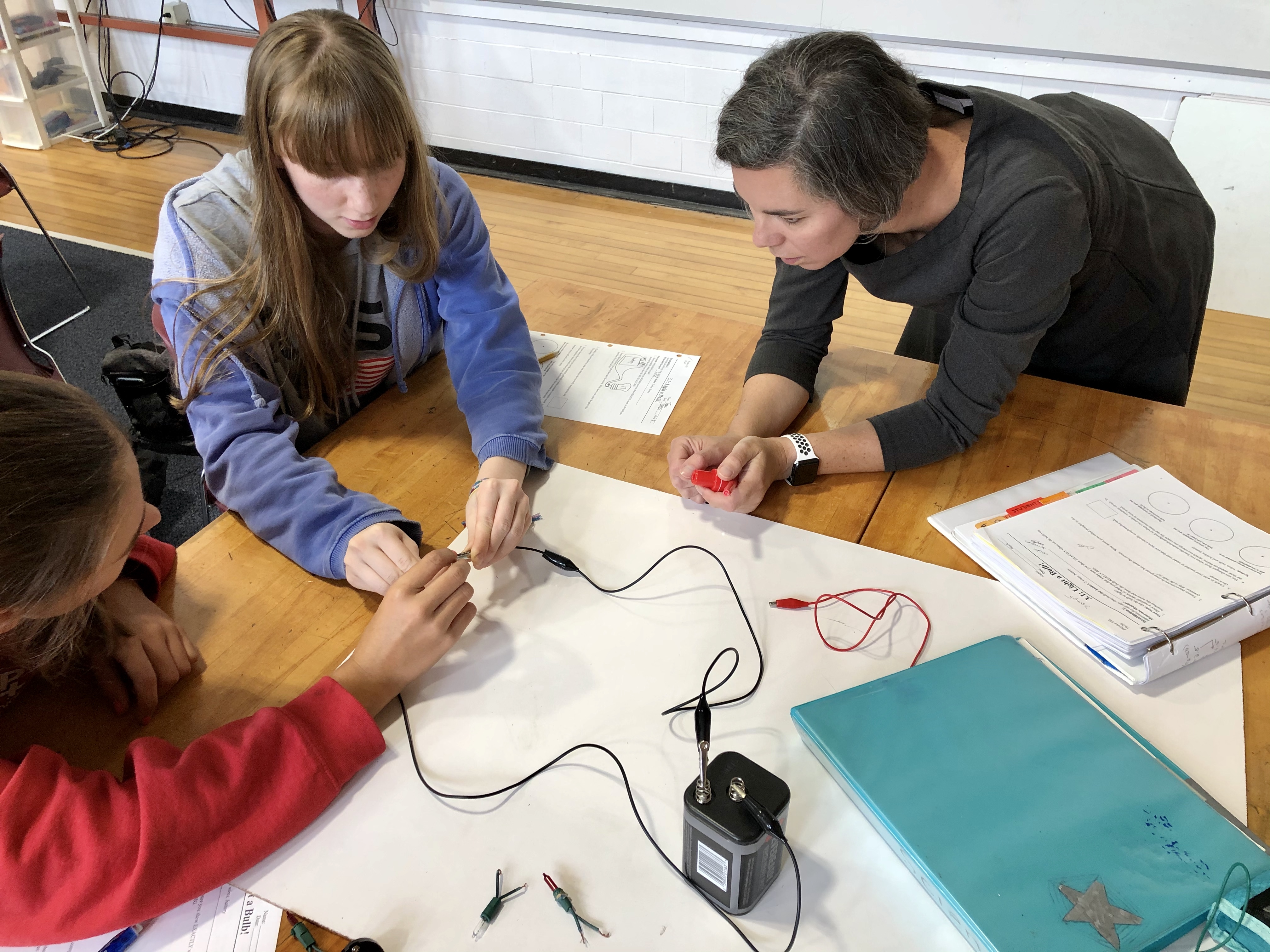 In 2019, BHS launched Experiential Physics, a three-year pilot program to develop a new curriculum for 9th grade Physics, supported by a grant from the BHS Innovation Fund. The redesigned course develops scientific, engineering, and entrepreneurial skills and teaches students collaborative, real-world approaches to designing solutions to today’s scientific problems. We caught up with three physics teachers, Julia Mangan, Jennifer Spencer, and Stacy Kissel, who shared their views on the new Experiential Physics course curriculum and teaching approach. Their collective insights are captured in the Q&A below.