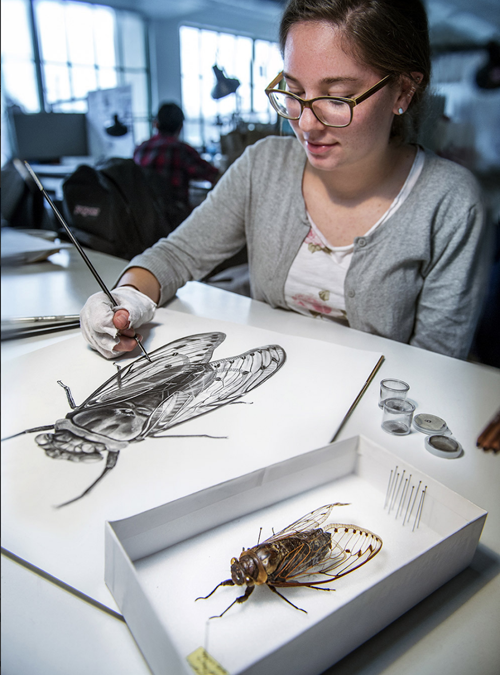
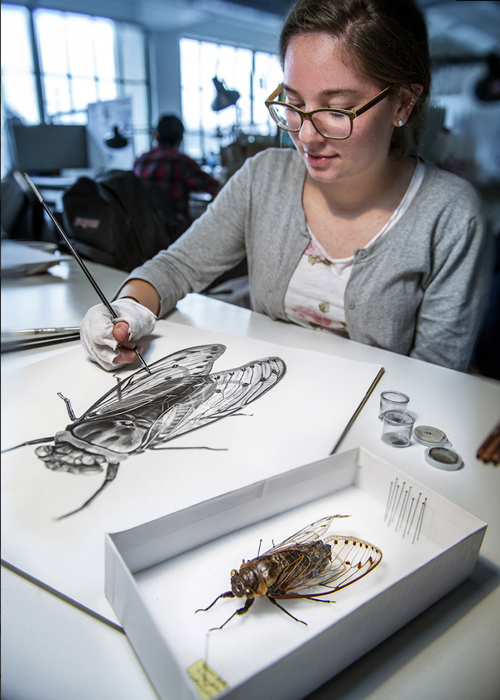
 BHS 2013 alum Siena Fried describes the impact of Innovation Fund class, “Drawing for Understanding in Field Science,” on her career.
In 2012, Siena Fried was a student in the pilot class of “Drawing for Understanding in Field Science,” supported by the BHS Innovation Fund. Siena had previously taken drawing and painting classes with BHS Visual Arts teacher Donna Sartanowicz, and saw the class as the perfect combination of her passions.
“I love biology, and I love art. This class was a way to do both.”
The class honed her skills and taught her how to observe something from real life and capture it on paper. Siena credits Ms. Sartanowicz for her mentorship and support in developing her portfolio for college applications. She also credits BHS for preparing her well for the Cleveland Institute of Art where she graduated in 2017.
Even better, the Innovation Fund class led Siena to her career as a biomedical artist. A biomedical artist, in many ways, is like a visual translator. As a bio-communication professional, Siena illustrates complex scientific concepts for research as well as the public.
Siena now works for a company in Newton that creates medical apps for students to help them understand human anatomy and physiology even before they touch cadavers, let alone real patients. “It’s safer and easier to have something digital,” she says. She also freelances for pharmaceutical companies. Patient education is a passion. She enjoys creating visual images for education materials that help patients understand procedures and make them less daunting.
Biomedical art has many avenues beyond medical education. A friend of Siena’s designs exhibits for a natural history museum. Attorneys use scientific illustrations to explain medical information to juries. Other medical illustrators specialize in certain areas like surgery or ophthalmology, or in types of media, like animation or 3D models.
Five years since taking Drawing for Understanding in Field Science at BHS, Siena remains enthusiastic about the class. Because her sister, a BHS senior, is taking the class and Siena keeps in touch with Ms. Sartanowicz, she knows that the class has evolved. “It was great when I took it, but it’s even better now,” she says. “I would retake it if I could.”
— Jennifer B. Wells
A 2018 Planning Grant for the Math Department
“The Innovation Fund provided the platform for the most inspiring experience of my teaching career,” says Julia Naimy, BHS 9th grade geometry teacher.
Thanks to an Innovation Fund planning grant, Ms. Naimy and two other teachers (Betty Strong and Adam Fried) had the opportunity to pilot a project-based learning unit that combined students in college prep (also known as standard), honors and advanced geometry classes. A key piece of the pilot was to design curriculum and assessments that valued all students’ strengths.
Spearheading the project was Bruce Mallory, a BHS math teacher for more than 20 years, the girls’ tennis coach and a mentor to Ms. Naimy through the Teachers Mentoring Teachers program, which was initially funded by the Innovation Fund.
Mr. Mallory has long questioned the value of homogenous (similar level) versus heterogeneous (many level) classes. A parent himself, he understands that parents want their kids to be both challenged and successful. And after decades in the math classroom he is well aware that tracking can be a hotbed issue. “We’ve all been teaching homogenous classes forever. The idea of this grant was to give us an opportunity struggle with and observe what it would look like to teach a chunk of content in a heterogeneous class.”
He credits the trio for setting up the classroom environment in a way that enabled the kids to get the best learning experience possible. Together with Josh Paris, the math department chair, the team carved out a three-week space to test what a mixed level class would be like. In the pilot, the teachers focused on the process of learning and on presentation skills. “That was exciting for the teachers,” Mr. Mallory says. “At the end of the day, memorizing the quadratic formula doesn’t make a difference in anyone’s life. What’s important is understanding how and when to use it.”
Working with the team was also a big plus for Ms. Naimy. “I collaborated with others that I hadn’t worked with before,” she says. “It was just great. I’m not sure I would have done it by myself. I also like that the Fund asked for a report, which formalized the experience.”
“This grant has moved us forward to continue these conversations,” Mr. Mallory says. “We know we can go back and knock on the Innovation Fund door again.”
— Jennifer B. Wells
“In the math department we have been having many conversations about the inequities that leveling creates. Many of us have long believed that we could create learning opportunities to meet the needs of all students in a classroom, regardless of their previous mathematical experiences. This Innovation Fund grant gave us the opportunity to put this belief into practice. This was a tremendously successful endeavor. By placing the focus of the class on collaboration and communication skills, the teachers were able to move all students forward in their mathematical thinking.”
Math Department Chair, Brookline High School
First, came a tragedy. In 1980, Andrew Warren Lurie, a Brookline High School graduate in his freshman year at the University of Chicago, died of an infection at school.
Years later, his parents, Bob and Syrul Lurie, came to Bob Weintraub, the headmaster of the high school, and explained that they wanted to create a memorial space at the high school in Andrew’s honor. They offered to pay to construct and furnish a beautiful library — named for Andrew — in School Within a School (SWS), which Andrew had attended.
The question was: could a public school use private money to do this kind of project? The Luries and Weintraub cited endowments for public colleges and universities as examples of spending private money for public institutions. The superintendent of schools, James Walsh, and the school committee supported the idea.
The Andrew Lurie Library exists to this day. And the project had an added effect: it sparked an idea. Weintraub recalls Andrew’s father, the late Bob Lurie, saying, “You know, if we can raise money for a room, we can probably raise private money for other stuff you need, Bob.”
A team from BHS visited the Boston Latin School and spoke with the headmaster, Mike Contompasis, and the school’s very sophisticated development team. Boston Latin actively solicited and cultivated their alumni — which included some very prominent and generous folks — and had built a multi-million dollar endowment. The Brookline team left Boston Latin saying, “We can do this.”
As this idea was germinating, two renowned senior teachers at the high school – Margaret Metzger and Gayle Davis — approached Weintraub to tell him that they were nearing retirement, and felt a need to create ways for seasoned staff to ease the entry for newcomers. Long story short, the plan for “Teachers Mentoring Teachers” was born. The teachers would be released from one of their classes so they could devote time to developing and running it, and their professional lives would be enriched. It wouldn’t be very expensive. Weintraub figured it would cost around $25,000. But that was money he didn’t have.
So he spoke with Bob Lurie and another prominent BHS grad and Brookline citizen, Arthur Segel, and a team began to coalesce around a goal — starting a private, non-profit foundation to support innovation at the high school. The Brookline Education Foundation already existed and was widely beloved for the awards and recognition it gave teachers — but its grants tended to be small.
“This was a very different idea,” Weintraub says. “This was to do big stuff, in the spirit of Brookline’s innovative history.”
“Local Solutions to National Education Challenges” became the mantra that defined the project. Brookline High would address important educational problems and develop compelling programs that, if validated, could be disseminated nationally. “Through this foundation, we can improve public education and simultaneously polish the mystique of Brookline High,” Weintraub argued.
After copious work by Lurie, Segel, and others, the Brookline High 21st Century Fund was launched with a gala in December 1998 at the home of a team member. The launch featured a star-studded list of speakers who graduated from Brookline High, including Mike Wallace, Mike Dukakis, Conan O’Brien, and Bob Kraft. More than 50 donors attended and kicked in $10,000 each. With $550,000 in hand, the “BHS 21st Century Fund” was born.
The Fund didn’t have much structure at the beginning, Weintraub says; it tended to generate ideas informally, focusing on problems and how to solve them. Teachers Mentoring Teachers was the first program and proof of concept. It was evaluated and validated, research conducted on the program was published in prominent national educational journals, and the program leaders — Margaret Metzger and Gayle Davis — presented to school systems across the country. Both Metzger and Davis acknowledged that their engagement with the program prolonged their careers at Brookline High by many years.
The Fund — now known as The BHS Innovation Fund — is celebrating its 20th anniversary. It has created 15 programs, including the nationally significant African-American and Latino Scholars Program, the Social Justice Leadership Program, and BHS Tutorial.
The Tutorial Program, which has also received national recognition, began with a research project. Weintraub saw that the only academic support/tutoring available at The High School was through the special education program. The “experiment” removed 40 students — the experimental group — from the special education Learning Centers and placed them with regular classroom teachers for tutoring. Forty other students — the control group — with similar academic profiles remained in the Learning Centers. The format for the services was the same — five students met with a tutor every day for one class period. Data was gathered over two years.
The results demonstrated that for students with mild learning issues, tutoring with regular classroom teachers — math, social studies, world languages, and science — was more successful in terms of academic data. Students in The Tutorial Program also reported feeling better about going into a mainstream classroom than a special education classroom.
For teachers, the program provided some professional variation, working with a small group of students in a different way, once a day. And for parents, it offered tutoring that they could not afford otherwise. Good for students; good for teachers; and good for parents.
In 2017, the Fund’s name was changed to the Brookline High School Innovation Fund, to more accurately reflect its mission. As it celebrates its 20-year anniversary, this mission continues to be not only relevant, but also paramount in supporting Brookline High School students as they enter today’s world.
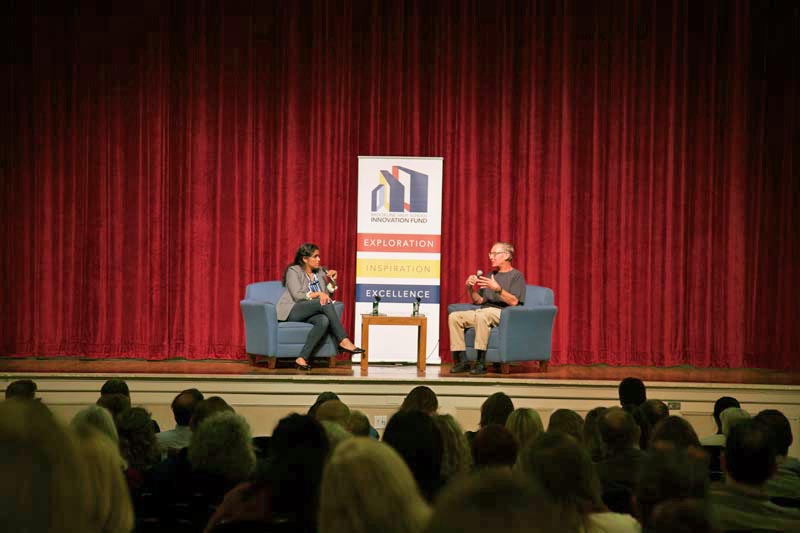
On Thursday, September 20, 2018, the Brookline High School Innovation Fund kicked off its 20th anniversary celebration with innovation expert and author Ted Dintersmith, who spoke about his new book, What School Could Be: Insights and Inspiration from Teachers Across America. The event was moderated by WBUR host Meghna Chakrabarti. More than 400 people, including parents, students, teachers, residents, administrators, and town officials from Brookline as well as attendees from all around Boston and the New England area, came to hear Mr. Dintersmith discuss key learnings and insights from his year-long experience meeting with students and teachers across the country.
The discussion focused on how to improve the current education system to meet the evolving demands of an increasingly innovative and rapidly changing world. Mr. Dintersmith shared his views on three core concepts that he believes can change the current teaching and learning paradigm for the betterment of students—trusting teachers to lead the way, letting students have a voice in their education, and aligning learning to what’s important in life. Mr. Dintersmith praised Brookline High and the Innovation Fund for leading the way by supporting teachers who champion innovative courses and initiatives that engage students and provide deep learning and a sense of purpose.
The author talk was the first in a series of events to celebrate the 20th anniversary of the Innovation Fund, which invests in new ideas, programs, and initiatives that foster a culture of innovation at BHS and prepare students to thrive in the 21st Century. The Innovation Fund is a 501 (c)(3) organization supported by private donations. All gifts are tax deductible.
Learn more about the Innovation Fund’s programs.
Donate to the Innovation Fund to support new courses and initiatives.
Read what The Boston Globe has to say about innovation at Brookline High.
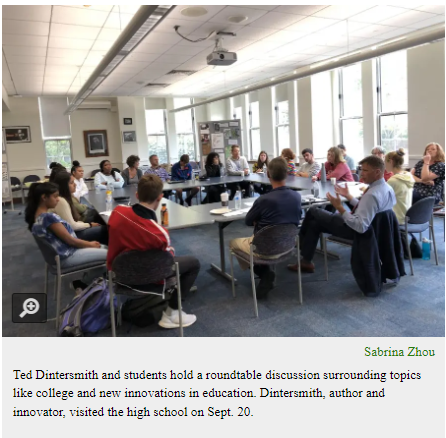
Ted Dintersmith and students hold a roundtable discussion surrounding topics like college and new innovations in education. Dintersmith, author and innovator, visited the high school on Sept. 20.
If you find yourself questioning the way Brookline’s education system is structured, you aren’t alone.
Ted Dintersmith, an advocate of innovation in education and author of What School Could Be, visited the high school on Sept. 20 during G-block. The visit was organized by the Brookline High School Innovation Fund, and it gave Dintersmith and 15 students an opportunity to discuss whether BHS is doing a good job for its students. Later that evening, Dintersmith led a second similar conversation, facilitated by WBUR’s Meghna Chakrabarti, in the Roberts-Dubbs Auditorium.
In discussing improvements needed in Brookline’s education system, Dintersmith and students focused specifically on the way students approached the college application process. In the conversation, Dintersmith and the students believed that the education system should do a better job of letting students explore options other than college and follow their interests more freely.
Dintersmith shared that an alternative to college – a gap year – can be a great idea, financially speaking.
listen “The gap year is for most kids, freshman year in college, where they spend 70,000 dollars to go to a bunch of parties and figure it out,” Dintersmith said. “I would say that most people think that a gap year is expensive; I’ve talked to kids that take a gap year who actually make money during the year, and for some reason people are just really reluctant to even think about that.”
According to junior Jasmine Benitich, with going to college as a norm, it can be difficult to approach alternatives such as a gap year.
“I grew up in a really strict household, so a gap year is never an option we have. It’s kind of a bridge to giving up,” Benitich said. “I don’t think I was ever taught in high school that a gap year is okay.”
Senior Ben Haber added that attending college is commonly what one has to do to succeed.
“There is the rare exception, like Mark Zuckerberg, who dropped out of college, but it is so rare and it’s so hard to ask students, ‘Why don’t you do something bolder, why don’t you do something different,’” Haber said. “I’d love to live in a world where we can all explore what we want to do, but we were born into a world where our education system has so much power.”
Dintersmith emphasized that if students are to go to college, it is important for them to know what they want to get out of their experience.
listen “It’s really easy to say, ‘I’m going to spend all college so that I can get the right job or graduate program. Then I’m going to spend those years so that I get into the right promotion,’” Dintersmith said. “You can do that for year after year after year and end up at my age and say, ‘I never did what I wanted to do.’”
Another area in which schools could improve, according to senior Eva Stanley, is encouraging students to follow their passions.
“Third grade onwards, we start to snap students into formulas, like ‘memorize this verb tense,’” Stanley said. “You get less and less flexibility up until the point in high school where you do have options to explore, but you become so afraid of how that’s going to impact your chances of getting into college, so you’re not going to take risks.”
Dintersmith believes that although college admissions tend to push towards the “routine and formulaic,” students should still remember to follow their interests instead of what everyone else is doing.
“Would you rather do the things you are passionate about and bring that to life in an essay or just keep checking off all those boxes?” Dintersmith said.
Sabrina Zhou
Yuen Ting Chow and Tree Demb

FOR IMMEDIATE RELEASE
Brookline High School Innovation Fund Presents:
What School Could Be – A Conversation About the Intersection of Education and Innovation with
Author and Innovation Expert Ted Dintersmith
WBUR’s Meghna Chakrabarti to Moderate this Free Community Event
September 20, 2018, 7:00-9:00 pm
BROOKLINE, Mass., August 9, 2018 – Brookline High School (BHS) Innovation Fund today announced it will host a conversation with innovation expert and former venture capitalist Ted Dintersmith, author of the new book, What School Could Be: Insights and Inspiration from Teachers Across America. The book offers an inspiring account of teachers in ordinary circumstances doing extraordinary things, showing what leads to powerful learning in classrooms, and how to empower teachers to make it happen. Moderated by WBUR’s Meghna Chakrabarti, the thought-provoking conversation will delve into how teachers can change the education system in creative, compelling and practical ways to positively impact students and better prepare them to succeed in the innovation economy and serve as responsible, contributing citizens.
The event, which is free and open to the public, will be held in Brookline High School’s auditorium (115 Greenough Street in Brookline, Mass.) on Thursday, September 20, 2018, at 7:00-9:00 p.m. Doors will open at 6:30 p.m. A reception will immediately follow the program. To register for the event, please visit here.
“I am incredibly excited for Ted Dintersmith to visit Brookline High School this September,” said Anthony Meyer, headmaster of Brookline High School. “As we celebrate the twentieth anniversary of the Innovation Fund, it makes sense to pause and push ourselves to think about the purposes of school, and how we can better develop students’ skills, agency, and knowledge that is both deep and retained. Ted Dintersmith’s What School Could Be builds on the most sacred relationship in schools: student and teacher. He shines the light on deep, meaningful learning that helps prepare young people for continued education and, more importantly, the broader world in which we live.”
Published in April 2018, What School Could Be captures the common elements of the powerful learning experiences that teachers across the U.S. are creating in their classrooms, and the ways leaders are changing schools at scale by establishing the conditions that let teachers and students thrive. During the 2015-2016 school year, Mr. Dintersmith took an unprecedented trip across America, traveling to all 50 states and visiting approximately 200 schools. As he traveled, he met innovative teachers all across the country — teachers doing extraordinary things in ordinary settings, creating innovative classrooms where children learn deeply and joyously. Each day, these students are engaged and inspired by their teachers, who in turn help children develop purpose, agency, essential skill sets and mind-sets, and deep knowledge. The insights of these teachers offer a vision of what school could be, and a model for how to help schools achieve it. The event is presented by the Brookline High School Innovation Fund, an incubator for new ideas that fosters success for all students by supporting academic innovation at BHS. Founded in 1998 as the 21st Century Fund, the Innovation Fund’s mission is to empower the BHS faculty and community by fostering a culture of innovation and supporting the development of new ideas and initiatives that will enable students to thrive in the new economy.
“Bringing Ted Dintersmith to Brookline is yet another example of the commitment the Innovation Fund has to the Brookline High School’s students and teachers,” said Andrew Bott, superintendent of the Public Schools of Brookline. “Year in and year out, the Fund benefits BHS students by helping to unleash the innovation and creativity within our teachers in a way that has long lasting impact.”
The BHS Innovation Fund invests in new courses, programs, forums and research that help administrators and faculty continue to deliver excellence in an evolving world. Working with BHS faculty and Town of Brookline administration, the Innovation Fund supports the design and implementation of forward-thinking ideas introduced by BHS faculty through a formal grant proposal process. Grants are vetted by both BHS administrators and the Innovation Funds’ board of directors. After a three-year testing and evaluation period, successful investments in new courses may become permanently funded by the Town of Brookline.
About Ted Dintersmith
Ted Dintersmith, PhD, is a change agent, philanthropist, author and documentary film producer, focused on issues at the intersection of education, innovation and democracy. In addition to authoring What School Could Be, he is the co-author of Most Likely to Succeed: Preparing Our Kids for an Innovation Age. He funded and produced the documentary film Most Likely to Succeed, which received critical acclaim and premiered at numerous film festivals, including the Sundance Film Festival. He was also the executive producer of The Hunting Ground, a film about sexual assault on college campuses. From 1996-2015, Mr. Dintersmith served as general partner of Charles River Venture Partners in Cambridge, Mass. In 2012, he was appointed by President Barack Obama to represent the US at the UN General Assembly, where he focused on global education issues, collaborating with UNICEF, the UN Foundation, and the Secretary General’s Office of the UN. He received his PhD in Engineering from Stanford University.
Event Details
What: BHS Innovation Fund Presents: What School Could Be: A Conversation About the Intersection of Education and Innovation with Author and Innovation Expert Ted Dintersmith
When: Thursday, September 20, 2018, at 7:00-9:00 p.m. (Doors open at 6:30 pm)
Where: Brookline High School Auditorium, 115 Greenough Street, Brookline, MA
Reception to immediately follow in the BHS Atrium
Transportation: MBTA: BHS is located at the Brookline Hills MBTA subway stop on the Green Line “D”
Parking: On street parking is available
Admission: Free and open to the public
Registration: Registration is recommended. Click here.
###
Media Contacts:
Michele Rozen: 617-953-2214
Mara Littman: 617-304-9488
Email: bhsinnovationfund@psbma.org
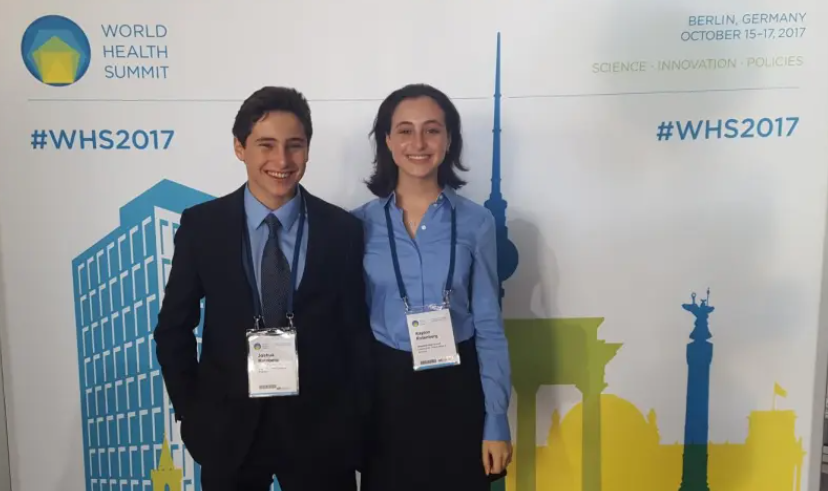
Juniors Josh and Kayton Rotenberg were participants in the high school’s trip to Berlin last October for the World Health Summit. This was just one of many trips the Global Leadership program runs.
Last October, sophomore Zeb Edros found himself surrounded by other people who truly cared about health issues in the world. The catch? He, along with other students from the high school, were the only non-professionals at this conference. Oh, and they were in Berlin.
Every year, students have the opportunity to travel to places such as Amsterdam, Portugal, Nicaragua, Tanzania and Berlin, some in the Global Leadership class, some not, but they all have a shared an interest in world health and learning.
The trips serve as a non-traditional approach for the students to learn and gain experience in a different environment.
According to social studies teacher Ben Kahrl, who teaches the Global Leadership class, the trips function to give the students insight on real situations.
“The trips have two purposes. One is for students to work with and get mentoring from adults who are seeking to solve real-world complex problems. The other is so that they can see these real-world complex problems,” Kahrl said.
According to Edros, who travelled to Berlin for the World Health Summit this past October, the conference was a unique experience for him.
“I think the fact that we were the only students at a professional conference meant that everybody talked to us as if we too were their equals, which let us understand not just more about their fields, but just how to interact with these people in general,” Erdos said. “They answered our questions. They gave us advice on our futures which is really helpful.”
Kahrl believes that the information and skills that the students learn on trips like these will help improve their future and their range of possibilities.
“They {now} have confidence. They can enter the adult world and have conversations with professionals rather than being on the sidelines,” Kahrl said. “Students get exposed to possible careers that they wouldn’t otherwise, simply because they meet people who do things they’ve never heard of.”
According to Kahrl, many of the students who go on Global Leadership trips are in the Global Leadership Class. Sophomore and Global Leadership student Jack Heuberger said that the students do a lot of work pertaining to many different aspects of global problem solving.
“You also learn about situations happening in other countries, such as the Libya slave crisis, and you have to think about ways to possibly solve those problems,” Heuberger said. “It’s about a lot of learning about how the world works and government and how other governments work together, and it’s a lot of critical thinking and collaboration.”
Kahrl said that he hopes to expand the program and give the opportunity of traveling and learning to many more students in the future.
“My goal is that all students, regardless of their socioeconomic background, have a chance to get mentoring from people around the world, and to have an opportunity to travel to places where these challenges are real and immediate” Kahrl said.
Contributed by Kayton Rotenberg
Dan Friedman, Staff Writer
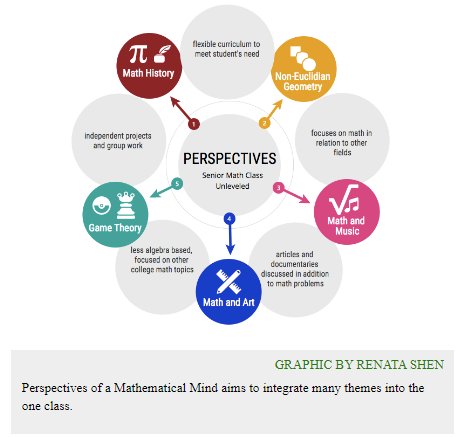
Perspectives of a Mathematical Mind aims to integrate many themes into the one class.
By the end of high school, an average math student can write a geometric proof, solve a quadratic equation and maybe even calculate a derivative. Give the student a traditional math textbook and a sheet of lined paper, and they’ll know exactly what to do — but ask that same student about non-euclidean geometry, game theory, the history of math, or real-world applications of operations and formulas, and you will likely receive a blank stare.
That is, unless you ask students from a senior math class, Perspectives of a Mathematical Mind, which introduces non-algebraic college math and connects concepts with other disciplines such as art, music and history. Through taking the class, students incorporate their own interests with math projects, which deepens their engagement and understanding of the material.
Math teachers Betty Strong and Grace Wang brainstormed the idea for the class after observing a lack of student interest in other algebra-based math classes.
“We would sit around and just be like, ‘it’s such a bummer that students don’t get a chance to see all of this really cool stuff about math,’” Strong said.“There’s so much more to math that kids don’t see.”
After submitting a proposal to the Innovation Fund, then called the Twenty First Century Fund, Strong and Wang received a grant to run the class for three years. After this trial period, the funding for the course was incorporated into the school’s math department budget. The class now covers topics such as tessellations, fractals, art, music and more. Although the class includes some mathematical calculations, the bulk of the class is spent completing other activities.
“We do a lot of group work and presenting, we watch videos, we read articles, we do a lot of discussions, we do a lot more in-depth math investigations,” Strong said.
Although she was already on the advanced math track freshman through junior year, senior Damani Gopal chose to take Perspectives this year, in addition to Advanced Placement calculus.
“I want to study computer science when I’m in college, so obviously the STEM fields are really big in my life,” Gopal said. “Taking a second math was a big benefit.”
Senior Noah Sesling chose to take the class after a presentation given to his Trigonometry and Analysis class junior year. Prior to taking the class, he had struggled to connect class material to his daily life.
“I liked the idea of taking a math class that actually could teach me things that I could apply to the real world,” Sesling said.
For Gopal, learning about other aspects of math has allowed her to extend her existing knowledge of STEM. She particularly enjoyed a unit on game theory, a field of study that is heavily rooted in human psychology.
“It’s the analysis of how two or more parties choose to play a certain game, so it can be like applied to fights like wars, or it can be applied to games,” Gopal said. “There’s a lot of connection to computer science to that. I’ve done game theory independently, so it was lot of fun to do it in school.”
During a unit on math and art, Gopal was able to apply her interest in coding to an end of unit project.
“I made a computer program that depicted tessellations and fractals, so involving coding with math,” Gopal said.
Sesling has incorporated his interest in music with math class. At the high school, Sesling participates in both Camerata choir and the a capella group, Testostatones. For one of his projects, Sesling studied twelve-tone serialism, a form of music composition.
“It basically uses numbers to create melodies,” Sesling said. “I found that really interesting, the way that Perspectives taught me and gave me the resources, and opportunities and open-endedness to actually explore how math and music come together.”
According to Strong, a unique aspect of the class is that it is non-leveled, allowing students who normally don’t interact an opportunity to learn together.
“There’s not a lot of prerequisite knowledge that students need, so we take kids from the college prep level all the way up to the advanced level,” Strong said, “the course is based on each student reaching their own level of mastery, so there’s a lot of individualization.”
For Sesling, taking the class has helped him recognize the significance of mathematical concepts.
“[Before Perspectives] I spent a lot of time memorizing and just trying to think of concepts that didn’t have a meaning to me. This idea of just 1+1=2,” Sesling said. “But with perspectives, it’s a lot more [of] much larger concepts rather than simple small ideas or equations. It’s not like anything you have to memorize, it’s just concepts, like how math would relate to everyday experiences or other forms of art.”
Renata Shen, Staff Writer