The emotional wrangling behind an intellectual response to AI’s influence on humanities education… And where to go from there.
Evan Mousseau Feb 26 SubStack
An opening confession: A major component of what took so long to get this Substack writing component of my project underway was a sense of sadness that has lodged itself in my reading, writing, and teaching soul this year. (Another piece of things: the discovery of just how little time a course release can be, particularly this year. The prolonged drafting process of this piece has allowed it—or forced it?—to grow and morph as my ideas and feelings have developed and intersected with the thinking of others, I think in good ways. Still, that time element will take the spotlight in a future reflection.)
Quite simply, I am saddened by so many of the changes emerging in this world infused with Artificial Intelligence, particularly where these infusions collide with the world of education. I am sad when I feel the values that have been the bedrock of my classroom practice being dislodged and undermined by values of efficiency. I am sad when the arc of a well-planned unit that I have tinkered with for years is derailed by the specter of digital dishonesty. I am sad when I read a beautiful sentence and then wonder right after, Did the student who presented this piece to me actually write it?
I know from conversations with colleagues that I am not alone in this grief. Far from it. Many of us have shared these sentiments with our department chair, who reflected powerfully earlier this year on the ways in which our response to the challenges we face mirrors the nonlinear journey described in the classic stages of grief framework. He presented the ways those stages—denial, anger, bargaining, depression, acceptance—manifest in his practice, and we saw our own journeys through the past year or two reflected back.
There were those moments of denial when we tried to use the same assignments and processes we’ve relied on for years, in spite of knowing their vulnerabilities. And our anger when we find a series of suspicious student submissions. Anger we directed toward students for taking dishonest shortcuts that short-circuit their learning, or toward the system that incentivizes these shortcuts, or toward the technocrats who enable and even actively promote taking these shortcuts.
The bargaining what-ifs and compromises. What if I try to appeal to our relationship, to their desire to learn, to the authenticity of the task? What if I allow some AI support in this way here, but not here? (And when these don’t work quite the way we hope, the should-haves come. I should have pursued a different career path—look at everyone who seems to be blithely using these tools without worrying about their potentially deleterious effects on learning! And the what-if that lingers behind that thought: What if it’s not too late?)
Given the nature of my role during this school year, in which I opted in through an application to spend a course release researching, thinking about, developing, writing about, and sharing approaches for a humanities-wide response and adaptation to AI, it is a common and fair assumption that I’ve reached the point of acceptance—the technology is here, so let’s get on with it! Adapt and adopt! And I admit there are times when I feel this way. When an AI tool helps me develop a mock-up of a website I want to use to share my work with others, while rekindling a decades-dormant pleasure in playing around with (extremely basic) HTML. When an AI vocabulary quizzing prompt script led to rapid and sustained growth in a student’s word knowledge. Still, I find these moments are often few and far between.
At one point this year, I confessed to a colleague that I felt sad almost every time I thought about school. Knowing my relationship to work, I think this colleague knew that what I was really saying was, “I feel sad almost all the time.” This feeling of depression was a consistent gnawing that has made this work incredibly hard. But it maybe also speaks to why this work feels incredibly important. I wouldn’t feel this way if I didn’t care about these colleagues, these students, this school, this field, this work, this world so deeply.
Toward the end of the first semester, as this grieving was beginning to feel a bit self-indulgent, I was floored by a short essay by Brian Keith Jackson published by The New York Times. The essay title alone spoke directly to what I was experiencing: “We Are All in a Constant State of Grief.”
In my own self-centered state of constant grief, I could not help but read through the lens of my particular struggle, a lens that likely did an injustice to Jackson’s work. Indeed, I feel self-conscious even referencing his work here. Given its beauty, its anchoring in the natural world, its reflection on mortal loss and separation, it feels a gross misuse of his essay to even use it here, magnified all the more by the aggressive banner ad that looms above it as I review it now: “5 Questions to Protect Your AI Budget.” How can I compare my AI-induced professional grief that veers toward grievance to the grief that comes with a loss of life, the separations between parents and children? (Is comparison the thief of grief, as well as joy?)
And yet, with grace, Jackson invites the comparison, encourages the admission that I, too, am grieving:
We are all in a constant state of grief, even though we don’t always admit it. Grief comes with any change. Our friends, our lovers, our jobs, our health: Nothing is ever as it was the year, or the moment, before.
If I am feeling grief more acutely this year, it is because I am feeling change more acutely. I am grappling with a rapid changes to my job induced by a rapidly changing technology, anxious that the tools of the humanities that I have long turned to as anchors in the changing world are becoming themselves unmoored.
When I am closest to acceptance, I find myself thinking of a passage in William Faulkner’s Go Down, Moses, a novel I read in my senior years of both high school and college. I return to my heavily annotated copy with some frequency, and the passage that I gravitate to is one that I have on more than one occasion before stripped of its context and used as a window into my own life:
“It seemed to him that there was a fatality in it. It seemed to him that something, he didn’t know what, was beginning; Had already begun. It was like the last act on a set stage. It was the beginning of the end of something, he didn’t know what except that he would not grieve. He would be humble and proud that he had been found worthy to be a part of it or even just to see it too.”
Their words give me some solace, as art long has and often does, here at the beginning of the end of something. Even after months of reading about it, talking about it, living in it, I don’t have a firm grasp on what is beginning, has already begun. But I do know that the world of teaching and learning that formed me, both as a teacher and a learner, is changing, is perhaps even at the beginning of its end, at least in the ways that it has long existed, the ways that drew me to it as a way to spend my working days.
I wish sometimes that I had the grace to see this change through with the clarity and dignity displayed in that passage from Go Down, Moses. To be “humble and proud” and acknowledge the “fatality in it.” No public whining in 1600-word essays. Just crisp, direct statements of feeling and acceptance. But then I wonder—maybe wisely, maybe cynically—if this denial of grieving that Faulkner describes is its own part of the grieving process, whether that grief is for the ways of life and hunting in Yoknapatawpha County or the ways of humanities education in our modern world.
But then, as I read and write my way through this, I wonder:
When my own students encounter grief, hopefully in far-off futures, will they feel equipped to turn to writing as a means of exploring and expressing their feeling? Will they cast out a line of communication to another human? Will they observe the metaphors that abound in the natural world around them? Will they open a book, return to a poem, seek out a song that reminds them that they are not alone in their feeling and perhaps even offers some guidance on how to proceed?
Or will they turn to an algorithm?
And then I am grieving again.
So what is there to do, as humanities educators, or as humans in general, on this nonlinear journey through this particular piece of our constant state of grief? How do we navigate the feeling of loss that both comes in waves and permeates our working and waking world?
I find myself turning once again to a great work of American Literature to make sense of things.
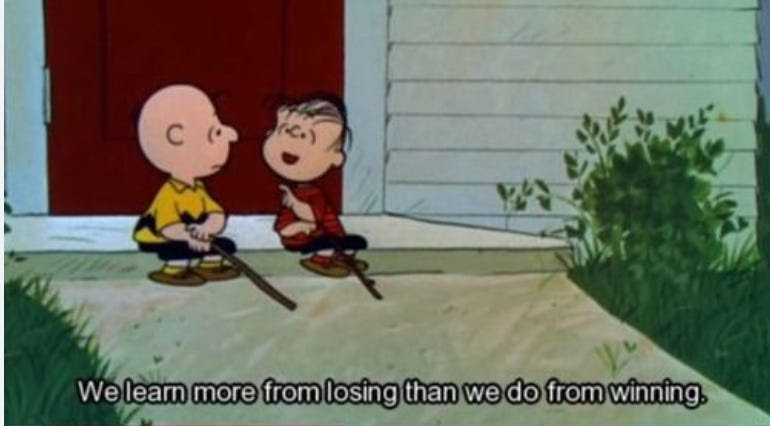
In one sequence of the 1969 film A Boy Named Charlie Brown, Charlie Brown sits on a stoop with Linus, lamenting an eternally terrible little league season following their 99th straight loss without a win. Seeking to provide some solace to his friend, the ever philosophical Linus quips, “Look at it this way, Charlie Brown. We learn more from losing than we do from winning.”
In a world of constant loss, Linus calls us to participate in a world of constant learning. And isn’t that what the humanities is all about?
Good grief, indeed.