Q&A: Drawing for Understanding in Field Science

Q&A: Drawing for Understanding in Field Science

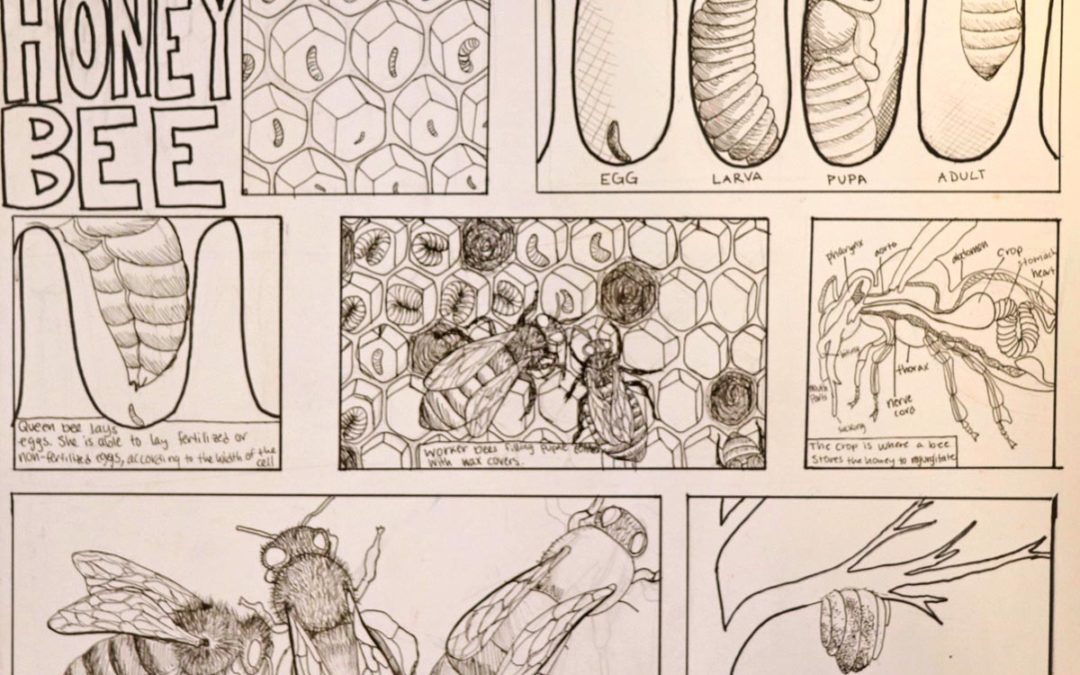
BHS Visual Arts teacher Donna Sartanowicz describes the evolution of the Innovation Fund Class, “Drawing for Understanding in Field Science.”
Drawing for Understanding in Field Science at the Arboretum 01 - © Sander SorokHow did you come up with the idea for the course?
It came from a workshop that Jill Sifantus, a since retired biology teacher at BHS, and I attended at Harvard University. The workshop focused on the very close relationship between art and science at the advent of serious scientific study of the natural world. Drawing was a routine part of studying the natural world for communicating ideas and discoveries.

What was the goal?
From our different vantage points — Jill, in the science department and I in visual arts — both came away thinking that this very old school idea would be a great new way to engage students in learning both subjects. Students learn in different ways and drawing is another system — just like language or mathematics — that they can use to learn information and express understanding.

Can you describe the Innovation Fund’s role in developing and expanding the course?
We were fortunate to have this idea while teaching at Brookline High School because of The Innovation Fund, which allowed us to put our idea into practice. The Fund’s review board was instrumental in helping us to hone our idea and think through all the possibilities. The grant money allowed us to teach and learn collaboratively for three years and this was some of the best professional development I have ever experienced. Working with Jill to integrate science teaching into the way I teach art enabled me to confidently teach this course on my own once the grant period was over.

This partnership opportunity resulted in a course so unique to our school that teachers from other schools have asked to visit and learn about this program, so they might propose something similar for their students. The ripple effects of the Fund’s generosity in supporting innovative educational ideas is spreading even beyond the walls of Brookline High School.
Drawing for Understanding in Field Science at the Arboretum 16 - © Sander SorokWhat happened after the three-year funding period ended?

After the funding period was over, the school picked up the class but did not keep it as a co-taught class. Since Jill was much closer to retirement than I was, it seemed better for me to continue the class solo. Although the three years of the grant were like “biology boot camp” for me (I hadn’t taken bio since high school) I decided that to keep up the rigor of the science end of the class, I would invite scientists into my classroom.

I had taken a project-based learning workshop a few years ago that stressed real-world questions and connecting with the professional community for launching, guiding, and giving feedback to students. In that first year after the grant, I did a lot of work setting up partnerships with institutions like the Arnold Arboretum, the Blue Hills Trailside Museum, the Harvard Museum of Natural History, and graduate programs at Boston University, Rhode Island School of Design, Harvard University and Tufts University.
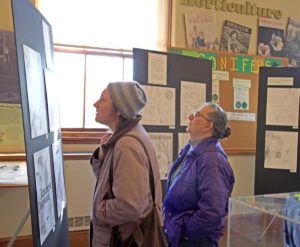
Drawing for Understanding in Field Science at the Arboretum 11 - © Sander SorokHow has the partnership with community organizations benefited the course?
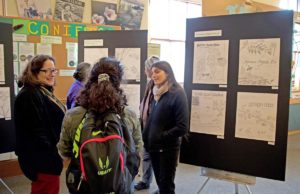
The institutions allow my students to have experiences with the natural world and to hear about people working in the field as naturalists, curators, educators, illustrators, and researchers. Though the universities I have connected with graduate researchers who present their research and talk to my students about what it is like to study and travel the world as part of their research. So much of what students learn about in regular science classes is second-hand information from books. Having the researchers come in helps students to understand that science is not a fixed set of information — that there is still more to be investigated and understood and that they could be a part of that.

In its sixth year, the class seems to have a great reputation. What’s happening now?
I have presented this course as a visiting speaker in the art education department at Boston University last year and will do so again this year. I have also presented this work, for the second time, at the National Art Education Association Conference this year. I continue to meet individually and informally with both art and science teachers from other schools/districts wanting to start a similar course.

Many in the education field talk about interdisciplinary and STEAM [science, technology, engineering, art, and math] classes but few receive the kind of support we got from the Innovation Fund to make it happen. The impact on students has been tremendous, as evidenced by the continued popularity of the course and students recommending it to other students.

Interview by Jennifer B. Wells

BHS Innovation Fund Kicks off 20th Anniversary Celebration with Speaker Ted Dintersmith, Innovation Expert and Author of What School Could Be

BHS Innovation Fund Kicks off 20th Anniversary Celebration with Speaker Ted Dintersmith, Innovation Expert and Author of What School Could Be

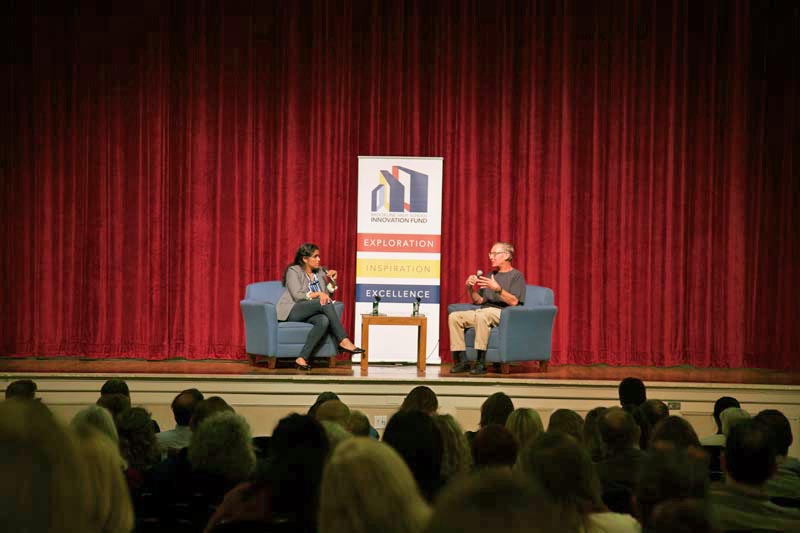
On Thursday, September 20, 2018, the Brookline High School Innovation Fund kicked off its 20th anniversary celebration with innovation expert and author Ted Dintersmith, who spoke about his new book, What School Could Be: Insights and Inspiration from Teachers Across America. The event was moderated by WBUR host Meghna Chakrabarti. More than 400 people, including parents, students, teachers, residents, administrators, and town officials from Brookline as well as attendees from all around Boston and the New England area, came to hear Mr. Dintersmith discuss key learnings and insights from his year-long experience meeting with students and teachers across the country.

The discussion focused on how to improve the current education system to meet the evolving demands of an increasingly innovative and rapidly changing world. Mr. Dintersmith shared his views on three core concepts that he believes can change the current teaching and learning paradigm for the betterment of students—trusting teachers to lead the way, letting students have a voice in their education, and aligning learning to what’s important in life. Mr. Dintersmith praised Brookline High and the Innovation Fund for leading the way by supporting teachers who champion innovative courses and initiatives that engage students and provide deep learning and a sense of purpose.

The author talk was the first in a series of events to celebrate the 20th anniversary of the Innovation Fund, which invests in new ideas, programs, and initiatives that foster a culture of innovation at BHS and prepare students to thrive in the 21st Century. The Innovation Fund is a 501 (c)(3) organization supported by private donations. All gifts are tax deductible.

Learn more about the Innovation Fund’s programs.

Donate to the Innovation Fund to support new courses and initiatives.

Read what The Boston Globe has to say about innovation at Brookline High.

Leaders diversify staff through hiring process

Some of the recently hired teachers have had little teaching experience, yet the school has consistently been highly ranked; US News and World Report stated it is 23rd in Massachusetts in 2013.

Headmaster Deborah Holman said the school, when hiring, focuses on the quality of the teaching by prospective teachers.

“We aim to hire the best teacher who is the best match for that program and that teaching position at the time.” She said that experience can range from one year to 20. “You have to think about the composition of the department already. Does the department have a bunch of folks in their 40s and older, and you want to bring in someone in their 20s, just to do some balancing?”

Holman said high-quality teachers can have varying degrees of experience.

“Sometimes a quite together, thoughtful, new teacher who maybe has one year of experience shows a ton of promise,” Holman said. “We might make a decision to say that’s worth it for us, because this person brings these different characteristics. Therefore, the department head would have to commit to supporting that person very, very heavily if they’re new to the teaching profession as well as new to Brookline High School.”

Mathematics Curriculum Coordinator Joshua Paris said his department’s hiring process, which he said resembles that of the other departments, starts with posting a position’s availability on the website SchoolSpring. He then goes through the applicants and chooses 10-15 out of 50-60, on average, to be reviewed by a committee of four to five teachers and himself.

The committee, according to Paris, then selects five to 10 teachers to interview, and to four of the remaining teachers usually asked to teach a class at the school. In the past, Paris said, he has seen videos of teachers or gone to visit them if they could not come to the school.

Holman said she wants to always be available to observe these teaching sessions because she will have a fresh perspective on the candidate, whom the hiring committee already knows from his or her interview and resume.

One or two of the candidates are chosen to be interviewed by Holman in the final step of the decision process, according to Paris.

“I won’t repeat the interview that the department interview committee had. I want to converse with the person and find out why they’re interested in Brookline High School specifically, who they are as a

person. I’ll talk to them about favorite books that they read, things in education that they’re particularly interested in,” Holman said. “I’m asking questions to see if they are a reflective teacher, or if my sense is that they think they have all the right answers.”

She also says she wants to get a sense of their teaching, the way they interact with kids, and their overall personality. She often asks about past situations.

Paris said he looks for regional, ethnic and experiential diversity when he hires teachers.

“I think more experienced teachers and newer teachers have different things to offer the school. I like to create a balance of those,” Paris said. “I might look at what type of person I think could enhance the department. Do they have a perspective that we don’t necessarily have that might push us in a certain direction?”

The school offers the Teachers Mentoring Teachers program to teachers new to Brookline, according to Paris. The program is currently run by math teacher Meghan Kennedy-Justice and social studies teacher Robert Grant. The program has new teachers discuss their experiences. In addition, they are given teacher mentors and they observe other teachers’ classes.

Holman said the program was created by the 21st Century Fund in the late 1990s.

“It was the idea of how you can get new teachers who come into the high school acclimated and oriented to not just teaching in a classroom, but the Brookline High School and Brookline community culture,” Holman said.

According to English Curriculum Coordinator Mary Burchenal, not all teachers are eligible for the program. Teachers who teach less than half-time and long-term substitutes who are not at the school for a full year are not included in the program. She said these teachers may have unofficial mentors, although overall, they do get less support.

Burchenal said this is a difficult place to be a new teacher.

“There are a lot of really great teachers here. Kids have high expectations, parents have high expectations, department heads have high expectations, colleagues have high expectations,” she said. “Although everybody is very understanding of a new teacher’s dilemma, that doesn’t change the fact that it’s still a challenge every day to plan every day, teach every day and have all these expectations surrounding you.”

Holman said she looks to hire teachers who strive to self-improve.

“If you get, collectively, a teaching staff, which we do not have, that is pretty self-satisfied, that’s not a lot of fun,” Holman said.

She said she will not hire a teacher who is not open to feedback from others or is not willing to help all of his or her students.

“Every kid who shows up in your classroom in September, regardless of who they are, what strengths and challenges they have, where they’re from, you support all of those kids,” she said.

Paris said there are benefits to hiring both new and experienced math teachers.

“To be a good teacher is a mix of an inherent energy and passion that you have for teaching, for math and for working with teenagers. Starting from there, I think high-quality educators learn how to take those ideals and implement them in the classroom. An experienced teacher has already figured out how to do that,” Paris said. “Their classroom management skills are usually excellent. The way they write lessons is well-defined. Newer teachers have to learn that, because that comes from experience, but what you get is that idealism and energy that I want all of our teachers to have.”

w

Contact

  • bhsinnovationfund@psbma.org
  • 617-713-5201
  • 115 Greenough St Brookline, MA 02445

Connect

© 2026 BHS INNOVATION FUND