Some of the recently hired teachers have had little teaching experience, yet the school has consistently been highly ranked; US News and World Report stated it is 23rd in Massachusetts in 2013.
Headmaster Deborah Holman said the school, when hiring, focuses on the quality of the teaching by prospective teachers.
“We aim to hire the best teacher who is the best match for that program and that teaching position at the time.” She said that experience can range from one year to 20. “You have to think about the composition of the department already. Does the department have a bunch of folks in their 40s and older, and you want to bring in someone in their 20s, just to do some balancing?”
Holman said high-quality teachers can have varying degrees of experience.
“Sometimes a quite together, thoughtful, new teacher who maybe has one year of experience shows a ton of promise,” Holman said. “We might make a decision to say that’s worth it for us, because this person brings these different characteristics. Therefore, the department head would have to commit to supporting that person very, very heavily if they’re new to the teaching profession as well as new to Brookline High School.”
Mathematics Curriculum Coordinator Joshua Paris said his department’s hiring process, which he said resembles that of the other departments, starts with posting a position’s availability on the website SchoolSpring. He then goes through the applicants and chooses 10-15 out of 50-60, on average, to be reviewed by a committee of four to five teachers and himself.
The committee, according to Paris, then selects five to 10 teachers to interview, and to four of the remaining teachers usually asked to teach a class at the school. In the past, Paris said, he has seen videos of teachers or gone to visit them if they could not come to the school.
Holman said she wants to always be available to observe these teaching sessions because she will have a fresh perspective on the candidate, whom the hiring committee already knows from his or her interview and resume.
One or two of the candidates are chosen to be interviewed by Holman in the final step of the decision process, according to Paris.
“I won’t repeat the interview that the department interview committee had. I want to converse with the person and find out why they’re interested in Brookline High School specifically, who they are as a
person. I’ll talk to them about favorite books that they read, things in education that they’re particularly interested in,” Holman said. “I’m asking questions to see if they are a reflective teacher, or if my sense is that they think they have all the right answers.”
She also says she wants to get a sense of their teaching, the way they interact with kids, and their overall personality. She often asks about past situations.
Paris said he looks for regional, ethnic and experiential diversity when he hires teachers.
“I think more experienced teachers and newer teachers have different things to offer the school. I like to create a balance of those,” Paris said. “I might look at what type of person I think could enhance the department. Do they have a perspective that we don’t necessarily have that might push us in a certain direction?”
The school offers the Teachers Mentoring Teachers program to teachers new to Brookline, according to Paris. The program is currently run by math teacher Meghan Kennedy-Justice and social studies teacher Robert Grant. The program has new teachers discuss their experiences. In addition, they are given teacher mentors and they observe other teachers’ classes.
Holman said the program was created by the 21st Century Fund in the late 1990s.
“It was the idea of how you can get new teachers who come into the high school acclimated and oriented to not just teaching in a classroom, but the Brookline High School and Brookline community culture,” Holman said.
According to English Curriculum Coordinator Mary Burchenal, not all teachers are eligible for the program. Teachers who teach less than half-time and long-term substitutes who are not at the school for a full year are not included in the program. She said these teachers may have unofficial mentors, although overall, they do get less support.
Burchenal said this is a difficult place to be a new teacher.
“There are a lot of really great teachers here. Kids have high expectations, parents have high expectations, department heads have high expectations, colleagues have high expectations,” she said. “Although everybody is very understanding of a new teacher’s dilemma, that doesn’t change the fact that it’s still a challenge every day to plan every day, teach every day and have all these expectations surrounding you.”
Holman said she looks to hire teachers who strive to self-improve.
“If you get, collectively, a teaching staff, which we do not have, that is pretty self-satisfied, that’s not a lot of fun,” Holman said.
She said she will not hire a teacher who is not open to feedback from others or is not willing to help all of his or her students.
“Every kid who shows up in your classroom in September, regardless of who they are, what strengths and challenges they have, where they’re from, you support all of those kids,” she said.
Paris said there are benefits to hiring both new and experienced math teachers.
“To be a good teacher is a mix of an inherent energy and passion that you have for teaching, for math and for working with teenagers. Starting from there, I think high-quality educators learn how to take those ideals and implement them in the classroom. An experienced teacher has already figured out how to do that,” Paris said. “Their classroom management skills are usually excellent. The way they write lessons is well-defined. Newer teachers have to learn that, because that comes from experience, but what you get is that idealism and energy that I want all of our teachers to have.”
Strapped for cash, a Massachusetts high school starts its own venture fund to grow teacher leaders and encourage innovation. Test score gains and higher teacher satisfaction result.
In June 1998, two veteran teachers at Brookline High School stood before Headmaster Robert Weintraub’s desk asking for money. Gayle Davis and Margaret Metzger requested funding for an innovative teacher mentoring program, which promised to provide skills and institutional knowledge to the next generation of BHS instructors.
To Weintraub, Davis, and Metzger, this idea was a no-brainer. Veteran teachers were retiring from BHS in large numbers, leaving the school in the hands of young and inexperienced newcomers. Weintraub agreed that a program for new teachers was essential, but said the school simply did not have funds for mentoring. Limited funding also stymied efforts to address other critical problems at the school. Class size and an achievement gap in its diverse student body were constant challenges. Located in a large town on the outskirts of Boston, the school’s 1,800 students came from 76 countries, spoke 36 languages, and spanned the socioeconomic spectrum. An additional 5% of students commuted from Boston as part of a state- funded school desegregation program. Significant academic achievement gaps existed between white and Asian students and black and Hispanic students, yet the budget had insufficient funds to address this burgeoning problem.
In today’s economic climate, school leaders are no strangers to the predicaments Weintraub faced over 10 years ago. As some schools struggle to develop new programs to resolve pressing issues, others lack funding for even the most basic school supplies, technology, personnel, and building maintenance. School administrators frequently fill the void by developing creative partnerships with private donors, religious institutions, foundations, federal and state governments, and local businesses. While relationships between public schools and private sectors bring much needed funding, they also cause controversy. For instance, parents question whether private corporations like Coca-Cola or Nike should be allowed to advertise in school cafeterias and gyms in exchange for donations. In one case, parents in Nashville, Tenn., were irked when a local high school accepted $150,000 from the Tennessee Credit Union in exchange for opening a bank branch in the school’s cafeteria (Levitz & Simon, 2010). There is much to resolve about the nature of these public-private relationships.
An innovative solution
In 1998, Weintraub found himself gravitating towards a private-sector solution to Brookline High’s problems. After inviting 10 prominent community members to participate in a “think tank,” the concept of a 21st-century fund emerged. It called for successful community leaders to join school officials in developing a nonprofit venture capital organization based in the high school. Relying entirely on donations from alumni, parents, community members, and foundations, the fund would create and support innovative academic and social programs at BHS. The fund would allocate money to enable teachers to implement programs designed to solve serious problems at the high school, in the hope that successful teacher-initiated programs might eventually serve as models for other school districts.
But it was unclear how such a large sum of money could be collected. In the past, BHS received support from a few local philanthropists, its Parent Teacher Organization, and the Brookline Education Fund (BEF), but those donations weren’t enough to meet the school’s most urgent needs, nor were they directed to underwriting innovative programming.
Weintraub was intrigued by the fundraising capabilities of private schools and universities, which raised millions of dollars annually from alumni and constituents. Like those institutions, BHS was well-regarded by community donors; however, the school lacked the organizational structure to collect and distribute private funding.
To overcome these challenges, Weintraub sought buy-in from district leaders and start-up money. He invited the superintendent and members of the Brookline School Committee to participate in the fund’s design. A group of well-connected town residents, several with experience in philanthropic fundraising, planned a kickoff event for December 1998. This steering committee gained financial commitment from many local alumni before the event and raised over $500,000 for what became the 21st Century Fund, which registered itself as a 501(c)(3) nonprofit organization capable of providing tax exemptions to donors. The committee crafted a mission statement to make clear that the 21st Century Fund would provide venture capital to pilot innovative programs — designed by BHS teachers and Brookline community members — responding to national problems in public education. Brookline High would be a beta site, a laboratory for innovation in public education. Money in hand, the 21st Century Fund established an office in the high school and prepared to select the organization’s founding programs.
Teachers were empowered to consider the challenges they faced daily and to propose solutions to Weintraub and his team. Over time, a formal process for selecting programs evolved, a democratic system of approval was established, and more people took ownership of the organization. A program committee consisting of parents, community leaders, and school administrators was organized to vet proposals and support teachers through the application process. Teachers were required to submit realistic budgets for their programs, along with descriptions of how proposed initiatives would solve problems at BHS. The process was competitive, with only the most impactful proposals selected by the program committee. If chosen, teachers presented their ideas to the superintendent and central office officials to assure consistency with district goals. Next, proposals went before the 21st Century Fund’s board of directors, and ultimately the school committee for final approval.
Selected programs were designed to be financially supported for a three-year test period, and teacher leaders were relieved of one or two classes for program development and implementation. Time is an important commodity for teachers, and partial release from teaching assignments was a valued and essential component of the fund’s projects. With released time came high expectations for performance; teacher leaders were required to use valid research techniques to document the program’s success. Teachers presented data to the 21st Century board and district administrators, who closely examined whether programs met their objectives and determined whether to incorporate them into the
system’s long-term budget. An unsuccessful program received no further funding and was discontinued.
In September 2000, the 21st Century Fund financed its first program. Davis and Metzger launched their Teachers Mentoring Teachers program to promote teacher retention and professional growth. Over the next 10 years, the fund added 15 programs. A tutorial program established in 2002 provides individualized, content-based support to enhance the academic performance of students with mild learning disabilities. In 2003, the fund helped develop the African-American Scholars program to narrow the achievement gap by establishing and nurturing a corps of academically outstanding African-American students. More recently, a Social Justice Leadership Program was established to provide students with the skills needed to become active agents of change in a deeply divided world. Each of these programs sought to improve the lives of students at BHS while providing teachers with authentic opportunities for leadership.
Implementation challenges
The 21st Century Fund encountered significant challenges in its early years and is still a work in progress. One early controversy involved leadership. Some school officials and parents expressed concern that private donations might end up in an unregulated “slush fund” for the headmaster. Others questioned whether community leaders with expertise in business and academia, but limited experience with education might support programs inconsistent with the district’s goals. To address both concerns, the fund developed a highly inclusive governance structure. Multiple boards consisting of parents, community members, alumni, school leaders, and elected officials regulate donations and select new
programs. This inclusiveness ensured that the 21st Century Fund was a unified democratic effort, supported by all.
Another challenge is integrating successful programs into the regular school budget. Teachers Mentoring Teachers, for example, costs about $30,000 per year (the cost of two teachers relieved of one class each). School administrators must somehow find the money for the program, usually by reallocating resources to support the new successful program. This process became particularly daunting when the school district experienced increased enrollment at a time of economic contraction. To address this issue, Weintraub and Brookline Superintendent William Lupini look ahead when reviewing program proposals.
“We only want the 21st Century Fund to establish programs that will be sustainable under the regular budget after the three-year process has run its course. Otherwise, we might run into a situation in which excellent programs can’t be funded,” Lupini said.
The unpredictable economy makes planning difficult and requires Weintraub and Lupini to modify the budget frequently when adopting new 21st Century Fund programs. Over the first 10 years, BHS incorporated about $900,000 in programs, while reducing the rest of the budget by nearly that amount.
This is an essential component of the whole process; without incorporating successful programs, there would be no motivation to innovate.
Finally, the 21st Century Fund created some initial tension with existing local education groups and foundations. Before the fund’s inception, the high school PTO and Brookline Education Foundation (BEF) were the primary fundraising entities for Brookline schools, and there was concern that the new organization would compete for limited donations. To quell tensions, leaders of the fund and BEF agreed to create separate spheres for fundraising. The 21st Century Fund would exclusively seek donations from parents of high school students for innovative programming, while BEF could access K-8 families and fund teachers’ professional development. As a result of this productive communication, Brookline’s fundraising organizations developed a respectful and stable collaboration.
Fund benefits
Over 10 years, the benefits of the 21st Century Fund have become very clear to Brookline educators.
#1. Brookline is a leadership factory.
Since its inception, the 21st Century Fund has transformed the professional lives of BHS teachers. The leadership opportunities created by the fund’s programs engage, challenge, and invigorate faculty members.
“Developing a program from scratch and being selected to lead it was both validating as a professional and a tremendous professional growth opportunity for me,” said Davis, a coleader of Teachers Mentoring Teachers.
Christien Polos, teacher leader of an arts program for at-risk teenagers, agrees. “The 21st Fund has enabled me to work through, cultivate, and then realize an innovative idea that could possibly change a child’s path in life. Professionally, a person couldn’t ask for more validation from their workplace.”
Being selected as a teacher leader convinced some of the finest teachers at BHS to remain in the profession many years beyond their expectations. Metzger was ready to retire in 1998 after a 25-year career teaching English. Coleading Teachers Mentoring Teachers compelled Metzger to stay an extra 12 years. “I loved having ownership over an exciting new program and a new purpose. This opportunity was very affirming and made me feel extremely connected to the school,” Metzger said.
The 21st Century Fund also prepares the school’s next generation of administrators. While many teachers are content to be program leaders, others use newly acquired leadership skills to assume administrative positions. English teacher Mary Burchenal used 21st Century funds to develop an interdisciplinary program, The Good Citizen in a Good Society. Later, Burchenal was selected as English department chair. Brian Poon, a social studies instructor who also developed the Good Citizen program, became an associate dean and now directs an alternative program for at-risk students at BHS. “Good Citizen was really an entry point for me into how schools make change both on the institutional and the district level. I cultivated an appreciation for how a person gets things done in schools,” Poon said.
By providing leadership opportunities, the 21st Century Fund allows BHS to nurture and retain some of its brightest assets.
#2. The fund expanded student learning opportunities and produced impressive achievement results.
Students appreciate access to unique and innovative programs each year. “The 21st Century Fund provides us with so many interesting class and program options unavailable in other schools. . . . I love being a student here,” said one junior.
Students value the access to additional academic support, and they praise the 21st Century Fund for increasing classroom engagement. For example, the Engineering by Design course launched by the fund is popular among students who want a hands-on approach to the sciences. “I have a hard time keeping focused when I am lectured to all day. After doing this program, I feel like I can fix, design, or build anything. My favorite part of this program has been putting my creative mind into physical things,” said one student.
Increased student engagement coupled with new academic support programs have narrowed the achievement gap at BHS. Between 2005 and 2010, the number of African-American and Hispanic students scoring proficient/advanced on the Massachusetts Comprehensive Assessment System increased 84% for language arts and 71% for math. Class of 2011 students enrolled in the African-American Scholars Program (AASP) outpaced the national average on the SAT and outscored non-Hispanic white BHS students in the writing section. Most AASP students (68%) increase the number of honor and AP courses they take between freshman and senior year, and there was more than a 100% increase in the induction of AASP scholars into the National Honor Society in the last three years. While results demonstrate a significantly reduced achievement gap, there is still much work to be done. Future 21st Century Fund programs must remain committed to helping all students receive a challenging and meaningful education.
#3. The fund has deepened and expanded community involvement.
The fund also plays an instrumental role in involving parents in the school community. Research indicates that parental involvement in school peaks at the elementary level and tapers off as independence-seeking teenagers enter high school (Eccles & Harold, 1993). The 21st Century Fund invites parents to remain involved by participating behind-the-scenes on planning boards and committees and working on fundraisers. Each opportunity provides social interaction and a means for contributing to programming. This is a win-win situation: Parents connect to the school while contributing valuable resources and expertise.
In one case, volunteering for the 21st Century Fund inspired a parent to become a teacher. After chairing a 21st Century committee, Julie Joyal-Mowschenson was moved by “the tremendous efforts of BHS teacher-leaders to reduce inequalities at school and in the world.” Joyal-Mowschenson, a nationally respected nurse, earned a master’s degree in education, passed the Massachusetts teacher exam, and initiated a popular course at BHS called Medical Careers. She now also teaches that course at Boston’s Madison Park High School and plans to disseminate her curriculum in eight other Boston public high schools.
The fund provides exciting opportunities for another traditionally underinvolved group at the high school: alumni. Before the fund’s inception, the BHS alumni network was small and exclusively collected donations for class reunions. The fund expanded outreach to alumni by empowering them to raise money for venture capital programs. Many alumni enjoy sharing ideas and expertise from their professional lives with teacher leaders in developing new programs. For example, the Global Leadership Academy, a project currently under development, is receiving feedback from alumni leaders in business, law, and education. Through this involvement, many graduates have reconnected with their high school,
bringing valuable resources and ideas.
Finally, the fund attracts some of the community’s most generous philanthropists. Like parents and alumni, local donors have adopted leadership roles on various committees. They enjoy socializing with other community members and contributing expertise to support a good cause. As these philanthropists become more involved with the fund, they frequently make donations. Chobee Hoy, a local real estate agent and one of the fund’s most generous benefactors, said, “The fund inspires confidence and is a great draw for donors because it’s related to the school system, which is highly regarded and has excellent leadership.” The fund’s excellent reputation with the sponsors is especially critical in the current economic climate as aggregate charitable giving has declined or had only modest increases in recent years (Center on Philanthropy, 2011).
Conclusion
The 21st Century Fund model provides one formula for harnessing private funding in tough economic times. It is a luxury to raise funds for innovative programming at a time when other schools can barely afford teacher salaries and provide students with basic supplies. However, developing a local foundation is not something that is available only to the nation’s most affluent districts. Leaders of middle- and lower-income schools can also leverage the financial and human resources of their communities into powerful fundraising structures. While a town’s financial situation will inevitably dictate how much money a school can raise, all school leaders can create their own 21st-century funds.
Brookline’s 21st Century Fund continues to be a work in progress. Like any nonprofit organization, the fund regularly examines its mission and strategic plan to ensure future growth and success. The fund’s goal is to enable Brookline High to continue as a laboratory searching for innovative solutions to some of the nation’s most intractable educational challenges.
While problems such as teacher retention and the achievement gap can seem insurmountable, lessons from the fund’s successes and failures can contribute to national efforts for their resolution. As stated by one BHS parent and fund leader, “What inspires me about the 21st Century Fund is that it goes after major problems facing public high schools nationally, but it does so with very specific solutions that are applied and tested in one school. In the laboratory of innovation that is Brookline High School, we have
proven that you can attack some of these problems successfully one student at a time.”
References
Center on Philanthropy at Indiana University. (2011).
Giving USA 2011: The annual report on philanthropy for the year
2010. Chicago, IL: Giving USA Foundation.
Eccles, J.S. & Harold, R.D. (1993). Parent involvement during
the early adolescent years. Teachers College Record, 94 (3),
568-587.
Levitz, J. & Simon, S. (2010, June 14). A school prays for help:
Towns tap businesses, churches to shore up budgets. The
Wall Street Journal
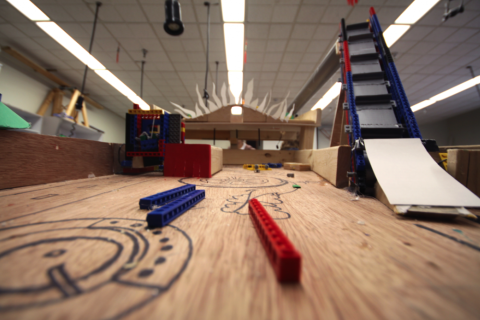
In Room 368, every table has a four-foot tall Rube Goldberg machine on it. In UA 11, saws, sanders and every other tool imaginable surround a few tables supporting the futuristic locker organizers students are building. These are the engineering rooms.
The school has two engineering classes: one run by the science department and one run by the career and technology education department. The two classes differ due to the role science plays in each class.
“Ninety-five percent of the time, the students are working and trying to solve problems,” said science teacher Aubrey Love, who teaches Engineering By Design, the science department’s engineering class. “I might be walking around and help a little bit here and there, but it’s really about what you can come up with through trial and error.”
Both classes focus on engineering, but Engineering By Design is more math- and physics- based than the elective class, Engineering the Future, according to Ed Wiser, the science department curriculum coordinator.
“It’s more hands on,” said Glen Gurner, of his Engineering the Future class. “I try to bring a little science into it. It’s more project-based, and it’s about making things and how to put things together.”
Both of the engineering classes follow the same design process of figuring out the problem, planning out what they are going to do, making a model, doing tweaks and then creating the final product, according to Wiser.
The Engineering By Design projects, however, require equations to help plan out every detail, according to senior Marshal Rekovskyson.
“Its a lot of physics,” Rekovskyson said. “Engineering requires a lot of physics because you need to know about the force needed to do something. We aren’t going to do calculations on the fly. Understanding the forces in effect, gravity and friction, definitely helps us make better machines.”
There is also a difference between the two classes in their access to large tools. The Engineering the Future class has access to all of the advanced tools in the basement of the Unified Arts Building, while the Engineering By Design class only uses the tools they have in their classroom and what the career and technology education department will give to them.
According to Wiser, Engineering the Future introduces fundamentals of engineering while Engineering By Design does projects that require more in-depth knowledge of engineering. Both aim to help students figure out whether or not engineering is something they want to pursue later in their life.
“We are given the freedom to do whatever we want and to add our own spin,” said Rekovskyson. “Most projects have strict guidelines and have a strict goal, but in this class, we just build.”
Bored with your math, science or Spanish class? There are three new classes that may be offered next year: A Human Math Experience, Drawing for the Understanding of the Field of Science and Medical Interpretation and Translation.
Every year, the 21st Century Fund introduces new programs and classes that are uncommon in high schools. This year, the program is hoping to fund these three new classes, two of which are not offered anywhere else in the country.
Faculty Leader of the Fund Gaelen Harrington has only good things to say about the new programs. She hopes that all of the planned classes will be initiated next year. If not, she intends to continue to push for these classes in the coming years.
“Part of our mission is that we see ourselves as an incubator of innovation,” said Harrington. “A proposal comes to us and we help it in its pilot phase of two, three, four years. If it is successful, we bring it to the school committee and ask the town to absorb it into its budget.”
A Human Math Experience will be about the application of mathematics outside of the classroom. According to Harrington, the unleveled class is not an average math class.
“The Human Math Experience arose out of math teachers’ concerns that so much of the teaching of math is to the test,” said Harrington. “Kids are taking math because it is required, or you want to take the AP exam, or you will take the MCAS or the SATs. There is not room in the school day to open kids up to real world application of math and the pure beauty of math. They wanted to offer a course that would provide that for kids,” Harrington said.
Mathematics Curriculum Coordinator Joshua Paris believes this class is different from other math classes for four main reasons: it gives insight into collegiate and professional math, it is not test-oriented, it is not constricted to the classroom and it is completely unleveled.
“I think that a lot of our classes use real world examples or questions, but more often than not, they are artificial,” said Paris. “This is the only place that will really look at what math is outside of the high school.”
Paris added that there will be projects and independent studies. He says that the students will not always be in their regular classroom because they will be using computers and visiting colleges. According to Paris, success in the course will commensurate with the level of dedication.
“It’s going to be about the effort you put into it,” said Paris. “As educators, that’s what we want. We want students who put in a lot of effort and invest their time to be successful.”
Unlike the math class, which is not taught in any other high school or college, the idea for Drawing for the Understanding of the Field of Science originated from a Harvard class which Donna Sartanowicz, an art teacher, and Jill Sifantus, a science teacher, took over the summer.
“One thing I love about it is that it breaks down the artificial wall between the arts and sciences,” said Harrington. “It’s really looking at drawing as a way of integrating and communicating knowledge. If you are doing field science and you are observing flowers or insects, you really get to know those thing if you are actually, pen in hand, drawing those things.”
Sartanowicz will be using her drawing skills and Sifantus her science knowledge to create a combined science-art class never seen before at the school.
“Both of us have our major interest. Mine in art, hers in science,” said Sartanowicz. “But both of us have an interest in the natural world. We are looking to collaborate by bringing in our separate strengths into a single course.”
The class will only count as an elective for the first year, but if it proves to teach the enrolled student a substantial amount of science, it will count for a science credit in subsequent years.
The new Spanish class, Medical Interpretation and Translation, also combines two subjects together: foreign language and science. This class was created to help students who are excelling in Spanish pursue their interest in other ways. These students will learn how to translate different medical terms from Spanish to English, and visa versa.
“It’s geared toward particular heritage speakers for whom the regular language course might not fit their level and sphere of skill,” said Harrington. “It is also geared towards very proficient Spanish speakers who are speaking it as a second language, who are looking for something more.”
This class is more than just a Spanish class. It offers an opportunity to learn about biology and Spanish while helping in the community. The students will be interacting with the Boston medical community by interning in hospitals and shadowing doctors as their Spanish interpreters and translators.
A common theme between these new classes is expanding the experience beyond the classroom. The math class visits colleges, the science-art class travels to fields and other locations, and the Spanish class works in a hospital.
“In this 21st century, in the world that we live in, I don’t think a class needs to be confined to four walls anymore,” said Paris. “One of the goals of this course is to remove those four walls from the classroom and to make it a more worldly class experience.”
Panel encourages students to pursue their passions
It could have been a typical Saturday afternoon in anyone’s living room, furnished with a red couch and a coffee table. However, on Nov. 9, this living room was the Roberts-Dubbs Auditorium and the spotlight shined on four important figures for the annual 21st Century Fund panel. The panelists spoke lightly of this year’s topic, pursuing your passions, showing the importance of pursuing ideals and values rather than a specific career.
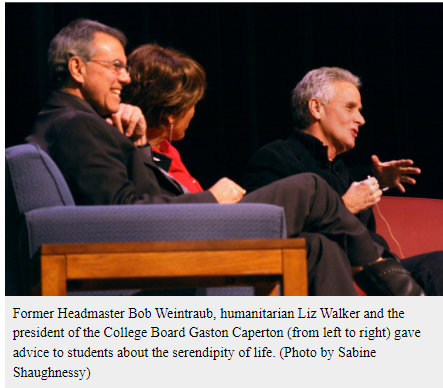
Gaston Caperton, president of College Board; Katie Johnson, former secretary to Barack Obama; Liz Walker, humanitarian; and Bob Weintraub, professor at Teachers College Columbia University, chatted casually with Brookline parent Tony Friscia, who moderated the conversation.
Weintraub co-founded the 21st Century Fund in 1998, according to Faculty Director of Programs of the 21st Century Fund and English teacher Gaelen Harrington. In light of his departure last June, the 21st Century Fund’s decision to honor Weintraub became more meaningful.
“Dr. Weintraub didn’t get a chance to say goodbye the way he wanted to last spring,” Harrington said.
She said that Weintraub’s values are prevalent in all of the 21st Century Fund’s 14 programs.
“We went back to the idea of pursuing your passions because that’s what Dr. Bob was all about,” Harrington said about this year’s panel discussion.
The 21st Century Fund’s core values include academic excellence, hard work over time, embracing diversity, civic responsibility and social justice. Weintraub prioritized these values with the 21st Century Fund due to his experiences as a teacher.
The panel serves as an “intellectual dimension of the fundraising weekend,” Harrington said. “If you couldn’t afford to go to the gala or if you couldn’t make it, the panel is a way to be engaged in an event that the 21st Century Fund is sponsoring.”
Each panelist and the honoree, Weintraub, overcame hardships with certain values in mind; these difficult experiences affected their values. The panelists pursued their values through their careers.
The panelists agreed that students should not focus on a particular career or college. Students should follow the values and ideals that they are passionate about, they said, to live a fulfilling life.
“There is no formula for the future or for a particular career,” Walker said.
While recounting his journey to the present, Weintraub reflected upon the casualness with which he approaches life.
“I think everything’s serendipity; it just happens,” Weintraub said.
Johnson, who is currently attending Harvard Law School, encouraged students to take risks and expand their focus beyond a particular college.
“You’re still going to live even if you don’t get into your first choice,” Johnson said.
Weintraub agreed that students need to learn about failure.
“I’m going to quote Mick Jagger when I say, ‘You can’t always get what you want,’” Weintraub said. “Many of us have gotten rejected. And you know what? You get back up.”
All in all, the panelists felt that students could change the future with a strong basis in academics and an adherence to ideals.
“The world must catch up morally,” Walker said. “And the universe opens up when you’re ready to step out of the comfort zone.”
Sabina Lee can be contacted at bhs.sagamore@gmail.com.
Former Headmaster Bob Weintraub, humanitarian Liz Walker and the president of the College Board Gaston Caperton (from left to right) gave advice to students about the serendipity of life. (Photo by Sabine Shaughnessy)
Picture the hot, dirty, crowded Schluntz Gymnasium where beads of sweat form on your neck as you stand on backpacks, cheering for your classmates at the pep rally.
Now erase that image entirely.
Imagine a spacious, ornately decorated room that hosts 350 of Brookline’s inhabitants dressed in sleek tuxedos and sparkling dresses. Beams of warm light from golden disco balls, twinkling chandeliers and purple lamps illuminate a fully stocked bar and long tables of items up for silent auction.
What you are visualizing is the entrance to the 21st Century Fund’s 11th Annual Gala.
Separated from the entrance by a white curtain are rows upon rows of circular dining tables leafed in gold. Waiters and servers in white shirts carry trays of champagne glasses to the guests.
From a raised stage, brightened by floodlights installed on a large metal scaffold hanging from the ceiling, English Curriculum Coordinator Mary Burchenal presents the man of the hour, the honoree of this 2011 gala.
Former headmaster Bob Weintraub promptly steps to the microphone with his usual radiating smile and says, “Thank you for coming to my Bar Mitzvah.”
The lavish expenses of transforming the Schluntz Gymnasium proved worthwhile, as this year’s gala raised more than $380,000 to contribute Weintraub’s philosophy of reaching out to each individual student through the programs created by the 21st Century Fund.
According to marketing consultant Eve Harris, the money raised at the event exceeded the 21st Century Fund’s net goal.
The gala, entitled “A Lifetime of Making a Difference One Student at a Time,” was themed after Loren Eisley’s poem “The Starfish” to highlight this philosophy, according to executive director Jessica Conaway.
“We are trying to live up to Bob’s gold standard of excellence,” said Conaway, referring to the extravagant decorations. “We are trying to live up to everything that he’s done as a headmaster here.”
Weintraub and a group of committed private donors founded the 21st Century Fund in 1998, envisioning a private foundation that would fund “innovation of the school,” according to Conaway. Conaway said that they established it to address the challenges and issues the school faced and to create classes and programs that help make the high school the best it can be. The 21st Century Fund hopes that, through its programs, students can be reached on a more personal level.
When speaking of offering special help to students and addressing the achievement gap in the school, Selectwoman Nancy Daly said, “Those are critical issues and sometimes when you’re trying to do so many things with your school budget, you don’t have the extra funds to zero in on some of the issues that really need it. That’s what the 21st Century does. It fills that gap and makes that difference.”
Specifically, the 21st Century Fund will use some of the money raised from donations, ticket sales and auctions during the gala to continue support of the relatively new Global Leadership and Social Justice programs, according to Associate Dean Anthony Meyer.
Funding for the African-American Scholars Program, the Ithaka Project and the Family Partnership also rely on proceeds from the Annual Gala.
According to faculty director of programs Gaelen Harrington, a small portion of the money will go to paying the office staff and the administration.
“We want the bulk of the money be spent on the programming that is making a difference,” said Harrington.
During an innovation summit dubbed “Innovation Palooza” by Conaway, 10 proposals for programs that the Fund may potentially sponsor arose, according to Harrington. The money would go towards the proposed programs that get selected for implementation, though they have not been completely formed yet.
“They’re still in the process of being drafted. I could describe a proposal now, and it could very well be something quite different a month from now,” said Harrington.
Nevertheless, three of the most developed programs at this point include a math elective that would be project-based and focus on real world applications of math, a medical translation and interpretation class in which internship time at local hospitals would be available, and a course that combines drawing and biology. The latter would observe the role of art in the sciences, allow drawing to communicate information and break down the artificial barrier between art and science, according to Harrington.
Math teacher Lisa Redding also spoke of the importance of a multidisciplinary math program.
“Really, math and science work together in the real world,” said Redding.
“It’s pretty exciting,” said Harrington. “Are we going to be able to fund all the proposals? No. But that people are thinking creatively and not just staying with the status quo is really important. And I think that is the Fund’s importance in the school, that it gives faculty incentive to think beyond what’s currently available.”
It is because of this spirit of academic innovation that social studies teacher Michael Normant does not see the gala as a final goodbye to Weintraub.
“His legacy will be here forever,” said Normant. “I’ve only been here for five years, but I already know that the work that Dr. Bob has done in his time here is what has made Brookline High what it is.”
According to the 21st Century Fund’s website, the fund has raised over $8 million in its 13 years of existence, creating 16 programs, several of which have since become national models. It is Weintraub’s philosophy of helping one student at a time that inspired the current leaders of the 21st Century Fund to choose the former headmaster as their honoree, according to Conaway.
“Young man, don’t you realize that there are miles and miles of beach and starfish all along it. You can’t possibly make a difference!” said Burchenal, reading aloud the words of a cynical elder in Loren Eisley’s poem “The Starfish.” As the young man throws a beached starfish into the ocean, he responds, “It made a difference for that one.”
“Amen,” said Weintraub as he ascended to the podium for what many hoped would not be his last speech in Brookline.
Ben Berke and Alex Johnson can be contacted at bhs.sagamore@gmail.com.
In a sea of high school leadership programs in Massachusetts, Brookline takes a step forward by leading an educational movement towards global leadership with a unique new course appropriately named Global Leadership.
Social studies teachers Daniel Green and Kathleen Boynton are currently creating the course, which is a class as well as a program, and they will co-teach it to about 30 students once a week.
Green and Boynton hope to give students the opportunity to gain the skills needed to be successful leaders, whether they want to go into business, work for the government or work for an inter-government organization such as the United Nations.
Although still in the making, the curriculum includes online discussion boards and chats, outside lectures and conferences, grant writing and designing and a core service learning project. At the end of the program, students will graduate with a specialized certificate in Global Leadership, after completing numerous of tasks relating to the course. The class is funded by the 21st Century Fund.
“There are a lot of Global competency programs and leadership programs in high schools and colleges,” said Green. “But I think what differentiates this is that there’s this core global leadership course in addition to students completing leadership tasks and being able to travel and being able to learn different new technological innovations, and so we’re really excited about this opportunity to try something that really hasn’t been done.”
Needham High School, Burlington High School and Swamscott High School all have leadership programs as well, but what makes Brookline High’s leadership program unique is a weekly seminar course and a selective application process.
According to Boynton other programs rely on students completing tasks and submitting paperwork. The BHS program focuses on integrating leadership skills with a global awareness.
Brookline’s program, made specifically by teachers, is individualized in a way that will give students the tools to become leaders. The different focus of the program caused freshman Eliza Fox to view the course on a different level than others at the school.
“Earlier I was thinking of applying to a private school but one of the main reasons that I chose to stay here for next year is because of the Global Leadership program,” said Fox. “I felt like it would just be really horrible to turn that down.”
Green and Boynton were both inspired after traveling to Cambodia with the Cambodia Partnership where they met “amazing leaders.” They came back asking what kind of skills a person needs to be such a leader and aimed to find the answer by creating the program.
When discussing the method for accepting students, Boynton said that they were looking for a diverse group of students with a passion for global issues yet weren’t looking for the students with the most experience.
“It wasn’t about having traveled to other countries before,” said Green. “What jumped off the page for me is there were examples of students who said, ‘I have a burning interest’ kind of like I did as a kid.”
Junior Nathan Evans, a student accepted into the class, said that he believes the course will give students a wider view of the world and that it is an important course for him to take regardless of the credit he would receive.
“Rather than getting homework assignments where you have to read in a textbook and write or look stuff up online, you get to do real world projects,” said Evans. “I know that’s part of the course so that gives you better experience than any homework assignment or class seminar will get you.”
Like Evans, Fox was excited by an interactive class to prepare the students for the global community. She said that she feels the class will be a challenge but is ready to take it on.
“I know that leadership is something that is a really good quality for someone to have in their life, whether it’s for a little sibling or even a whole country. I feel like it’s a really important quality to have and I know its something I have to work on personally,” said Fox.
Green and Boynton want to create and assign projects in the class to empower students to become leaders, and Boynton said that it’s extremely important to help students become globally aware.
“Why not prepare students not only to be competent,” said Boynton, “but to be global leaders?”
“I am going to college because of the Brookline High School Tutorial. The program saved my academic life; it’s as simple as that.”
— Danny
A Massachusetts high school demonstrates that a mainstream academic support program for students with mild learning problems can help motivate students to learn and improve their academic performance as well as promise long-term financial savings at a time when special education budgets are increasing dramatically.
refocused and distracted, Danny was diagnosed with a learning disability during middle school. That diagnosis meant that Danny was placed in the special education program when he enrolled as a student at Brookline High School in suburban Boston, Massachusetts. By his sophomore year, he was struggling to pass his courses and complained to his mother that he was unhappy with being in the high school’s learning center for special education students.
JULIE JOYAL MOWSCHENSON is a teacher, vice chair of the 21st Century Fund at Brookline High School and director of the Premedical Summer Institute at Harvard Medical SchooL ROBERT J. WEINTRAUB is a teacher, headmaster of Brookline High School and trustee of the College Board
“I didn’t have a learning disability, “he says. “I just couldn’t focus, and didn’t know why.” In 2002, during his junior year, his mother enrolled him in Brookline High School’s new Tutorial Program, an alternative to the more traditional special education learning center. The Tutorial serves students with learning disabilities, replacing conventional special education support with academic guidance from regular classroom teachers. Tutorial students meet daily with a team of two teachers — usually one from the humanities and the other from math/science – in a regular C-block class. Meeting with regular academic teachers allows students like Danny to escape the stigma often associated with special education. These students have greater access to the general curriculum, prepare for the state-mandated standardized test required for graduation, and feel more like an integral part of the mainstream school community. While enrolled in the program, Danny’s confidence and performance improved, and he made honor roll for the first time. He has already been on the dean’s list for three semesters in college.
Educators’ initial sense that too many students were being diagnosed with learning disabilities led to the creation of Brookline’s innovative Tutorial Program in 2002. The Tutorial offered an alternative to a system that was stigmatizing too many students and costing too much money. Brookline High Schools is now better able to address the needs of students defined as special education students by moving them into a mainstream academic support program. At the same time, the program offers teachers a new, inspiring, and reinvigorating means of interacting with students and sharing their love of the subjects they teach. Parents also see the positive effects in their children’s intellectual self-confidence and their ability to succeed in mainstream academics.
The Tutorial corrected a system that was stigmatizing too many students and costing too much money.
At BHS, over 100 students have left special education for the Tutorial. As the Tutorial becomes more established in the school, this promises a long-term shift in moving special education dollars into the regular education budget.
In recent years, many students have been diagnosed with disabilities because this was too often the only way they could receive academic support services. BHS psychologists reported, for instance, that they were at times ambivalent about diagnosing disabilities. In order to receive an Individual Education Plan (IEP), a student must have a diagnosed disability and must not be making “effective progress” in school. Students might well need assistance, but not necessarily “specialized instruction” provided by special education staff. The psychologists wanted to help these students and thus recommended special education services. The psychologists also reported that they felt pressure to recommend IEPs so that students could receive accommodations on standardized tests like the SAT (Miranda and Goldberg 2003). This dynamic is especially prevalent in more affluent communities where there is intense competitive pressure among students and their parents. As a result, the number of students on IEPs and 504 Plans is large and growing.
Educators, policy makers, scholars, and practitioners have long debated the most effective way to educate special needs students, both in financial and academic terms. Since the 1997 reauthorization of the Individuals with Disabilities Education Act (IDEA), a consensus has been growing that students are best and most efficiently served by having access to the mainstream general education curriculum. As the National Center for Educational Restructuring and Inclusion has found, students with disabilities in inclusive, integrated classrooms show academic gains in a number of areas, including improved performance on standardized tests, mastery of IEP goals, higher grades, on-task behavior, and increased motivation to learn. They also show better postgraduation outcomes, such as employment, postsecondary education, and income. Research shows that the benefits of inclusive classrooms reach beyond the academics, allowing children who are mainstreamed to feel that they are part of the community instead of being segregated from their peers (Hehir 2006).
HOW IT WORKS
The idea for the Tutorial Program originated in a visit to Oxford University in 2002. As the headmaster of a large urban-suburban high school, Robert Weintraub (one of the authors) was impressed by the content-based tutorial style of teaching at Oxford and felt that, with some adaptation, a tutorial could be a powerful model for helping students who struggle academically. During the Oxford visit, Weintraub envisioned an alternative and effective way to support students, allowing them to succeed academically in the mainstream, alleviating the stigma commonly associated with special education, reducing paperwork, increasing teacher morale, and saving the district money over time.
The BHS Tutorial establishes teams of two academic teachers, pairing a teacher from the humanities with one from mathematics or the sciences. Each two-person team is assigned 10 students for the school year, matching student needs with teacher strengths. The students meet with their Tutorial teachers for one, 50-minute period. Teachers monitor the students’ academic lives as they help students set goals, establish benchmarks, focus on content in specific academic areas, check in with the students’ other teachers, and communicate with parents. Students receive one academic credit for the course.
Another important ingredient in the Tutorial recipe is the availability of teachers beyond the two on a student’s team. If, for example, a student needs to prepare for a test in a world language and there is no world language teacher on the student’s Tutorial team, the student can go to an adjacent room where a world language teacher is available. Six Tutorial teachers are available during each instructional block.
RADICAL CHANGE
The Tutorial Program represents a radical change in the structure and organization of the school. With increasing interest in educating students with disabilities in inclusive settings and with federal requirements mandating that all students achieve high academic standards, BHS identified an opportunity to restructure its approach to special education. The Learning Center provides “specialized instruction” for students with mild learning disabilities. It is a skill-based program in which certified special education teachers follow each student’s IEP and tailor the curriculum accordingly.
This change was fueled by our growing sense that too many students were being diagnosed with learning disabilities and our skepticism about the efficacy of “specialized instruction” for students with mild learning issues. Before the Tutorial Program, there was no formal instructional support — outside of special education — during the school day for students struggling with subject-specific issues. Parents often expressed concern about this. While appreciating the excellent work done by the special educators in the learning centers, students and parents asked for help in the content areas that defined the heart of a strong academic high school: math, science, world languages, English, and history. They wanted teacher/tutors to preview their academic work and to reinforce the instruction of their classroom teachers. Content specialists were not available in the Learning Center, as is the case at most public high schools.
It became dear, in short, that many students needed content-based support. The fundamental innovation of the BHS Tutorial, therefore, is that it stresses subject-specific support rather than generalized “study skills and learning strategies.” If a student needs help in Spanish, the Tutorial will get them a Spanish teacher; if he needs help in science, Tutorial gets him a science teacher.
FUNDING THE PILOT
But how can a public high school, with always constrained budgets, spend $150,000 to launch a new pilot program, paying eight Tutorial teachers, a program leader, and researchers? Innovation requires venture capital.
Brookline is fortunate to have the BHS 21st Century Fund, a nonprofit organization founded in 1998 by a dedicated group of alumni, parents, educators,and philanthropic members of the community, which provided the funds. “Our goal is to serve as a sustainable source of funding for innovative programming at the high school. We are a venture capital fund that supports and helps facilitate local solutions to national challenges in public education,” said Tony Friscia, the fund’s chair.
The fundamental innovation of the Tutorial, therefore, is that it stresses subject-specific support rather than generalized “study skills and learning strategies.”
The 21st Century Fund enables BHS to explore bold, pioneering programs that address the challenges confronting public education nationwide. BHS is the perfect place to try new ideas, an ideal laboratory for innovation. Our students represent 76 nations and a full spectrum of racial, ethnic, and socioeconomic groups. Not unlike other large diverse high schools, many BHS students achieve at high levels, while others struggle. Supporting high achievement across the spectrum of the student body is a fundamental expectation of public education and a critical goal of the fund.
The investments of the fund have met with an impressive return, financially, academically, and professionally. Even in an area as seemingly inconsequential as paperwork, for example, the Tutorial Program has made a significant impact. Millions of dollars are spent each year in this country on documentation to comply with current special education regulations. Problems with paperwork can result in lawsuits. In addition, paperwork places a heavy burden on teachers who already have too little time to devote to students. Special education teachers spend on average five hours a week completing forms and administrative paperwork, about the same amount of time they spend preparing lessons. Many special education teachers feel the job now requires “a Ph.D. in paperwork” (Shorr 2006).
In addition to its immediate benefits for students, therefore, the Tutorial also addresses the issue of teacher retention and recruitment by providing new professional opportunities. Participating in the Tutorial involves time and commitment on the part of the teachers, but the Tutorial work is different from work associated with teaching regular classes and therefore provides welcome variation. Teachers also appreciate the opportunity to work closely and develop strong relationships with a small group of students. Finally, they enjoy the opportunity to develop collegial relationships with staff from other departments. In part, because of the Tutorial Program, teacher attrition at BHS is one-third the national average.
The Tutorial experience also has a positive effect on teachers’ course loads, enabling them to teach four regular classes instead of five; the fifth assignment is the Tutorial. For teachers, this is a major improvement in their working conditions and an important change in their professional responsibilities. With five classes, they were responsible for about 100 students — planning and preparing for classes, correcting and grading student papers, providing extra help, interacting with colleagues about the students they share, communicating with parents, and teaching classes. Teachers spend at least 15 minutes a week grading papers for each student they teach. For the 20 students in the fifth class, that saves about five hours of work each week.
Teachers’ responses to the Tutorial have been enthusiastic. “I think the Tutorial is one of the most successful programs at BHS. It provides students with content-based tutoring within a formal structure,” said one history teacher. `All teachers provide kids with ‘extra help,’ but that is so much more difficult to schedule during a busy school day. The magic of the Tutorial is that we see the kids every day for an hour for thisvery important supplementary academic support.”
A math teacher said, “The Tutorial experience has been enriching because it has given me a greater sense ofwhat the whole school is about, rather than just my subject. I find it interesting to see what the students are working on, and I find it fulfilling intellectually.”
In addition to students and teachers, parents constitute a third group that has voiced its enthusiastic support for the Tutorial Program. This is important, not least because educators understand that parents are an essential constituency. Parents have reported a positive effect on their children’s academic self-confidence. The Tutorial has helped de-stigmatize students’ learning problems. “All Oliver wanted was to go mainstream,” said the mother of the graduating senior. “He did not want to be in a `Sped’ or special education program. He found that demoralizing.”
Another parent reported that her daughter had been “totally disorganized.” The Tutorial helped her become organized without the extensive testing and labeling associated with special education. “The Tutorial experience really put all her pieces together and saved her. She established strong relationships with her Tutorial teachers, and she would not have graduated from high school without the support of the program.” Parents are also appreciative that the program saves them money on private tutoring.
EVALUATING THE TUTORIAL
External evaluators from the Harvard Graduate School of Education found that Tutorial students improved their grades, test scores, academic self-confidence, and organizational skills as much or more than students from the traditional special education learning center. The evaluation done in 2004 concluded that the direct academic support from content teachers was a contributing factor to the higher grades of these students and that the Tutorial Program “constitutes a compelling alternative to the more traditional approaches to special education — and offers effective ways of addressing many of the issues that continue to frustrate special education programs in a public school setting” (Hehir et al. 2004).
The evaluation focused on 80 randomly selected students, 40 who remained in the special education learning center and 40 who joined the Tutorial. Evaluators examined student academic performance, looking at four academic measures — state assessment scores, PSAT scores, SAT scores, and grades. They also looked at qualitative differences in the two programs. They collected data from classroom observations, teacher interviews, student focus groups, parent surveys, current and previous IEPs and 504 plans of students, as well as student transcripts.
“The magic of the Tutorial is that we see the kids every day for an hour for this very important supplementary academic support.”
In an interview after completing his study, evaluator Thomas Hehir reiterated his sense of the success of the program. “The BHS Tutorial is based on the premise that what these kids really need is high-quality instruction by teachers who have the content knowledge. All school districts struggle to improve the academic performance of disabled kids. It is critical to give students real solutions that have a high degree of promise… we have found this solution in the Tutorial Program at BHS,” he said.
The Tutorial Program had only 40 students when it was launched in 2002. Now, Tutorial has more than 200 students and is fully supported by the high school budget. When the Tutorial began six years ago, 260 students were enrolled in the learning center; today that number has dropped to 160 students. Tutorial’s growth — after it was validated — required a shift in funding from the venture capital of the 21st Century Fund to the budget of the Brookline Public Schools. Instead of creating a burden on the school budget, the Tutorial Program gave the school greater flexibility in allocating resources and actually reduced the special education budget. There were eight Learning Center teachers before the Tutorial; now there are five, a movement of $150,000 from the special education to regular education budget.
In Brookline, the school budget for special education has been steadily increasing. Between 2002 and 2007, the special education funding went from $10 million, or 20% of the school budget, to almost $16 million, or 25%. The Tutorial Program is a legitimate and compelling alternative to special education for many students. Over time, as more and more students and parents choose the Tutorial, fewer students will be enrolled in special education. That is already the case at BHS, where almost 100 students have left special education for the Tutorial. Funds have moved from special education to regular education. Over time, with fewer students in special education, the “special education bureaucracy” — staff that does the testing, conducts the IEP meetings, and spends hours on paperwork — will shrink, providing a real savings for the school budget.
Researchers have validated our belief that students with mild learning issues benefit more from subject-based tutoring by regular education teachers than from special instruction by certified special education teachers. This conclusion has revolutionary implicadons for all public schools because these effects need not be unique to Brookline High. Schools across the country can implement similar programs with equal success. Ultimately, the Tutorial is surprisingly simple: It asks regular classroom teachers to tutor kids who have a variety of learning needs. And it works.
Hehir, Thomas. New Directions in Special Education: Eliminating Ableism in Policy and Practice. Cambridge, Mass.: Harvard Education Press, 2006.
Hehir, Thomas, Allison Gruner, Joanne Karger, and Lauren Katzman. “Brookline High School Tutorial Program: Year 2 Evaluation Report.” Manuscript, Harvard School of Education, August 16, 2004.
Miranda, Helena, and Arnie L. Goldberg. “Brookline Tutorial Program Evaluation Report for the 2002-2003 Academic Year.” Manuscript, Boston College, September 3, 2003.
Shorr, Pamela Wheaton. “Special Ed’s Greatest Challenges and Solutions.” District Administration 42 (May 2006): 48-53.
Beyond Special Education: A New Vision of Academic Support
By Julie Joyal Mowschenson and Robert J. Weintraub