
Daria Stoyanova, News Managing Editor • January 13, 2026
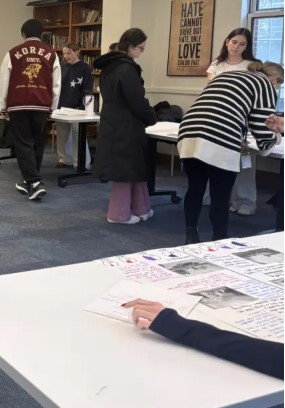
Students in the Justice in Action class do a gallery walk around the MLK room as they present their poster projects on Boston Neighborhoods.
Interning for a judge, visiting jail and learning directly from the Brookline Police are not generally experiences associated with a high school class. Yet, they are just a few of the opportunities gained by students in Justice in Action.
Justice in Action is an interdisciplinary social studies and English class that began this school year. The social studies portion examines the criminal justice system, and focuses on different case studies such as the OJ Simpson and Charles Stewart trials. The English class explores themes of justice through literature and film. The class has two blocks and is taught by social studies teacher Marcie Miller and English teacher Rob Primmer.
According to Primmer, the idea for a combined course came when he and Miller realized they shared many senior students.
“A couple years ago, Ms. Miller and I were just talking about shared students. We found that I had a lot of students in my senior fiction and film class who overlapped with her Legal Studies course,” Primmer said. “We started thinking it would be kind of cool if there was an English portion to the Legal Studies. What if we read books that were connected in some way?”
Miller and Primmer were curious in exploring what a combined class might look like, so last year they wrote a grant, which was later approved by the Brookline High School Innovation Fund. With two blocks to teach the course, Miller said they are able to explore topics in depth.
“[Before, we] didn’t have as much time to do the philosophy side of, ‘what is justice? What does it mean to actually get justice? Why do people turn to violence so quickly?’” Miller said. “All those big philosophical questions, we just didn’t have time to address in a one period class.”
The increase in time, according to Miller, is particularly helpful to a central aspect of the course: the third quarter internship. Students spend four hours per week observing justice work, from nonprofits to judges to the chief of police at Boston University. Senior Bea De La Rosa said she is looking forward to her opportunity to work with the New England Innocence Projects.
“I’m really excited to work with the New England Innocence Project for my internship because it will be interesting to learn about everything to do with the exoneree [one who is exonerated] network, and I’m really grateful for Ms. Miller [who] set it up,” De La Rosa said.
Senior Annabelle Sneider said the class has taught her a lot about the criminal justice system, and she enjoyed the experience of being able to hear other people’s stories firsthand.
“I really enjoyed going to the jail and hearing different people [speak]. I met a guy named Sean Ellis, who was exonerated and he was in jail for 22 years and he didn’t need to be. It was a really cool and really eye-opening experience,” Sneider said.
Miller said something the class strives to do is to help students form informed opinions.
“We have a very different police system in Brookline than in other neighborhoods. So this gives kids a chance to really take a deep dive,” Miller said. “We’re not teaching them what to think.
We’re just teaching them how to think.”
Primmer said he recommends the class to students ready to question systems and experience them hands-on.
“People who are interested in, perhaps the pursuit of law, people who are just interested in issues of justice. How do we evaluate what’s right, what’s wrong, what’s morally right and what’s ethically right?” Primmer said. “Then also thinking about, ‘What do I learn about Boston?’ Because there’s a lot of self examination about our own city that we’ve tried to pull into this as well.”
Miller said she has truly enjoyed the aspect of collaborating with Primmer in effort to create this innovative course.
“I love collaborating with Mr. Primer. I think it’s so refreshing, and when you’ve been here a long time, things can feel redundant,” Miller said. “[Justice in Action] is sort of teaching the same course that I’ve been teaching with a whole new set of eyes, curriculum, readings and speakers, all things that I wouldn’t have been able to do without that collaboration.”